Historical report preserved from an archived 2008 local news story.
Mobile Police investigated the deaths of a 29-year-old woman and her 2-year-old child at a mobile-home park in Semmes in 2008, according to an archived local news report — a case that stands as one of the most sobering entries in the recorded history of the western Mobile County community.
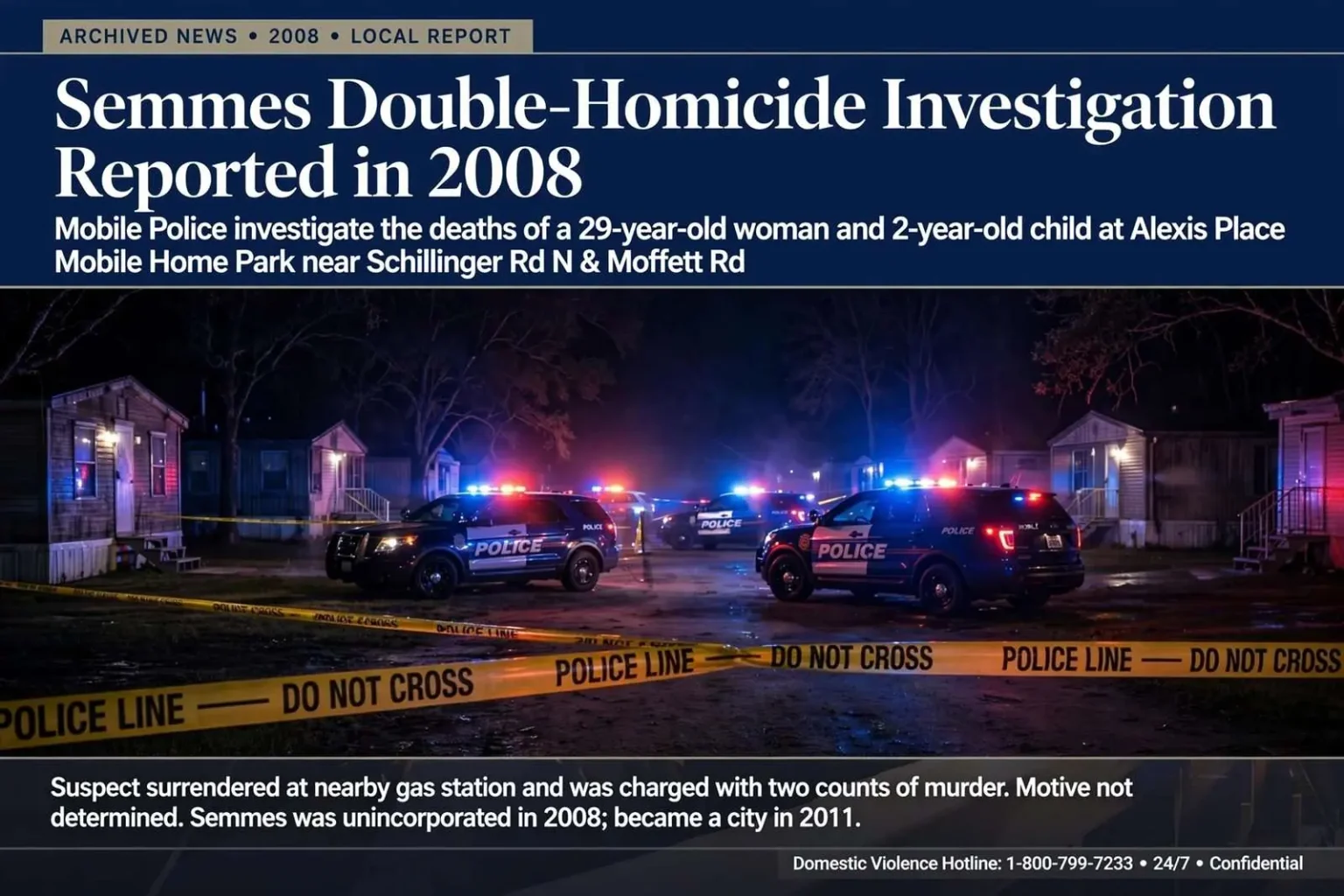
Officers responded shortly after midnight to Alexis Place Mobile Home Park near Schillinger Road North and Moffett Road, the crossroads area that anchors Semmes. The report said a 29-year-old man later approached a patrol officer at a nearby gas station and surrendered, presenting investigators with an immediate suspect in the deaths of his wife and child.
Investigators alleged that the man used a handgun to kill his wife and child. He was charged at the time with two counts of murder, and investigators said they had not determined a motive. This article intentionally avoids graphic detail. It records the investigation and charges reported in 2008 and does not state any later court outcome.
The scene and the response
The report of deaths at the mobile-home park after midnight brought Mobile Police patrol units, investigators and forensic personnel to Alexis Place, a residential park of the kind that houses working families throughout western Mobile County. In 2008, Semmes was still an unincorporated community — it would not become a city until 2011 — and law enforcement in the area was provided by Mobile Police Department precincts and the Mobile County Sheriff’s Office under the jurisdictional arrangements that governed the county’s populated outskirts before municipal incorporation spread across the region.
Moffett Road, the historic highway that runs west from the city toward the Mississippi line, and Schillinger Road North, one of the main north-south routes through the area, frame the neighborhood where the park sat. The area in that era was a mix of mobile-home communities, family property and fast-developing subdivisions — communities where a major crime investigation drew immediate attention from neighbors, many of whom learned of the deaths from the activity of patrol cars and investigators rather than from any official announcement.
Domestic violence professionals note that cases in which a spouse and a young child are killed together represent the most lethal end of the family-violence spectrum, and that the hours and days after such deaths involve coordinated work among homicide investigators, coroner’s personnel, family members and victim-service staff. The surviving family on both sides — and, in cases involving a child, the extended community of schools, churches and neighbors — absorb the loss and the questions that follow.
The surrender and the charges
The surrender of the suspect to a patrol officer at a nearby gas station was the detail that shaped the earliest phase of the case. Voluntary surrenders of this kind remove the most dangerous phase of a homicide investigation — the search for an armed suspect — and shift the work immediately to evidence processing, interviews and the preparation of charges. The man was taken into custody and charged with two counts of murder, the counts corresponding to the two victims.
Under Alabama law, murder charges involving multiple victims are charged separately for each death, and the penalty structure allows sentences to run consecutively. The allegations in this case — a handgun used against a wife and a 2-year-old child — placed it among the most serious categories on the docket, and the investigation that followed involved the standard work of homicide prosecutions: forensic processing of the scene, the weapon, autopsy findings from the coroner’s office, and interviews with everyone who knew the family.
Investigators said at the time that they had not determined a motive. Motive, in the legal process, is not an element that must be proven for a conviction, but in cases involving the deaths of a spouse and child it is the question that families and communities ask first, and its absence from the public record left the case defined by what investigators could establish rather than by any explanation of why.
Semmes in 2008
The Semmes of 2008 was a community in transition. Long known as the nursery capital of Alabama — home to generations of wholesale nurseries and tree farms that supplied landscapes across the Southeast — the area had spent two decades absorbing the outward growth of Mobile, its nursery land steadily giving way to rooftops. Residents debated incorporation for years precisely over issues like law enforcement and services, and the area’s unincorporated status in 2008 meant that major-crime response came from city and county agencies rather than a local police force of its own.
Semmes would incorporate as a city in 2011, and its growth since has made the Alexis Place area and the Moffett Road corridor part of one of the fastest-developing corners of Mobile County. For longtime residents, the 2008 deaths remained one of the community’s darkest memories — the kind of case that people in a small community do not forget, and that resurfaces whenever the subject of domestic violence is raised.
Domestic violence and the Gulf Coast response
Because the alleged offender was the husband and father of the victims, the case belonged to the category that domestic violence organizations across Alabama work to prevent. Advocates in the Mobile area — from the regional shelters and crisis lines to the courts’ specialized domestic-violence dockets — have spent decades making the case that family violence escalates, that the presence of firearms multiplies its lethality, and that young children in the household are the most vulnerable victims of all. Cases in which a child dies alongside a parent are, statistically, the extreme end of a pattern that begins with less visible violence.
The resources that exist today across Mobile County — crisis hotlines staffed around the clock, shelters, court advocacy, and the coordination between law enforcement and victim services that modern domestic-violence response requires — grew in part from community reckonings with cases like this one. Advocates urge anyone in danger to reach a crisis line or law enforcement, and remind friends and family members that the risk of a lethal outcome is highest when a victim is attempting to leave a violent relationship.
Why the case is remembered
This article records what was reported in 2008: the deaths, the scene at the mobile-home park near Schillinger Road North and Moffett Road, the surrender at the gas station, the handgun allegation, the two counts of murder, and the absence of a determined motive. It does not record any later court outcome — what became of the charges in the years after the arrest is a matter for the court record of Mobile County, not for this preserved report.
What remains from the 2008 report is the account of a community confronting the loss of a 29-year-old woman and her 2-year-old child, and a reminder of the work that followed across the Gulf Coast: the investigation that charged a husband and father, the family and neighbors left behind, and the region’s continuing effort to keep the next family out of the case file. The archived report is preserved here as history — complete as to what was known at the time, silent as to what came after, and deliberate in leaving out the details no community needs retold.
How the region’s agencies handled such cases
The investigation in 2008 reflected the division of labor that governed major crimes in unincorporated western Mobile County at the time. Mobile Police handled incidents inside the city limits and, under then-existing arrangements, areas served by its precinct structure, while the Mobile County Sheriff’s Office covered much of the unincorporated county; jurisdiction in a case like this one was sorted out in the first hours, and the responding agencies worked the scene with the county coroner’s office responsible for the official determinations of cause and manner of death.
Homicide investigation of that era relied on the fundamentals that still govern such work today: securing the scene in the opening minutes, the methodical collection of physical evidence, canvassing of neighbors for what they saw and heard in the hours before, and interviews with family members and associates. The coroner’s autopsy findings and the forensic processing of the scene then became the backbone of the charges prosecutors would file.
Prosecution of a two-victim homicide in Mobile County moved through the grand jury system, where evidence is presented to determine formal indictments, and then to the circuit court docket. Cases of that seriousness typically took a year or more from charge to trial, and the archival 2008 reporting, like most initial coverage, ended at the point where the judicial process began — which is why preserved reports of this kind record the charges and investigation but not the disposition.
The children left behind in such cases
Victim-service professionals emphasize that when a parent kills a spouse and a child, the surviving children of the family — if there are any, and in the wider sense, every child touched by the loss — face the most complicated grief there is. Schools, churches and counselors in communities that experience such a loss typically mobilize support quietly, and the years that follow are shaped by guardianship arrangements, family court proceedings and the long-term care of children who have lost a parent and a sibling to violence in a single night.
Community organizations across the Mobile area that work with grieving children — from school counseling programs to nonprofit grief centers — have built their practices around the understanding that children process violent loss differently from adults, and that the support needs to last for years, not weeks. The memory of a case like the 2008 deaths in Semmes often surfaces in that work, as families and counselors help children make sense of what happened.
The archived report is preserved as part of the historical record of Mobile County — a record that includes the community’s hardest days as well as its best. It stands as documentation of the investigation and charges reported in 2008, an acknowledgment of two lives lost in a Semmes mobile-home park, and a marker of the distance between what was known then and the questions that only the fullness of the court record could answer.