Mobile Man Turns Himself In After Uncle’s House Set Ablaze
A Mobile man turned himself in to fire investigators after his uncle's Carter Avenue home was set ablaze following a family argument.
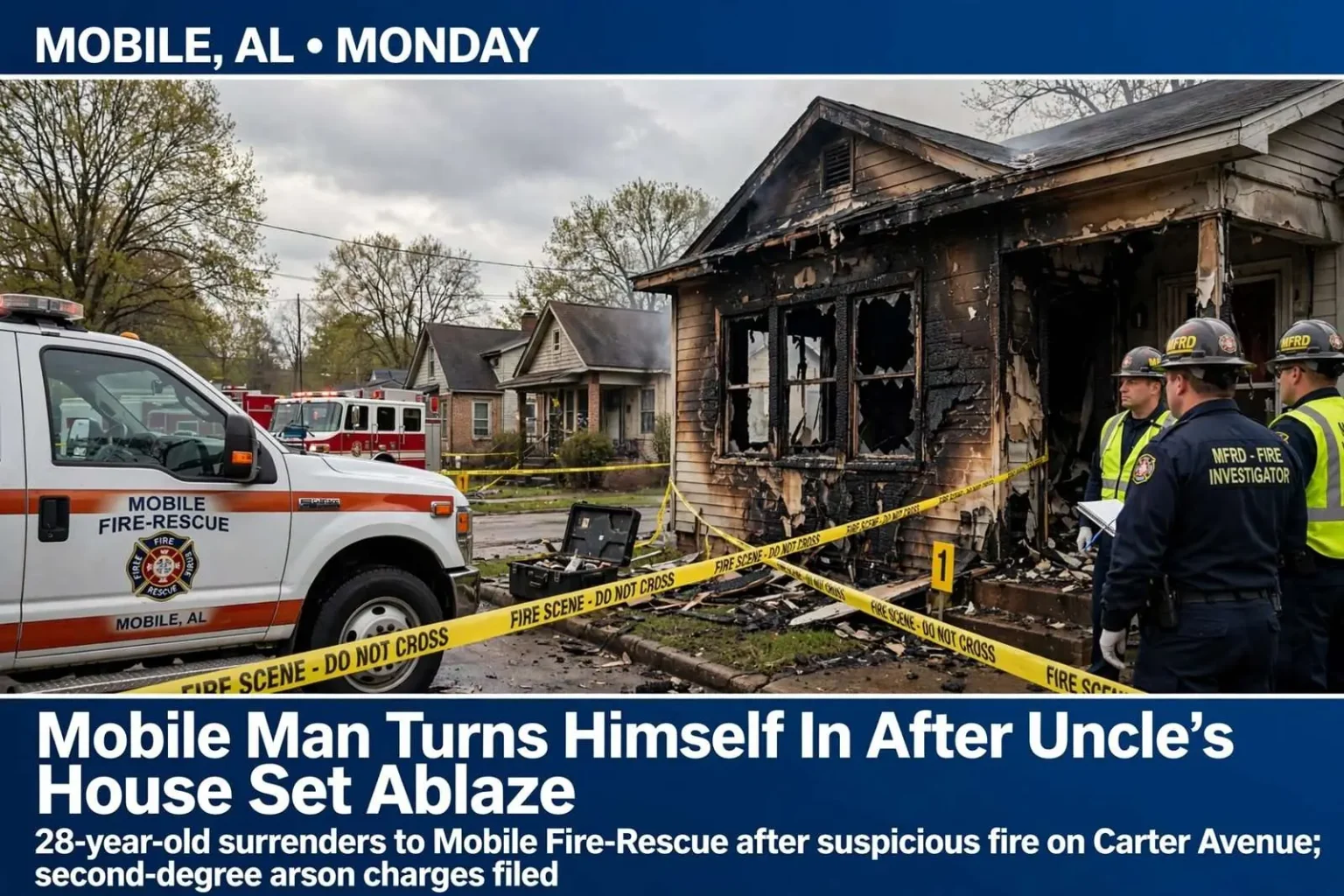
A Mobile man surrendered to authorities Monday afternoon after being named a person of interest in a suspicious house fire that investigators say followed a heated argument with a relative. Michael Anthony Mauldin, 28, turned himself in to Mobile Fire-Rescue Department investigators around 2 p.m. Monday. Hours earlier, fire officials had publicly asked for the community’s help locating him in connection with a blaze at his uncle’s home, putting the case on a fast track from public appeal to voluntary surrender within a single day.
The fire broke out Friday afternoon at a residence on Carter Avenue, between Jesse and Main streets, a block of older residential homes in the heart of the city. Firefighters arriving at the scene found flames coming from the home’s windows, a sign that the fire had developed inside the structure rather than starting at its exterior. Crews attacked the blaze before it could extend beyond the house, but the interior damage left investigators with the task of determining where and how the fire began.
Investigators determined the fire had been intentionally set, according to MFRD spokesman Steve Huffman. Fire investigators build those determinations from burn patterns, the location of the fire’s origin point and the elimination of accidental causes such as electrical faults or unattended cooking. Once a fire is classified as incendiary, the investigation shifts from the science of the scene to the question of who was present and why, which is where the case moved next.
An Argument Preceded the Fire
Huffman said Mauldin and his uncle had gotten into an argument shortly before the fire started, and that the dispute appeared to be connected to how the blaze began. Authorities have not described the subject of the argument or precisely how investigators believe it escalated into the fire, and MFRD has not released additional details about the specific nature of the dispute that preceded it. What investigators established, they said, was a timeline that placed the dispute close enough to the fire’s start to make it central to the case.
After reviewing the evidence gathered at the scene, investigators moved to bring second-degree arson charges against Mauldin once he was in custody. The decision to seek charges rather than wait out an extended investigation reflects the strength of what the scene work produced, according to the department. Mauldin’s decision to turn himself in Monday afternoon, hours after the public appeal, spared both sides a prolonged search and allowed detectives to begin the formal interview and charging process the same day.
Mobile Fire-Rescue Department crews credited quick response times with keeping the fire from spreading to neighboring structures on the residential street. Carter Avenue’s homes sit close together along a traditional neighborhood grid, and structure fires that begin in one dwelling can threaten adjacent rooflines within minutes under wind conditions. Keeping the fire to the house of origin spared the block far greater damage and likely kept the displacement of residents to a single household.
No Injuries Reported
No injuries were reported in connection with the blaze. That outcome stands out in residential arson cases, where occupants, firefighters and bystanders are all exposed to risk from smoke, collapse and re-ignition. It also means the criminal case, while serious, proceeds without the aggravated injury elements that can multiply charges and penalties in fire-related prosecutions.
Second-Degree Arson Under Alabama Law
Second-degree arson is a felony offense in Alabama, and cases involving a private home typically draw significant scrutiny from fire investigators given the risk to occupants and neighboring properties. Under the state’s criminal code, arson offenses are graded by the circumstances of the fire, including whether a building was occupied and whether anyone was harmed, and the second-degree classification still carries the potential for years in prison upon conviction. Prosecutors in Mobile County handle these cases through the circuit court system, where fire investigators’ scene reports and interview records form the backbone of the state’s evidence.
Fire investigation is a specialized discipline within MFRD, separate from the engine and ladder companies that fight the blaze. Investigators document the scene photographically, reconstruct the fire’s path and origin, collect debris samples for laboratory analysis, and then conduct interviews to place people at the scene. In cases involving family members, that interview work is often decisive, because relatives have ready access to a property and straightforward explanations for their presence that either hold up or fall apart under questioning.
The arrest process itself is straightforward from here: Mauldin will be booked at Mobile County Metro Jail, appear before a district court judge for an initial hearing, and face a preliminary proceeding to determine whether probable cause supports binding the case over to a grand jury. If indicted, the case moves to Mobile County Circuit Court for trial. Standard conditions in arson cases can include no-contact orders protecting the property owner, which in a family case like this one would formally bar contact between nephew and uncle while the charge is pending.
Part of a Busy Spring for Investigators
The case adds to a string of suspicious fires that Mobile fire investigators have worked through the spring, with department officials continuing to urge residents to report any information related to open arson investigations. A cluster of suspicious fires strains an investigative unit’s resources, because each scene demands careful documentation before weather and foot traffic degrade the evidence. Officials have repeatedly emphasized that tips from neighbors — a description, a vehicle, a timestamp — often provide the thread that ties a suspect to a scene.
That public appeal is exactly how the Carter Avenue case began its final phase. Within hours of MFRD asking for the community’s help locating Mauldin, he came forward voluntarily. Fire officials have framed the episode as a demonstration that the department’s requests for public assistance produce results, and investigators handling the spring’s remaining open cases have repeated the same appeal to residents in the affected neighborhoods.
Anyone with additional information about the Carter Avenue fire was asked to contact MFRD directly, and officials have not ruled out additional investigative steps as the case moves forward. Departments typically keep arson cases open even after an arrest in case new evidence emerges or additional participants are identified.
What the Case Means for the Neighborhood
For the residents of Carter Avenue and the surrounding streets, the episode distilled into a single afternoon of sirens and smoke, followed by days of uncertainty while a suspect remained unidentified. House fires on residential blocks carry consequences well beyond the damaged structure: neighbors store the displaced family’s belongings, traffic gets cut off for hose lines, and the sight of an intentionally set fire raises questions about safety that last long after the debris is cleared. The quick containment and the rapid arrest address both the physical and psychological dimensions of that disruption.
MFRD’s handling of the case reflects the department’s standard posture toward structure fires of suspicious origin. The department treats every unexplained residential fire as a potential crime scene until investigators rule out human causes, which is why crews preserve debris patterns and restrict scene access while the investigation is underway. That discipline preserves the evidence that later supports charges, plea negotiations or, in some cases, insurance determinations for the property owner.
The Road Through the Courts
Insurance and recovery questions will also follow the uncle in the aftermath of the fire, since a dwelling intentionally set fire to by a family member raises distinct issues for the property owner’s insurer and for any assistance programs the household pursues. Fire departments routinely advise owners of incendiary fires to document the damage thoroughly and to keep copies of the investigative report, which becomes a key document in the claims process.
Mauldin’s case will proceed through the Mobile County court system following his surrender. The path from surrender to resolution typically runs through booking, an initial appearance, a preliminary hearing and grand jury review before any trial date is set, a process that unfolds over months rather than weeks. Arson prosecutions also frequently involve expert testimony from fire investigators, which adds scheduling complexity as the state presents the scientific basis for its determination that the fire was intentionally set.
The relationship between the defendant and the property owner adds a familiar dynamic to the case. Family-involved arson cases often resolve through plea agreements rather than trial, in part because the facts of access and presence are rarely disputed and in part because restitution to a relative is a component courts can weigh at sentencing. None of those outcomes are decided at this stage, and prosecutors have not publicly discussed the disposition they intend to seek.
What remains clear from the department’s account is the sequence that cracked the case: a Friday afternoon fire, scene work that established an intentional origin, a documented argument between uncle and nephew, a public appeal for help finding a person of interest, and a voluntary surrender within hours. Mobile fire investigators will now hand the evidence to prosecutors and turn to the other suspicious fires still on their spring docket, with the department repeating the same message to residents that produced results on this case: if you know something about a fire in your neighborhood, say something.