University of South Alabama Mobile
University of South Alabama Holds First-Ever Double Commencement, Celebrates 2,020 Graduates
USA held its first-ever double commencement ceremony this spring, awarding degrees to 2,020 graduates across two separate sessions in one day.
A Milestone Day in Mobile
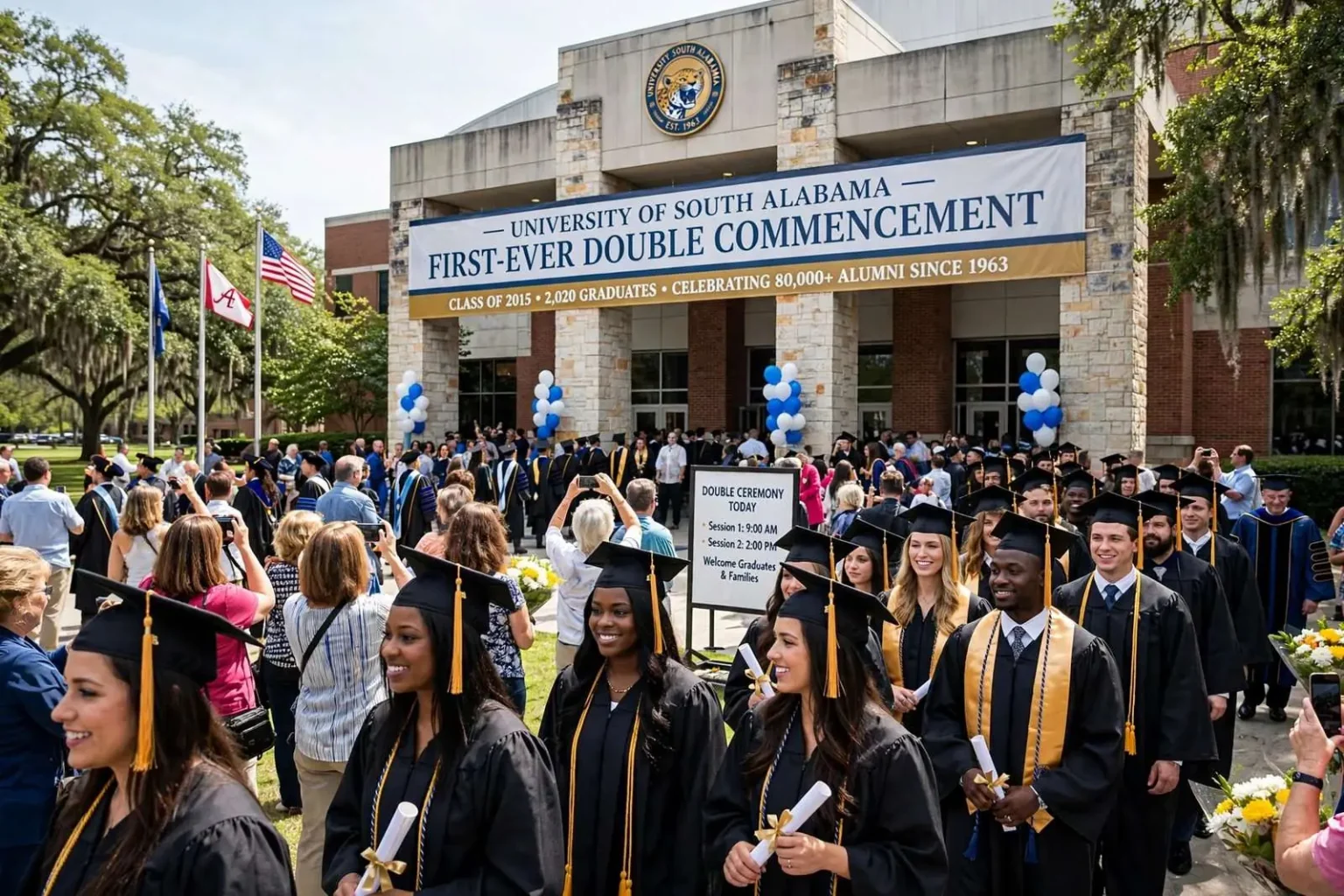
The University of South Alabama reached a graduation-day milestone that had never occurred in the school’s 52-year history: two separate commencement exercises held in a single day. The dual ceremonies celebrated degrees for 2,020 graduates and pushed the university’s all-time graduate total past 80,000. University officials said the decision to split the ceremony into two sessions reflected the continued growth of graduating classes at the Mobile-based university, and it allowed more space for families and friends to attend in person rather than condensing an increasingly large number of graduates into a single event.
The historic day capped a full week of commencement-related activities at the university, including a Friday event that set aside time to spotlight several standout students from the class of 2015. When the ceremonies finally arrived, family members packed the venue for both sessions, with many wiping away tears as their graduates crossed the stage to receive diplomas. The atmosphere in the stands was as much a part of the story as the stage itself, with two separate crowds given room to cheer without the crush of a single oversized ceremony.
University administrators said they intend to continue holding two separate ceremonies in future years following the successful debut of the format. They cited positive feedback from graduates and families who appreciated the additional space and the shorter individual ceremony times. For a university that has watched its graduating classes grow steadily larger, the double-ceremony format appears to have solved a space problem before it became a crisis.
A University Built on Growth
The milestone comes as South Alabama continues to grow its enrollment and academic offerings, with the university’s total number of graduates now exceeding 80,000 since its founding. Established in 1963 as one of the youngest public universities in Alabama, South Alabama has grown from a small commuter-oriented institution into a comprehensive university with programs spanning medicine, nursing, engineering, business, education and the liberal arts. Its campus in western Mobile has expanded alongside the city itself, and its teaching hospital and health system have made the university a major presence in Gulf Coast health care.
That growth is precisely what made the old single-ceremony format untenable. A graduating class of more than 2,000 students, once spread across separate college-level ceremonies, now required a single large venue and a seating plan that could accommodate thousands of guests. Officials chose to add a second session rather than ration tickets, preserving the ability of grandparents, siblings and friends to watch graduates walk in person.
Lapchick Urges Graduates to Advocate for Equality
Dr. Richard Lapchick, a sports sociologist and longtime social activist, addressed one of the two sessions and used his platform to urge graduates to advocate for equality. Lapchick, who founded the National Consortium for Academics and Sports, spoke about issues including human trafficking, connecting the celebration of academic achievement to a broader obligation to serve others. His message framed a diploma not as a finish line but as a credential for public engagement.
Lapchick has built a national career on the intersection of athletics and social justice. The organization he founded brings together colleges and universities to use the influence of sports to address issues ranging from diversity and community outreach to student-athlete development. Over the years his work has taken him to college campuses across the country, and his appearance in Mobile placed South Alabama graduates in the audience of one of the most recognized voices in that field.
For graduates in the first session, the choice of speaker underscored the university’s emphasis on civic responsibility. Rather than a celebrity or politician, the morning belonged to an advocate whose life’s work has been aimed at problems that persist long after graduation day ends. His remarks on human trafficking gave the ceremony a seriousness that many in the crowd said they would carry with them.
Mabus Honors Veterans and Calls Graduates to Serve
Secretary of the Navy Ray Mabus addressed the second session, using his remarks to honor veterans and active-duty service members while encouraging graduates to vote and to dedicate their lives to serving others. As the civilian leader of the Department of the Navy, Mabus oversees the Navy and Marine Corps, and his presence carried particular resonance on the Gulf Coast, where military installations and defense industries are woven into the regional economy. He reminded the audience that the freedom to celebrate a commencement comes from the sacrifices of those in uniform.
Mabus brought a career of public service to the podium. A former Mississippi governor and U.S. ambassador, he has served at the highest levels of state and federal government, and his tenure as Navy secretary has kept him closely tied to Gulf Coast shipbuilding and defense communities. That experience shaped a message built on duty: graduates should participate in democracy, serve their communities, and treat public life as an obligation rather than a spectator sport.
The secretary also urged the graduating class to show extra gratitude toward the parents, teachers and other mentors who supported them on the path to graduation. He told the crowd that no one reaches the stage alone, and that acknowledging that debt is the first act of a life spent in service to others. The remarks drew applause from graduates and the family members seated beside them.
What Two Ceremonies Mean for Local Families
For families across Mobile and the surrounding Gulf Coast region, the split format changed the practical experience of graduation day. Parents no longer had to arrive hours early to claim seats, and guests who once watched a loved one disappear into a sea of caps and gowns could follow each name called with more breathing room. Shorter ceremonies also meant less time in long lines for parking and less strain on family members with young children or elderly relatives in tow.
The ripple effects extend beyond the arena. Commencement weekends bring an influx of visitors who fill hotels, restaurants and shops across Mobile, and doubling the ceremonies spreads that traffic across two sessions instead of concentrating it in one. Local businesses that cater to graduation celebrations benefit from the added traffic, and the city’s tourism infrastructure absorbs a major event with less congestion than a single mega-ceremony would produce.
A Pipeline for the Gulf Coast Workforce
The 2,020 graduates of the class of 2015 represent more than a milestone for the university; they represent a pipeline of talent for the Gulf Coast economy. Nursing and health sciences graduates enter a hospital network serving the region, education graduates staff classrooms across Mobile and Baldwin counties, and engineering and business graduates feed the shipbuilding, aerospace and manufacturing employers that anchor the area’s economy. Every commencement season, the university’s output becomes the region’s incoming workforce.
That connection between campus and community is a large part of why the university’s growth has been embraced locally. An institution that has now produced more than 80,000 graduates over five decades has alumni in hospitals, schools, courthouses and businesses across south Alabama and beyond. Each of the two ceremonies honored a different half of that legacy, and together they marked both the size of the present class and the depth of the institution’s history.
University leaders said the successful debut of the double-ceremony format gives them a template for future years as enrollment and degree programs continue to expand. If the positive feedback from graduates and families holds, what began as a practical solution to a seating problem may become a lasting tradition at South Alabama — two caps in the air in one day, and thousands of new alumni joining a graduate count that continues to climb.
Behind the Scenes of a Split Ceremony
Pulling off two full commencement exercises in one day required an enormous logistical lift that most attendees never saw. University staff had to reset the venue between sessions, turn over seating for a second capacity crowd, and coordinate the movement of hundreds of faculty in regalia who process at each ceremony. Name readers, stage marshals and volunteers each worked a double shift, and the university’s events team rehearsed the turnaround so that guests arriving for the second session encountered a hall indistinguishable from a fresh start.
The planning also weighed the rhythm of the day for the graduates themselves. A ceremony condensed into a single session would have meant earlier call times, longer waits in line and a slower pace at the stage as each of 2,020 names was read. By splitting the class, organizers kept each session at a length that let families stay engaged from processional to recessional — one of the specific benefits administrators cited in explaining why the format will return next year.
A Message That Outlasts the Tassels
The two speakers, taken together, gave the class of 2015 a paired charge: pursue justice and pursue service. Lapchick’s call to advocate for equality, including his pointed remarks on human trafficking, challenged graduates to use their education on behalf of the vulnerable. Mabus’s appeal to vote, honor veterans and thank the parents and teachers who made the day possible framed service as the natural next step after a degree is earned.
As the second session ended and the last graduates crossed the stage, the day closed both a chapter for the class of 2015 and a new opening in the university’s history. The first double commencement in 52 years produced more than a larger crowd count — it signaled how a growing university intends to honor its graduates without shrinking the moment for any of them.