University of Mobile Sends Off Nearly 370 Graduates at Spring Commencement
University of Mobile awarded nearly 370 degrees at its 49th spring commencement, honoring outstanding graduates in English and music this year.
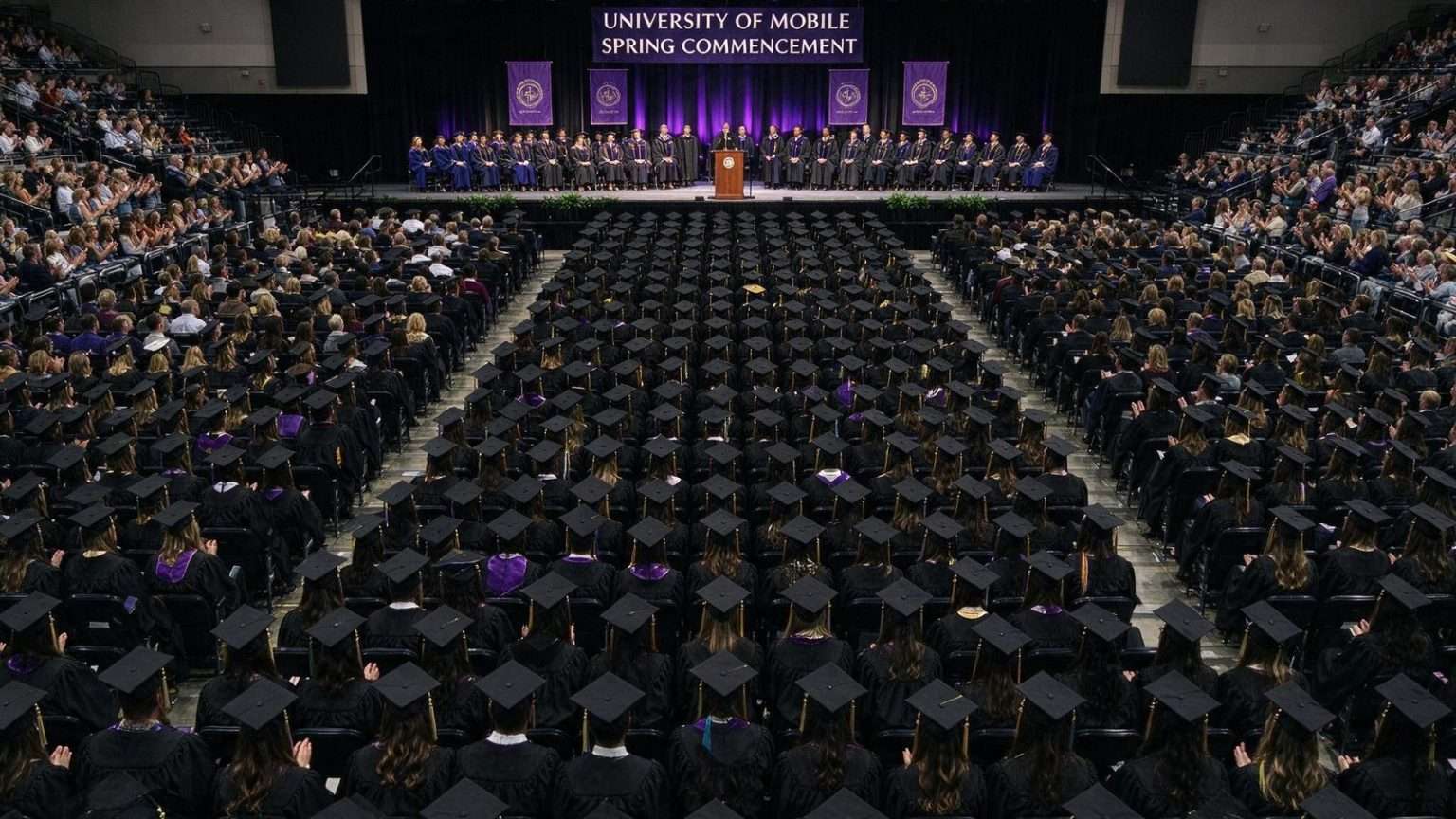
The University of Mobile awarded approximately 370 degrees during its 49th commencement ceremony, held on a Saturday morning at the Mobile Civic Center in front of family, friends and faculty. The venue gave the private university room to stage a ceremony that has outgrown what its campus facilities can comfortably hold, with graduates crossing the stage while rows of families filled the Civic Center’s floor and stands.
The morning marked the culmination of years of coursework for graduates in nursing, business, education, music, ministry and the liberal arts — the programs that form the core of the university’s academic identity on its campus in west Mobile.
A charge for the graduates
University President Dr. Mark Foley addressed the graduating class of the Christian university, encouraging students to hold firmly to their beliefs as they enter a rapidly changing culture. The message fit the institution’s founding purpose: the university has always framed higher education as formation of the whole person rather than career preparation alone, and commencement is where that framing is stated most directly to the students about to carry it into their professions.
Foley told graduates the university’s mission is to prepare men and women who not only master their chosen field of study but also understand what they believe and why, so they can use their influence to make a positive difference in their communities and careers. For a graduating class heading into nursing units, classrooms, churches and businesses across the Gulf Coast and beyond, the charge was a reminder that the credential being conferred carried an expectation of service with it.
The university’s highest honors
Two students received the university’s highest honors. Danielle Rae Standifer, a Chattanooga, Tennessee, native who graduated summa cum laude with a bachelor’s degree in English and humanities, received the top award given to an outstanding female graduate. Her record represented the breadth the university prizes: during her time on campus, Standifer served as president of an English honor society, published poetry, tutored fellow students in the writing center and took part in international mission trips to Europe and Central America, all while maintaining a perfect grade point average.
The combination of scholarship and service in her record is what the award is designed to recognize. A perfect GPA across an English and humanities curriculum, layered over leadership of an academic honor society, published writing, and volunteer tutoring in the writing center, marked her as a student who shaped the campus around her — and the mission trips extended that footprint beyond Mobile entirely.
The top honor for a male graduate went to Joel E. King of Auburn, who earned a bachelor’s degree in music cum laude. King served as a resident assistant and led the university’s student government association while also serving as a church music minister in Chickasaw throughout his college years. The role in Chickasaw meant King spent his undergraduate years holding down a real ministry position — planning and leading weekly music for a congregation — while carrying a full academic load in the university’s music program.
He performed in several operatic productions on campus and sang with multiple university vocal ensembles, giving him stage experience across the range of vocal work the department stages. Graduates of the program leave with training in performance, pedagogy and church music, and King’s resume spanned all three by the time he crossed the stage.
Honors convocation the day before
Additional academic honors were handed out a day earlier during the university’s Honors Convocation. The convocation is where departmental awards, academic society inductions and specialty recognitions are presented — the recognitions that would slow a commencement ceremony to a crawl if each were read aloud on Saturday morning. Splitting the events lets commencement stay focused on the degree itself while still giving the university’s top students their moment.
Students from across the Mobile area were recognized, including nursing, business, education and psychology graduates from Mobile, Satsuma, Semmes, Citronelle and Chunchula, along with out-of-state students who traveled to Mobile for their degrees. The list of hometowns reads like a map of the university’s recruiting footprint: the city itself, the small communities along Highway 43 and Highway 45 to the north, the western suburbs, and the out-of-state students who chose a private Christian university on the Gulf Coast.
The nursing and business programs deserve particular mention because they anchor the institution’s enrollment. Nursing graduates from the university feed hospitals and clinics across Mobile and Baldwin counties, where demand for registered nurses has outpaced supply for years, and business graduates staff the region’s banks, healthcare systems and growing employers. Education graduates fill classrooms across the region’s public and private schools, and the psychology and music programs round out the mix of professional and liberal arts offerings.
An institution with deep regional roots
University of Mobile, a private Baptist-affiliated institution founded more than five decades ago, continues to be one of the region’s notable centers of higher education, drawing students from across Alabama and the Gulf Coast into its nursing, business, education, music and ministry programs. The university sits on a wooded campus in west Mobile, and its Baptist affiliation shapes not only its curriculum but its culture — chapel attendance, campus ministries and the mission trips that students like Standifer took part in are woven into the undergraduate experience.
The spring ceremony capped an academic year for the university’s various colleges and schools, sending graduates into fields ranging from healthcare to worship leadership. That range — from the hospital units of USA and Providence to churches across the Gulf Coast — reflects the institution’s dual identity as both a professional school and a ministry-training institution, a combination few universities in the region maintain at this scale.
University officials said the commencement, split this year to accommodate award recognitions the day before, reflects the growing size of the graduating classes coming through the Mobile campus each spring. Growth in graduating classes tracks with growth in overall enrollment, and it explains the move to the Civic Center: a ceremony approaching four hundred graduates, plus faculty and a full complement of families, needs a venue far larger than anything the campus itself can provide.
What the graduates take with them
For the roughly 370 graduates, the Saturday morning ceremony closed chapters of very different lengths. Some finished nursing degrees begun at the university after transferring from community colleges across the region; others spent four years on the west Mobile campus from freshman orientation onward. The Civic Center audience — parents, spouses, children and the faculty who taught them — reflected that range, as did the regalia of the honor societies represented on the floor.
The honors awarded to Standifer and King will be noted in the university’s records, but their broader significance is what they signal to the students watching from the seats: that the institution measures success by scholarship, leadership and service together rather than by any one of them alone. Both honorees paired top academic records with roles that served others — a writing center, a student government, a church in Chickasaw — and that pairing is the model the university holds up.
A region that depends on its private universities
The events described in this report connect to broader patterns across the Gulf Coast region, where communities continue to navigate growth, infrastructure needs, and the challenges of maintaining quality of life. Higher education sits near the center of that work: the region’s hospitals, schools, churches and businesses draw their professional workforce from a mix of public and private institutions, and each graduating class shifts that workforce a measurable step.
Local institutions, government agencies, and community organizations all play roles in addressing these issues, but universities occupy a particular position — they are simultaneously employers, builders of the professional pipeline, and institutions whose graduates tend to stay and put down roots. The University of Mobile’s approximately 370 new alumni are now part of that pipeline, in intensive care units and elementary classrooms and church ministries from Mobile to Chattanooga and beyond.
The outcomes of these efforts will shape the region’s future development and resilience. A Gulf Coast economy that is growing in population, healthcare demand and educational need will keep drawing on the graduates its universities produce, and the 49th commencement held at the Mobile Civic Center was, in the end, the region’s own investment being returned — one class at a time, credentialed and commissioned to make a positive difference in their communities and careers.
Inside the ceremony
The Civic Center format gave the ceremony the full proceedings families expect: the processional, the addresses, the turning of the tassels and the conferral of degrees by school. For graduates, the venue mattered less than the arithmetic it allowed — every graduate’s name read aloud, every family member seated, and no one turned away. Commencements at institutions the size of the University of Mobile are family events as much as academic ones, and a Saturday morning slot downtown let relatives from Chattanooga, Auburn and the small towns of north Mobile County attend without competing with workweeks or weekend travel crowds.
The faculty procession carried its own weight. For nursing students in particular, the ceremony marked the end of a clinical sequence that has already put them in hospital units across the region under supervision; the degree they received on Saturday formalized what many have been functionally doing for a year. Music graduates heard their own department’s work woven into the ceremony’s program, as it typically is, and education graduates closed a sequence of classroom placements in area schools.
Looking toward the next class
The split ceremony format will likely become the template going forward if graduating classes continue to grow. University officials have framed the change as a response to size rather than a break with tradition — the Honors Convocation keeps its own identity, and commencement keeps its focus — and the arrangement mirrors what larger institutions across the state have long done with departmental recognitions. For the university, the benefit is administrative as well: a shorter main ceremony and a dedicated awards event make both easier to stage and stream for families who cannot travel.
Behind the ceremony numbers is the enrollment reality that drives them. The university’s growth in graduating classes has tracked the expansion of its health science offerings in particular, which have become the engine of enrollment growth at private colleges across the Gulf South as regional healthcare systems recruit heavily. Each new cohort of nursing students arrives with clear employment prospects on the other side of the stage — a factor that keeps applications strong in a competitive market for private higher education.
For the city, the annual rite downtown is a small but regular economic marker: hotels filled with visiting families, restaurants around the Civic Center busy on a Saturday morning, and a convention-space booking that recurs every spring. The 49th commencement continued that rhythm, and the university’s trajectory suggests the 50th and the ones after it will be larger still.