Why Mobile Landed a Major 2016 Presidential Campaign Stop
Donald Trump's decision to hold a 2016 campaign rally in Mobile has local leaders and political analysts weighing why the Port City was chosen.
When word broke that 2016 Republican presidential front-runner Donald Trump would headline a campaign rally in Mobile, the announcement caught even some local Republican Party officials off guard — and left political observers debating exactly why the campaign chose the Port City for its first Alabama stop of the cycle. In a state that reliably delivers Republican majorities in presidential elections and where the party’s primary contest typically attracts intense attention, a candidate’s choice of where to campaign carries meaning, and the selection of Mobile rather than Birmingham or Huntsville prompted a round of questions about strategy, logistics, and audience.
The rally, initially set for the Mobile Civic Center, was expected to draw such a large crowd that organizers had to consider moving it to a bigger venue than originally planned. That problem — too many people for the space a campaign thought it needed — is one most campaigns would envy, and it quickly became part of the story of the visit itself. The Civic Center, the city’s longtime downtown arena on Civic Center Street near Government Street, had hosted generations of concerts, circuses, and civic gatherings, but the sheer scale of interest in the appearance pushed organizers to weigh alternatives capable of holding a far larger audience.
City officials, for their part, welcomed the spotlight. “Politically, it’s an indication that Mobile matters,” said George Talbot, spokesman for Mobile Mayor Sandy Stimpson. “It’s exciting for our citizens to get direct access to a presidential candidate, whomever they choose to support.”
Talbot’s framing captured the posture city hall took toward the visit: whatever the ultimate destination of the campaign, and whatever candidate any given resident planned to support, the administration treated the stop as evidence that Mobile registers on the national political map. For a city that has spent decades working to build its profile as a Gulf Coast port, shipbuilding, and aerospace hub, national attention of any kind is generally regarded as useful, and a presidential campaign visit — with its traveling press corps, its television trucks, and its images of a packed venue broadcast across the region — delivered a concentrated dose of it.
Local Party Leaders Learned of the Visit Late
Local Republican Party leaders said they had little advance notice of the visit. John Skipper, vice chairman of the Mobile County Republican Party, said the campaign coordinated the event almost entirely on its own, without going through the local party apparatus — a pattern political watchers say has defined the campaign’s approach nationally. Rather than working through county committees, local chairs, and the traditional volunteer infrastructure that presidential campaigns have long relied on to fill venues and organize ground operations, the campaign planned the stop in-house, handling venue negotiations, promotion, and security coordination directly.
The approach reflected a broader feature of the 2016 cycle that analysts noted repeatedly: a campaign built around a candidate’s direct communication with voters — through large rallies and, later, social media — rather than through the intermediaries of party organization. For county party leaders accustomed to being the first call a campaign makes when it comes to town, the experience of learning about a major rally the way the general public did was unusual, and Skipper’s account of it underscored how differently this campaign operated from the presidential efforts that had come through Alabama in cycles past.
A Crowded Field, and a Commanding Poll Lead
Polling data released just before the visit showed Trump with a commanding lead among Alabama Republican primary voters, well ahead of the rest of the crowded GOP field. That field, at the time of the Alabama stop, remained large, featuring sitting governors, senators, and former officeholders competing for the nomination — a slate that made the size of the frontrunner’s lead in a conservative Southern state all the more striking to political watchers.
Jonathan Gray, of the firm that conducted the poll, said the numbers in Alabama mirrored a broader national trend, but argued the candidate’s blunt, unfiltered style resonated in particular with Southern voters.
“People in Alabama speak what they think,” Gray said. “We’re very polite and very southern-charmed people, but we’re very opinionated in the South, and we don’t have a problem flexing those opinions.”
Geography as Strategy: Why the Coast, Not Birmingham
Gray also pointed to Mobile’s location along the Gulf Coast as a strategic draw, noting that a rally in the Port City pulls in supporters from a wider swath of the region than a stop further north in the state would.
“Coming to Birmingham, all you are getting is Birmingham,” Gray said, arguing that Mobile’s position near the coast and closer to the Florida Panhandle broadened the potential audience for the event.
The observation reflects the actual shape of population along the northern Gulf Coast. Mobile sits within easy driving distance of Pensacola and the growing communities of the Florida Panhandle to the east, the Eastern Shore communities of Baldwin County across the bay, and the Mississippi Gulf Coast cities of Pascagoula, Biloxi, and Gulfport to the west. A resident of Escambia County, Florida, can reach downtown Mobile in under an hour; the same is true of much of coastal Mississippi. A campaign stop in Mobile therefore functions not merely as an Alabama event but as a regional one, drawing from three states’ worth of potential attendees within a two-hour drive.
Birmingham, by contrast, is the population anchor of central Alabama, and while it draws from Tuscaloosa, Huntsville corridor commuters, and the surrounding counties, its catchment area is essentially confined to the state’s interior. For a campaign seeking maximum attendance and maximum imagery — a venue filled to the walls, with crowds turned away — the coastal location offered arithmetic advantages that an inland stop could not match. The candidate’s own background in the region added a further wrinkle: the Panama City Beach area and the broader Panhandle constitute a market where the candidate had long been a familiar figure, and the proximity of that audience to Mobile did not go unnoticed by analysts.
From the Civic Center to a Stadium Crowd
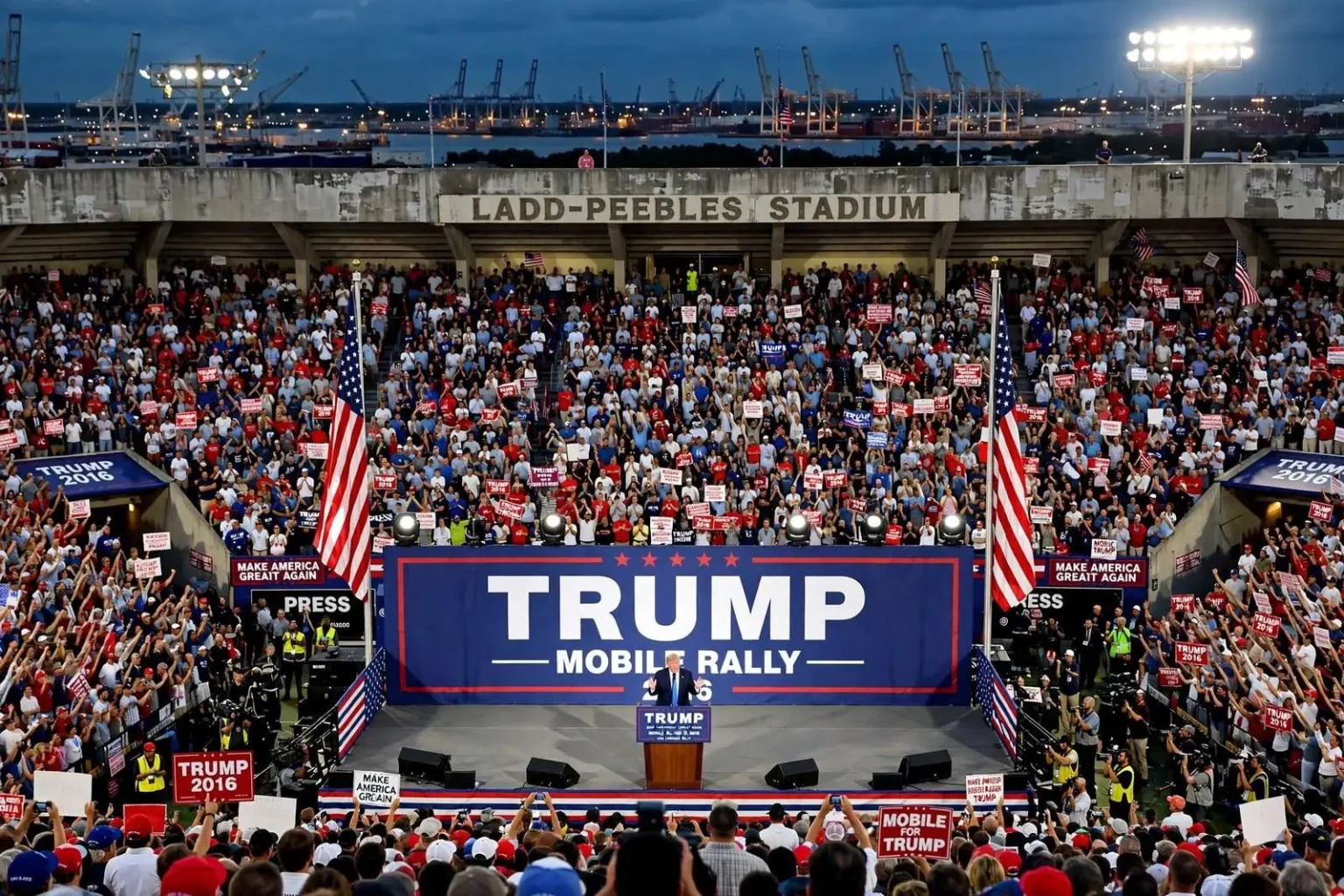
The venue question resolved itself in the most emphatic way possible. What began as a rally booked for the Mobile Civic Center ended as a stadium event, and by the time the visit took place the campaign had relocated to Ladd-Peebles Stadium, the city’s historic football venue in the Toulminville area of West Mobile. The stadium — long the home of the Senior Bowl, the annual all-star game that draws national scouting attention, and the site of decades of high school and college football — offered the kind of capacity the Civic Center could not approach.
The crowd that filled Ladd-Peebles, by multiple estimates, numbered in the tens of thousands, a figure that placed the Mobile rally among the largest single campaign events of the 2016 cycle to that point. Images of the packed stands and the crowds on the field circulated nationally, and the size of the turnout became, for a night, the story itself — proof of concept for a campaign whose central claim was the breadth and intensity of its support.
Beyond the political strategy, city leaders framed the visit as a moment of civic significance for Mobile, regardless of individual residents’ political leanings. Rarely does a presidential campaign, from either party, choose the city as a stop, and officials said the attention itself carried value for a community not always in the national spotlight.
That framing has deep roots in how Mobile sees itself relative to the rest of the state. Alabama’s political and media gravity has historically centered on Montgomery, Birmingham, and Huntsville, and Mobile — despite being the state’s only major seaport and one of its oldest cities, with a civic history stretching back more than three centuries — has often watched presidential politics pass it by. Campaigns fly into Birmingham or Huntsville, hold their events, and leave the Gulf Coast to read about it. A frontrunner’s decision to route a marquee event through Mobile instead inverted that pattern, and city officials were careful to note the point without turning it into a partisan statement.
For residents, the practical meaning of the visit was straightforward: a chance to see a leading presidential candidate in person without traveling to Atlanta, New Orleans, or Birmingham. Direct access to the people who would be president has always been unevenly distributed across a state, concentrated in the media markets where campaigns expect to find voters and cameras. An event in Mobile redistributed that access, if only for an evening, to the southwestern corner of the state and, by extension, to the neighboring coastal counties of Mississippi and Florida.
The Stop in the Context of the 2016 Alabama Race
The rally added Mobile to a short list of Alabama appearances by leading 2016 candidates, and it set the stage for a contest in which the state’s March primary would carry real weight in the Republican nominating fight. Alabama’s primary voters had, in recent cycles, delivered lopsided margins to the eventual nominees of both parties, and the state’s place on the SEC-primary calendar made it a target for candidates seeking momentum across the South.
What distinguished the Mobile visit was less the fact of an Alabama stop than its scale and its manner. Other campaigns worked the state through county party fish fries, chamber of commerce luncheons, and retail politics in doughnut shops. This one arrived, announced itself through sheer public demand, and filled a football stadium. The contrast between those two modes of campaigning — organization versus energy, infrastructure versus enthusiasm — became one of the running stories of the nominating contest, and Mobile offered an unusually vivid illustration of it.
For the Mobile County Republican Party, the episode was a lesson in the changed mechanics of presidential campaigns. The county organization remained what it has long been: a durable, active operation that staffs precincts, screens candidates, and turns out voters in November. But the visit made plain that a candidate able to command a stadium crowd without local help occupies a different position in the party ecosystem than the candidates who need that help. Party leaders, for their part, took the pragmatic view — their job, whatever the campaign’s methods, was to make the visit a success and to keep the county’s voters engaged through the primary and into the general election.
What a Rally Leaves Behind
The deeper significance, as city hall saw it, was the precedent. A campaign that chose Mobile once, and drew a stadium crowd, had demonstrated that the audience was here — that the central Gulf Coast, properly located and properly timed, could deliver an event of national scale. Political consultants and party officials on both sides took note of the same arithmetic that Gray described: a Mobile stop reaches three states, not one. Whatever the fortunes of any individual candidate in a given cycle, that geographic fact does not change, and it is the reason city officials greeted the announcement not with anxiety over politics but with the plain observation Talbot offered — that Mobile matters, and that a night when tens of thousands gather at Ladd-Peebles Stadium to take part in a presidential campaign is, whatever a resident’s party, a night when the rest of the country is reminded of it.
The visit ultimately became one of the memorable political moments in the city’s recent history, cited ever since whenever the question arises of whether national campaigns can and should route through the Port City. The answer the crowd itself provided — tens of thousands strong, in a stadium that had to be swapped in when an arena proved too small — settled the question for the foreseeable future.