University of South Alabama Mobile
Mobile Ramps Up Security, Logistics for Trump Rally at Ladd-Peebles
Mobile officials prepared Ladd-Peebles Stadium for a Trump campaign rally expected to draw 35,000 people, addressing parking and water access.
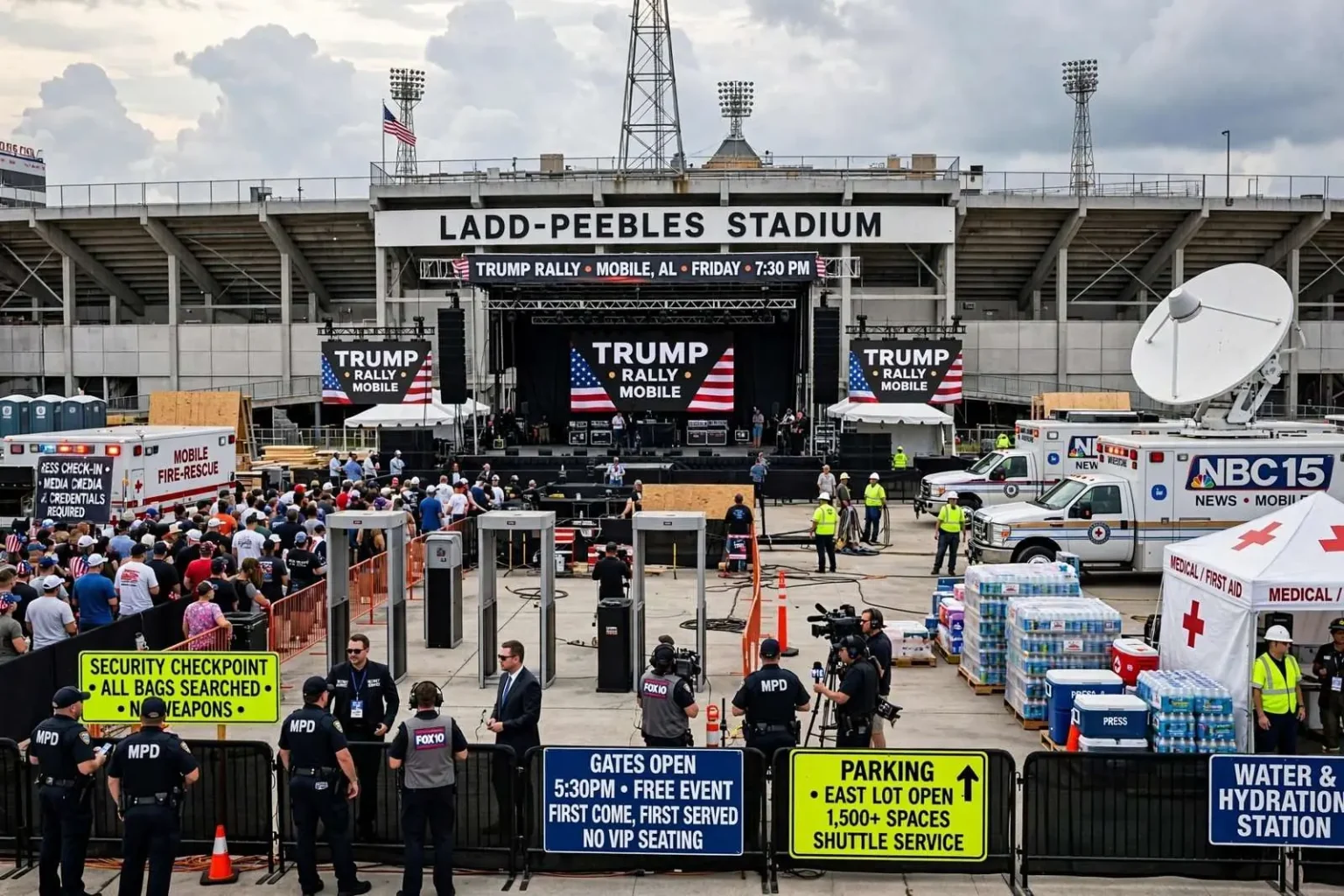
City officials and stadium staff spent this week scrambling to prepare Ladd-Peebles Stadium for what could be one of the largest political rallies South Alabama has seen in years, as then-candidate Donald Trump prepared to speak before a crowd expected to reach 35,000 people.
The scale of the expected crowd dwarfs the typical midsummer calendar at the Mobile stadium, which ordinarily sits between football seasons during the hottest stretch of the Gulf Coast year. Turning a venue built for Friday night games into the setting for a national political event required weeks of compressed planning and, in the final days, a round-the-clock push by staff and contractors to have everything in place before gates opened.
Ladd-Peebles has anchored major sports in Mobile for decades, hosting University of South Alabama football games, high school championships and other events that have made it the region’s most familiar stadium. Few of those events, however, arrived with the media attention and logistical demands that accompanied this visit, and staff spent the week adjusting the facility to a purpose it had rarely if ever served.
Building a stage in the end zone
Stadium manager Vic Knight said crews removed a goal post in the north end zone to make room for a stage, part of a rapid buildout for the Friday evening event. The work converted one end of the stadium into a production zone for the candidate, his staff and the broadcast equipment that would carry his remarks to a national audience.
Removing a goal post is no small task in itself, requiring crews to extract the structure and its deep footing before the stage framework could go up. The decision reflected the realities of stadium conversion work: with a fixed calendar and a Friday deadline, crews worked through the week to disassemble, relocate and rebuild the pieces of a football venue into a rally site.
The stage placement in the end zone also dictated the sight lines for the crowd, which would fill the seating bowl and spill onto the field and surrounding areas. Stadium events of this magnitude require sight line planning, barricades and security perimeters, all of which were being finalized in the days before the event under pressure of the approaching Friday evening start.
A national media presence in Mobile
More than 150 members of the national media, including major television networks, were expected to cover the rally, which was set to begin with a news conference before remarks around 7:30 p.m. The press contingent alone represented a logistical operation, with workspace, connectivity and camera positions that had to be arranged for outlets unaccustomed to working out of a midsize Gulf Coast stadium.
The media attention underscored how far the candidate’s summer surge had carried him in the national conversation. What began as a long-shot campaign had become a rolling spectacle, and rallies in Southern cities had repeatedly drawn crowds and coverage that surprised even veteran political observers, making Mobile the latest stop on a tour that was rewriting expectations for the campaign season.
For Mobile, the arrival of the national press corps brought a spotlight the city rarely receives in August. Local officials familiar with hosting major events noted that the attention cuts both ways, showcasing the city to a national audience while placing its infrastructure and hospitality capacity under scrutiny from reporters working on deadline.
Security planning ran alongside the physical buildout, with coordination among stadium staff, Mobile police and the campaign’s own protection detail. Events featuring major candidates bring layers of security that ordinary stadium events never require, from magnetometers at the gates to restricted zones around the stage, and each layer had to be fitted into a venue designed for athletic competition rather than head-of-state style protection.
Parking and moving the crowds
Parking emerged as one of the bigger logistical challenges. Unlike football games at the venue, officials said the stadium’s east parking lot would be opened for the event, adding roughly 1,500 additional spaces. Whether attendees would be charged to park had not been finalized as of Thursday, and the question remained open as crews finalized the layout of the lots surrounding the stadium.
The east lot’s opening reflects the simple math of a 35,000-person crowd, which far exceeds what the stadium’s regular parking arrangements accommodate on a football Saturday. Fans attending high school and university games rarely tax the full capacity of the surrounding lots, but a rally of this size would fill every available space and spill into surrounding areas, requiring coordination with property owners near the venue.
Local transit buses were also expected to run extra service throughout the evening, giving attendees an alternative to driving into the stadium area. Transit agencies in Mobile historically supplement service for major events at Ladd-Peebles, and the extra runs were designed to move crowds between remote parking areas and the stadium gates as the evening progressed.
Tickets to the free event were distributed on a first-come, first-served basis through an online ticketing platform, with no VIP seating arrangements. The egalitarian ticketing approach matched the campaign’s rally style, which filled venues on a general admission basis and left seating and standing room open to whoever arrived earliest. Gates were set to open at 5:30 p.m., roughly two hours before the rally’s planned start, giving early arrivals time to pass through security and claim positions close to the stage.
Heat, hydration and lessons from 2014
Officials also focused on making sure the venue, which has hosted University of South Alabama football games and high school contests for decades, could handle a crowd in the summer heat. The concern followed criticism of concession and hydration issues during a 2014 USA football game that saw dozens of heat-related medical calls on a day when temperatures topped 90 degrees.
That game became a case study in how quickly a stadium crowd can overwhelm concessions when temperatures climb, with long lines for water and reports of fans waiting in the sun for refreshments that could not be delivered fast enough. The episode drew pointed criticism at the time, and stadium officials had two years of hindsight to draw on as they planned for a crowd that would be larger still.
Stadium officials said this time they were coordinating closely with concessions staff to ensure adequate water access. Plans included expanded points of sale, additional water distribution and medical staff positioned throughout the venue, the standard playbook for outdoor events in the Gulf Coast summer but one that demanded more scale given the size of the expected crowd.
Emergency medical planning for an event of this type also involves coordination with city fire and ambulance services, which stage units near the venue and plan routes for moving anyone who needs hospital care. The combination of heat, crowds and long periods of standing makes medical readiness a central part of any summer rally plan in South Alabama.
The campaign’s decision to stop in Mobile also reflected the region’s role in the primaries to come. Alabama’s presidential preference primary falls early in the nomination calendar, and candidates competing across the South schedule Gulf Coast stops to build organizations and enthusiasm in the weeks before voters go to the polls. For local party activists, the rally doubled as an organizing opportunity, with volunteer sign-ups and campaign literature reaching thousands of prospective supporters in a single evening.
What the rally means for Mobile
Mobile’s mayor said the city intended to treat future political rallies similarly, while acknowledging the scale of interest surrounding this particular visit was unusual for the area. The comment signaled that city hall viewed the event as a template for handling large political gatherings, whatever the candidate or the party, and that the preparations made this week would inform the response to whatever comes next.
Local officials and political observers noted that the region’s political landscape has been shifting, with Southwest Alabama’s reliably conservative base showing particular enthusiasm in the early stages of the presidential campaign. A candidate drawing 35,000 people to Mobile in August of an election year sends a message about the intensity of feeling on the Gulf Coast, and the rally gave local Republicans a chance to participate in a national story from their own backyard.
The economic footprint of the event was also part of the calculation for the city. Thousands of visitors fill restaurants, hotels and gas stations surrounding a venue on event nights, and a crowd the size of the one expected Friday would leave a noticeable one-night mark on businesses near the stadium and across the city.
Stadium staff, for their part, will spend the days after the event restoring Ladd-Peebles to its familiar configuration, reinstalling the goal post removed for the stage and resetting the facility for the high school and university football seasons that follow. The quick turnaround is part of the rhythm of a venue that has long served multiple masters, and by the time fall games begin, the traces of the rally will be gone from the field.
What will last is the memory of a summer evening when Mobile found itself at the center of American politics, with a national audience watching a stadium that usually hosts Friday night lights instead hosting a moment in a presidential campaign that had already defied expectations at every stop.
Weather, as always on the Gulf Coast in late summer, hovered over the planning. Afternoon thunderstorms are a near-daily possibility in August, and event staff tracked forecasts through the week while preparing for the possibility that rain would complicate crowd movement and stage operations. Contingency planning for summer storms is second nature to anyone who has run an outdoor event in South Alabama, and the final days before the rally included reviews of what to do if the skies turned.
The event also tested the communication channels between the city and the stadium’s operators, whose agreement governs how the facility is used for non-athletic events. Large private events at public venues require negotiation over costs, staffing and revenue, and the arrangements worked out for the rally will inform how the city handles similar requests in future election cycles.