Trump Rally Draws Tens of Thousands to Mobile’s Ladd-Peebles Stadium
A presidential campaign rally at Mobile's Ladd-Peebles Stadium was expected to draw roughly 40,000 people, prompting citywide parking and shuttle plans.
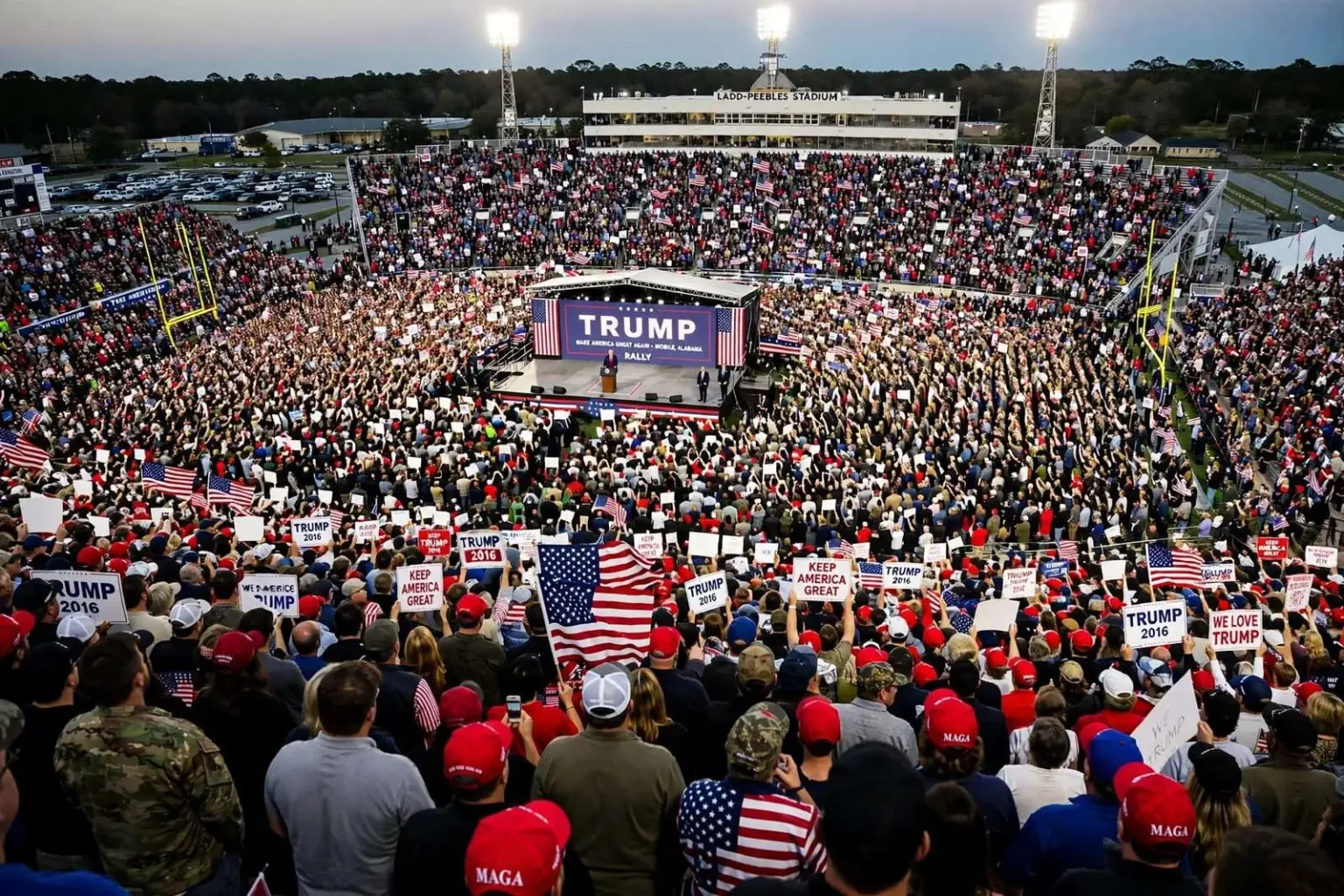
Ladd-Peebles Stadium has hosted big crowds before, but few nights in its long history matched the scene when a campaign rally for Donald Trump filled the Mobile venue with tens of thousands of people. The event turned the historic stadium into one of the largest political gathering points Alabama’s Gulf Coast had seen in a presidential campaign season. Organizers prepared for a big turnout, and the response from across Mobile, Baldwin County, and beyond quickly exceeded anything a routine campaign stop would draw. By the time the program got underway, the stands and field areas were packed with supporters, and late arrivals found themselves funneling into overflow space as the crowd kept building.
The rally carried significance well beyond the size of the crowd. Mobile has long been a stop for national politicians courting Alabama voters, but events of this scale are rare for the city. A gathering of this magnitude brought statewide and national attention to the Port City during a campaign cycle when Alabama’s role as a reliably red state made candidates compete for enthusiasm as much as votes. For the Trump campaign, the event served as a showcase of grassroots energy in a region where conservative turnout has historically been strong, and for local officials it was a test of how the city handles a crowd far larger than most concerts or sporting events ever bring through the gates.
Ladd-Peebles Stadium itself gave the event a distinct backdrop. Opened in 1948, the stadium has spent generations as one of Mobile’s signature sports venues, with a seating capacity in the neighborhood of 33,000. It is best known as the longtime home of the Senior Bowl, the college football all-star game that draws scouts and fans to Mobile every year, and it has hosted bowl games and playoff football in addition to serving area high school programs. A stadium built for football Saturdays and Friday night lights proved adaptable to a different kind of gridiron moment, one where the action belonged to a candidate addressing a sea of supporters rather than players running plays.
A Crowd That Filled the Stadium
Attendees did not simply show up and walk in. With a crowd that size converging on one venue, the evening became an exercise in patience for thousands of people who arrived hours before the scheduled start. Lines stretched across the stadium grounds as security screening moved thousands of guests through the gates, and the wait became part of the shared experience for many who attended. Supporters compared notes in line, traded signs and shirts, and turned the long wait into an early version of the rally itself. For a campaign event, the atmosphere outside the gates often matters as much as the program inside, and in Mobile it set the tone for what was to come.
The composition of the crowd reflected the breadth of the region. Alongside Mobile residents came supporters who drove from Baldwin County communities such as Daphne, Fairhope, and Foley, from Washington and Escambia counties, and from the Mississippi Gulf Coast just across the state line. Presidential campaign stops rarely reach the Gulf Coast, so a rally within driving distance drew people who might otherwise never see a major party candidate in person. That dynamic transformed the event from a local political gathering into a regional one, with the stadium serving as the meeting point for supporters across south Alabama and neighboring areas of the panhandle and Mississippi.
Inside the stadium, the program followed the familiar rhythm of a campaign rally, with the candidate addressing the crowd on the themes that defined his candidacy. The setting amplified the message in a way smaller venues could not. A candidate speaking to tens of thousands of people in a football stadium creates images that travel far beyond the people in attendance, and national media coverage of the Mobile event did exactly that. The crowd itself became part of the story, cited as evidence of the campaign’s ability to generate enthusiasm in the Deep South at a moment when skeptics questioned the durability of the movement behind the candidate.
Logistics of Hosting a Massive Rally
Events of this size do not come together without significant planning. Stadium staff, campaign organizers, and city departments had to coordinate parking, security, first aid, and crowd flow in a venue normally configured for football games rather than political programs. Parking around the stadium filled quickly, pushing many attendees onto shuttle arrangements and surrounding lots, and traffic on the roads approaching the venue slowed for hours before and after the event. Mobile police and other agencies managed intersections and directed vehicles as thousands of cars converged and then dispersed at the same time at the conclusion of the rally.
Security was a central consideration from the start. A visit by a major presidential candidate brings the Secret Service, which works alongside local law enforcement to screen everyone entering the venue and to secure the areas around the stage. Magnetometers at the gates slowed entry, contributing to the long lines but allowing the event to proceed without major incident. The scale of the operation gave Mobile agencies experience with security planning that serves a community whenever large events return, from bowl games to festival weekends, and demonstrated that the city’s public safety infrastructure could absorb a crowd of this magnitude.
The economic footprint of the night was felt across the city as well. Thousands of visitors stopping at restaurants, gas stations, and hotels before and after the rally brought a one-night boost to businesses along the corridors leading to the stadium. For a community that markets itself as a host city for conventions, cruises, and college football, the rally offered another demonstration that Mobile can deliver the crowds that national events produce. Local hospitality workers and business owners often describe large-event nights as among their busiest of the year, and a rally of this size fit that pattern.
What the Rally Meant for the Campaign and the Coast
For the Trump campaign, Alabama in general and Mobile in particular represented friendly territory where a candidate could generate powerful visuals and renewed energy. The state’s presidential primary season and the broader southern political calendar make the Gulf Coast a natural stop for candidates looking to consolidate support, and the size of the Mobile crowd sent a signal that the campaign’s appeal extended deep into the region. Rallies like the one at Ladd-Peebles functioned as both campaign events and media events, and the Mobile stop accomplished both goals.
For residents of the area, the rally became one of those shared community experiences that people remember and retell. Those who attended could say they were part of one of the largest political crowds the city has ever seen, and even residents who stayed away felt the effects in the traffic, the conversations, and the coverage that followed. Large events leave that kind of mark on a city, becoming reference points that people measure later gatherings against. In the years since, any major event at Ladd-Peebles has drawn comparisons to the night the stadium filled for a presidential campaign.
The event also underscored the enduring role of Ladd-Peebles Stadium in the life of Mobile. Venues age and communities debate their futures, but the stadium’s ability to absorb a crowd of tens of thousands showed why it has remained central to the city’s event calendar for more than seven decades. From Senior Bowl Saturdays to high school playoffs to a presidential campaign rally, the venue has proven flexible enough to host the moments that draw the community together, and the rally stands as one of the clearest demonstrations of that capacity in the stadium’s long history.
For supporters, part of the appeal of attending was simply being present at a moment when national politics arrived in their city. Many attendees described the experience as unlike any political event they had previously joined, with the scale of the crowd creating an energy that smaller venues cannot generate. Political scientists often note that large rallies serve an emotional purpose for attendees as much as a strategic one for campaigns, reinforcing a sense of belonging to a movement. The Mobile crowd illustrated that dynamic, with the sheer size of the gathering functioning as a message of its own to both supporters and critics.
The rally also arrived at a moment when Alabama’s place in presidential politics was under scrutiny. The state reliably delivers Republican majorities in general elections, which means candidates spend limited time and resources there during the fall campaign. Primary season is different, and a campaign stop in Mobile gave the candidate a chance to bank enthusiasm and organization ahead of Alabama’s primary contests. Volunteers and local organizers used the occasion to sign up supporters and build the kind of grassroots network that matters when primary day arrives, making the stadium event a foundation for the campaign’s Alabama infrastructure.
Coverage of the event highlighted the contrast between the scale of the crowd and the expectations that preceded it. In the run-up to the rally, questions circulated about how many people would actually come to a midweek campaign event in Mobile, and the answer overwhelmed the skeptics. The gap between expectations and turnout became a recurring theme in how the campaign’s Gulf Coast support was discussed afterward. For attendees, the sense of having been part of something larger than anticipated was part of what made the night memorable, and it fed the narrative that the campaign’s strength in the region had been underestimated.
The Stadium’s Place in Mobile Life
Understanding the significance of the rally requires understanding the venue’s standing in Mobile. Ladd-Peebles Stadium was built in the years after World War II and named for two of the figures behind its creation, and it quickly became the center of football culture in the city. Generations of Mobile-area players have competed on its field, and the stadium’s annual calendar has long revolved around the sport that dominates the region’s attention. Its capacity makes it one of the larger venues on the Alabama Gulf Coast, and its location has made it a familiar landmark for anyone who has followed Mobile sports.
The Senior Bowl connection gives the stadium a national identity that most mid-sized cities never enjoy. Every year the game brings the country’s top senior college players, NFL scouts, coaches, and media to Mobile, filling hotels and restaurants in the week leading up to the contest. Hosting a presidential rally added a different category of national attention to that resume. The stadium has now proven it can serve as the stage for events where the entire country is watching, whether the subject is the future of professional football or the future of a presidential campaign.
High school football also remains central to the stadium’s identity, with playoff games and championship events bringing families from across Mobile County through its gates each fall. That community role shaped how the rally was experienced by many locals, who were accustomed to navigating stadium traffic and crowds on autumn Fridays. The skills and routines that generations of Mobile residents developed for football nights transferred easily to a rally evening, and the familiarity of the venue helped make a politically charged event feel, for many attendees, like another gathering of the community in a place they already knew well.
In the broader story of the 2016 campaign cycle, the Mobile rally remains a touchstone for how the candidate’s support in the Deep South manifested in person. It demonstrated that the enthusiasm driving his candidacy was not confined to early primary states or large media markets but extended to communities like Mobile, where a campaign stop could still draw a stadium-sized crowd. For the city, the night was a demonstration of capability and a shared experience, and for the thousands who attended, it was a rare chance to see, in person, a presidential campaign moment unfolding on the field of one of Alabama’s most familiar stadiums.