

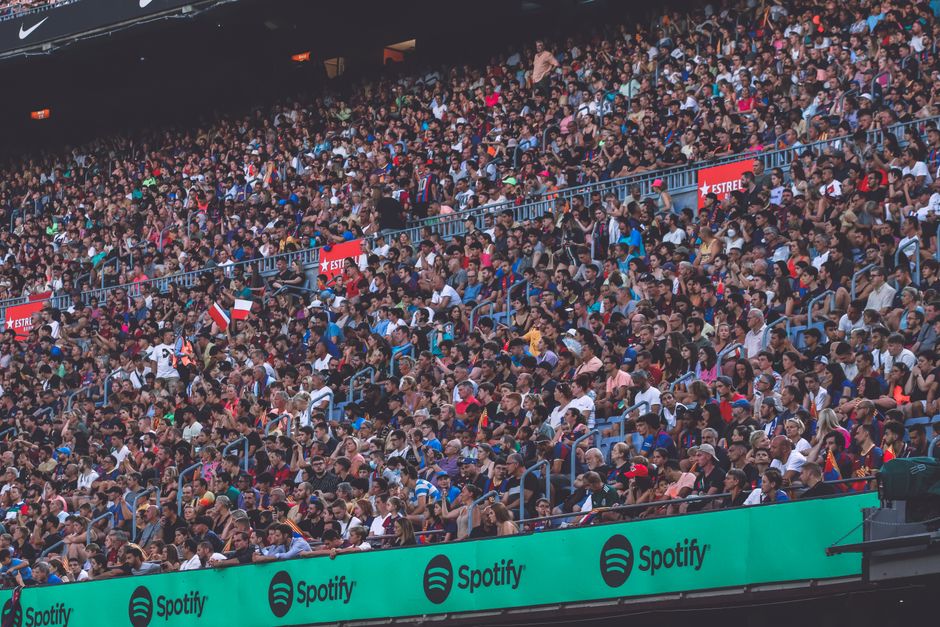
Ladd-Peebles Stadium played host to one of the largest political rallies in Mobile’s history this month, as tens of thousands of people packed the stands for a presidential campaign event that turned the north end zone into a stage for one of the year’s most talked-about candidates. The Friday-night spectacle transformed the aging stadium off Airport Boulevard into the center of the political universe for an evening, drawing national media, Secret Service cordons and a crowd that stretched from the bleachers to the parking lot beyond.
State officials estimated the crowd at between 25,000 and 30,000 people, filling large sections of the stadium’s grandstands even though projections beforehand had called for as many as 42,000 attendees. The final count still dwarfed anything the venue typically sees outside Alabama football, and it vindicated the campaign’s decision to book the 40,000-seat stadium rather than a smaller hall — even as the below-projection turnout suggested that thousands who requested tickets never made it through the security lines and parking crush.
Gates opened at 4 p.m., and long lines formed outside the stadium well before then as supporters waited to get inside. The queue snaked through surrounding lots in the August heat, where vendors hawked water and campaign merchandise from folding tables, and where the wait itself became part of the experience for many attendees, some of whom had traveled from across south Alabama and the Florida Panhandle for a seat.
Tailgates and T-shirts
Local businesses got in on the action throughout the day. ABC Signs of Theodore handed out 500 campaign signs and 1,000 T-shirts to attendees, a giveaway that had the candidate’s name blooming across the grandstands by the time the program began. For the Theodore print shop, the rally was the kind of order that can carry a small business for weeks, and its staff worked the crowd like a marketing operation, camera-ready for the national coverage beaming down from the press box.
A tailgate hosted by a local radio station served jambalaya and crab cakes from Naman’s Catering, a spread that sold out within 20 minutes of being set up. The food line — Gulf Coast cuisine at a political event — became its own attraction, with hundreds lining up for a taste before the supply vanished, and the radio hosts broadcasting live from the middle of it all.
Inside the stadium, the atmosphere took on what one observer described as a “political carnival,” with homemade signs and a steady buzz of activity among the crowd. Vendors, petition-gatherers, families with small children and first-time political attendees mixed in the concourses, and the crowd noise built steadily through the warm-up speakers until it erupted when the main event finally took the stage.
Sessions brings the candidate home
U.S. Sen. Jeff Sessions, R-Mobile, drew a loud ovation when he stepped to the podium ahead of the main speech, welcoming the candidate to “my hometown, Mobile, Alabama.” Sessions has been a vocal supporter of the campaign’s immigration platform in the weeks leading up to the rally, and his role as warm-up act carried real weight: Alabama’s senior senator had spent months championing the positions that defined the campaign, and the Mobile crowd greeted him as a favorite son making good on his advocacy.
The pairing was strategic for both men. For the candidate, Sessions lent conservative credentials and an established national platform on immigration; for the senator, the alliance positioned Alabama squarely inside the story of the year’s most unconventional campaign. The ovation he received at Ladd-Peebles — arguably as loud as the one that greeted the headliner — showed how thoroughly he had carried his constituents along.
Among the crowd was Joyce Baker of Mobile, who brought her family, including her 6-year-old granddaughter, Tyler Ann Collard, who had told her first-grade teacher earlier in the day that she was headed to the rally. “This is historical, and we have much hope,” Baker said, describing the excitement her family felt about attending. Her granddaughter’s school-day announcement captured the event’s odd place in local life: a presidential campaign arriving in town on a Friday night, competing with high school football for the city’s attention — and winning.
A signature moment for Mobile
The rally’s scale placed it among the largest single-night political gatherings of the 2016 presidential campaign cycle nationally, rivaling other high-turnout events held elsewhere that summer. Political observers noted that few campaigns of any era have drawn crowds of that size to Gulf Coast venues, and the images of the packed stadium circulated nationally for days afterward, read as a barometer of the candidate’s appeal in the Deep South heading into the primary season.
For Mobile, the event brought a significant one-day economic boost to local vendors, security staff and nearby businesses, while putting the city’s largest stadium venue in the national spotlight. Restaurants around the stadium did rally-night business on a scale usually reserved for game days, hotels filled with press and staff, and the city’s police and fire departments managed a crowd that tested every access route to the venue.
Beyond the spectacle, the rally underscored Mobile’s growing role as a stop on the national political circuit, with Ladd-Peebles Stadium proving it could handle a crowd and media presence on a scale rarely seen in the city. The venue — opened in 1948 and home to generations of high school football and the Senior Bowl — has long been the city’s gathering place, but rarely for anything with this much national attention attached.
Whether the stadium hosts similar events in the future remains to be seen, but the rally is likely to be remembered locally as one of the signature moments of Mobile’s 2015 calendar. For one August evening, a presidential campaign made the Port City the loudest place in American politics, and 25,000 or more of the city’s residents were there to see it happen.
Logistics of a mega-rally
Events of this size do not simply happen; they consume a city’s infrastructure for a full day. Secret Service screening funneled thousands of attendees through a limited number of magnetometer lines, which meant most people spent hours in the sun before reaching their seats, and the gates’ 4 p.m. opening was less an invitation than a starting gun for a slow-motion procession through security. Police directed traffic on the surrounding streets, parking lots filled by early afternoon, and ride-shares and shuttle drivers improvised drop-off points blocks away from the entrance.
Stadium staff and campaign volunteers scrambled to manage the crush — restrooms, concession lines and seating all ran at full capacity for hours. The gap between the 42,000-ticket projection and the 25,000-to-30,000 who made it inside was largely a function of that funnel: ticket requests outpaced the building’s physical ability to admit and seat people, a familiar pattern at the campaign’s biggest venues that summer.
For Mobile officials, the night doubled as a stress test. The city had hosted political events and stadium concerts before, but never a crowd of this size with national media in residence, and the generally smooth handling of arrivals and departures became a talking point afterward among local leaders who hope to court larger events as the city grows.
The 2015 political backdrop
The rally landed at a moment when the campaign was defying every rule of the traditional playbook, drawing the largest crowds of the cycle with a message aimed squarely at voters who felt left behind by both parties. Alabama, with its early-March primary, had suddenly become relevant in a way the state’s Republicans had not experienced in modern cycles, and candidates who once would have flown over the Gulf Coast were now scheduling stops in its largest city.
Sessions’ embrace of the campaign was the state’s clearest signal of that shift. The senator’s hard line on immigration had once made him a lonely voice in Washington; by the summer of 2015, the issue had moved to the center of the national debate, and the man who had argued for it for two decades was suddenly speaking to arenas full of voters who wanted to hear it. His Ladd-Peebles introduction was the homecoming version of that transformation.
Local Democrats and independents attended too, some out of curiosity, some in protest, and the rally’s carnival atmosphere accommodated them all in the sprawling concourses. By the time the campaign plane departed, Mobile had experienced the full 2015 phenomenon — the crowds, the merchandise, the media scrum, the mix of celebration and controversy — and the city had a new data point in its ongoing case that it can host events of national consequence.
What the night left behind
In the days that followed, the images kept traveling: the packed grandstands on national broadcasts, the jambalaya line on local social media, the front pages pairing the stadium’s floodlights with a story that would define the political year. For ABC Signs, Naman’s Catering, the radio station and the stadium’s own staff, the rally was a business windfall; for the Bakers and thousands of families like theirs, it was a night they described to their grandchildren.
Historians of the era would come to mark that August as the point when the campaign’s momentum became undeniable, and Mobile’s rally stood among the largest proofs. The city, for its part, learned something about itself: that when national politics comes looking for a stage, Ladd-Peebles and the people around it can still deliver one, on a Friday night, in the August heat, with room to spare for history.