Cain’s Piggly Wiggly Opens Fifth Baldwin County Store in Spanish Fort
Cain's Piggly Wiggly opened its newest Baldwin County store in Spanish Fort after a 14-year effort by owner Tommy Cain to secure the property.
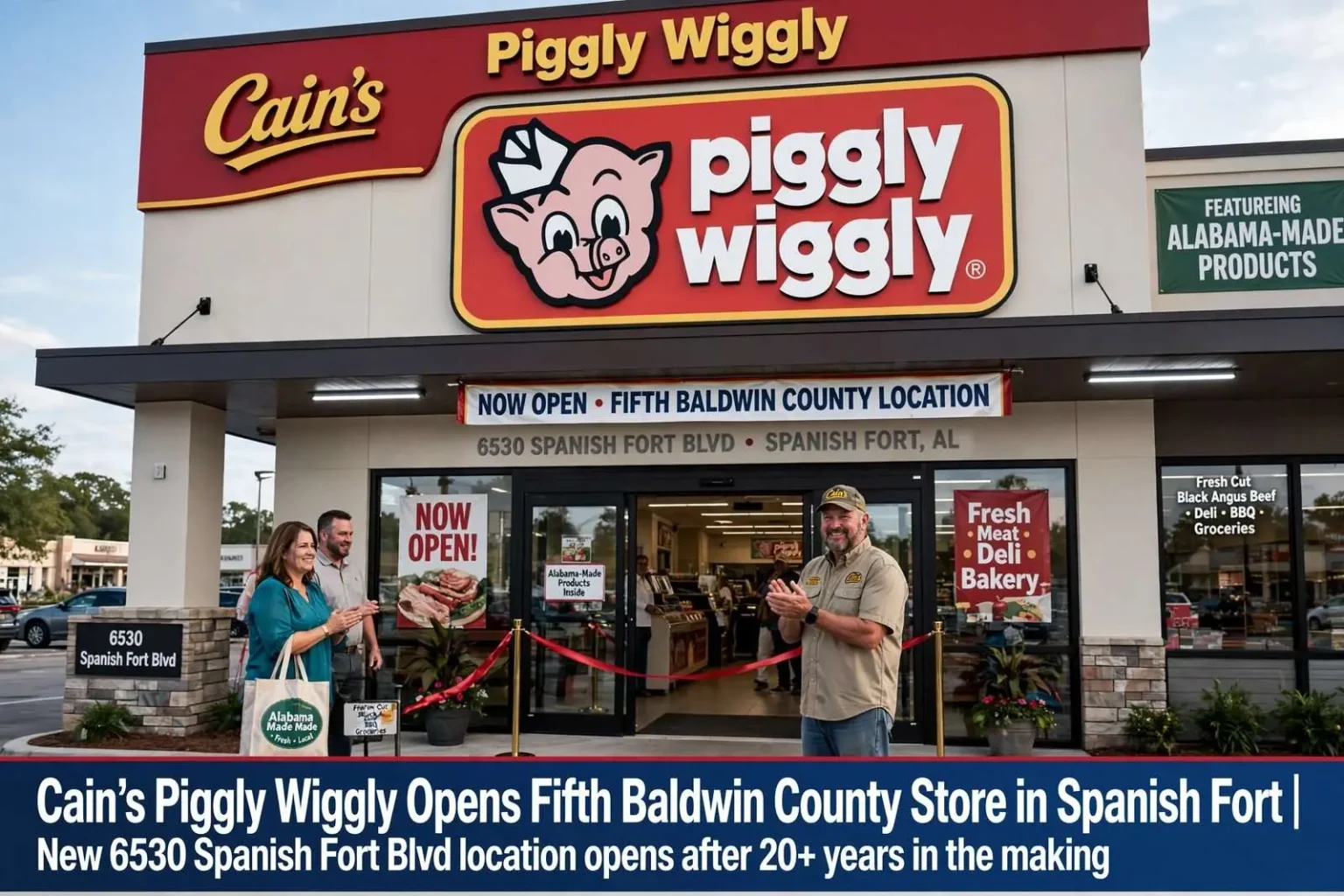
Cain’s Piggly Wiggly has opened its fifth Baldwin County location, bringing a new full-service grocery store to Spanish Fort after more than a decade of effort by owner Tommy Cain to land the site. The new store sits at 6530 Spanish Fort Blvd. and marks the latest expansion for Cain, who opened his first Piggly Wiggly in 1989. Cain said he began eyeing the Spanish Fort property back in 2001, but repeated attempts to buy it fell through over the years. After roughly six months of negotiations, he finally closed the deal in early May, setting the stage for the store’s opening this month.
A Deal More Than Two Decades in the Making
The property previously belonged to Spanish Fort United Methodist Church, and Cain credited the congregation with helping clear and prepare the site for the remodel that followed. “The folks at Spanish Fort United Methodist Church were a big help to me in cleaning it up and getting it ready to remodel,” Cain said. “I can’t thank them enough for that.”
The long pursuit of the parcel says much about how Cain approaches expansion. Rather than chasing multiple sites at once, he identified the Spanish Fort location as the right one and stayed with it as ownership, timing and negotiations shifted over more than twenty years. The patience paid off with a site on Spanish Fort Boulevard, the commercial spine of one of Baldwin County’s fastest-growing cities, just a short drive from the Interstate 10 interchange that channels Eastern Shore traffic in both directions.
Spanish Fort has grown from a small crossroads community into a retail destination for the eastern shore of Mobile Bay, anchored by major shopping centers near the interstate and steady residential growth along the Highway 31 corridor. A full-service grocery store within the city limits gives residents a closer option for everyday shopping trips and adds to the city’s base of sales tax revenue, which funds services in one of the fastest-growing municipalities in south Alabama.
Local Products Front and Center
John Robitaille, director of marketing and advertising for the Cain’s chain, said the Spanish Fort store reflects the company’s ongoing push to spotlight fresh, local and Alabama-made products alongside the usual grocery lineup. The emphasis on Alabama producers has become a signature of the Cain’s stores, setting the shelves apart from national chain competitors whose buying decisions are made far from the Gulf Coast.
The new location is also the first Cain’s store built with LED lighting throughout, which the company says makes it the most energy-efficient store in the chain. Lighting is one of the largest steady electrical loads in a grocery store, where sales floors stay illuminated from before opening until after closing every day of the year, so a full conversion to LED trims operating costs over the long life of the building while reducing the store’s overall energy footprint.
Though somewhat smaller in footprint than some of Cain’s other Baldwin County stores, the Spanish Fort location carries the same signature amenities shoppers have come to expect, including an in-house delicatessen serving fried chicken, smoked ribs and Boston butts. The prepared-food counter has become a draw for time-pressed shoppers across the chain’s stores, turning a grocery run into a stop for a ready-made family meal in a region where barbecue and Southern staples are a point of pride.
A Butcher Counter That Works for the Customer
The meat department offers Black Angus beef cut fresh in-store, with butchers available to cut orders to a customer’s specifications. The service stands out in an era when most supermarket beef arrives case-ready, pre-cut and pre-packaged at distant processing facilities. An in-store butcher can trim a roast to size, cut steaks to a thickness a customer requests or prepare specialty orders for holidays and gatherings, a level of customization that has largely disappeared from larger chains but remains a hallmark of the independent grocer tradition.
Cain said the store also features a special end cap dedicated to products made in Alabama. “Anything that is made in Alabama and I can get is in that store,” he said, describing his preference for working with local producers over larger national suppliers. The rotating display gives Alabama food companies premium placement at the end of an aisle, one of the most visible spots on the sales floor, and gives shoppers a curated look at goods from across the state without hunting for them.
That commitment ties the store to a network of Alabama farmers, sauce makers, bakers and specialty food producers who often struggle to get shelf space in national chains. For local producers, a regional grocer willing to build merchandising around their products can be a meaningful sales channel; for shoppers, it keeps dollars circulating within the state economy and puts products on the shelf that reflect the region’s own food traditions.
The Piggly Wiggly Banner in Alabama
The Piggly Wiggly name carries particular weight in Alabama. Founded in Memphis in 1916, Piggly Wiggly was the world’s first self-service grocery store, pioneering the shopping basket, priced items and checkout counters that every supermarket now takes for granted. The chain later shifted to a franchise model, and today independently owned stores operate under the banner across the South, with Alabama home to a dense concentration of them. The familiar pink pig logo remains one of the most recognizable grocery brands in the state, and locally owned Piggly Wiggly stores often serve as the hometown grocer in communities large and small.
Cain’s operation fits that independent tradition. Since opening his first store in 1989, Cain has grown steadily within Baldwin County rather than spreading thin across a wide region, building density in a market he knows customer by customer. The Spanish Fort store is the fifth in the county, joining locations serving communities across the Eastern Shore and south Baldwin, and the company’s marketing and store standards are managed close to home rather than from a distant corporate headquarters.
What Shoppers Will Find at the New Store
The Spanish Fort location combines the smaller footprint with the chain’s established formula: a full-service delicatessen, a staffed meat counter with fresh-cut Black Angus beef, a grocery lineup stocked with local and Alabama-made goods, and the LED lighting that makes the building the most efficient in the chain. Store staffing brings new jobs to the city, and the store’s position on Spanish Fort Boulevard places it along the daily commute routes of thousands of Eastern Shore residents.
For Cain, the opening closes a chapter that started in 2001, when he first tried to buy the church-owned property, and another that started in May, when the deal finally closed after six months of negotiations. It also opens a new one in a growing city where the competition for grocery dollars includes national and regional chains. Cain’s bet, honed across more than three decades and five Baldwin County stores, is that fresh-cut meat, Southern deli counters and a shelf full of Alabama-made products will keep shoppers coming back to the pig.
Growth on the Eastern Shore
The store arrives as Spanish Fort continues one of the fastest growth runs in Baldwin County, which has ranked for years among the fastest-growing counties in Alabama. The city’s population gains have fed demand for everyday retail along the Highway 31 corridor, where the new store sits among the businesses that serve residents of Spanish Fort, nearby Malbis, and neighborhoods spilling over from Daphne. Grocery access has become a measuring stick for suburban quality of life, and city officials have generally welcomed investment that keeps daily shopping trips inside city limits.
Spanish Fort Boulevard itself carries a steady flow of commuters between the Interstate 10 interchange and the older heart of the city, making the 6530 address a natural stop for shoppers heading home from work in Mobile or Daphne. The store’s site, once church property, now joins the retail row that defines the corridor, a transformation that mirrors the city’s broader shift from rural crossroads to suburb over the past three decades.
Competition and the Independent Grocer’s Niche
The Eastern Shore grocery market is crowded, with national chains and warehouse clubs competing for the same shoppers across Daphne, Spanish Fort and Fairhope. Independent grocers survive in that environment by doing what the big boxes cannot easily copy: staffing service counters, cutting meat to order, stocking local products that regional buyers overlook and building relationships with the producers and customers who live nearby. Cain’s emphasis on Alabama-made goods and in-house barbecue is a direct expression of that strategy, and the Spanish Fort store replicates it in a smaller building where the same standards apply to every department.
The energy-efficient LED build-out also reflects a practical reality of modern grocery economics, where thin margins make every utility dollar matter. As the first store in the chain with LED lighting throughout, the Spanish Fort location may well become the template for future remodels and openings across the company’s stores.
From One Store in 1989 to Five in Baldwin County
Cain’s growth since 1989 tracks the broader transformation of Baldwin County itself, which has swelled from a largely rural landscape of farming and fishing towns into one of the Gulf Coast’s strongest suburban economies. Each store opening followed population movement: as new neighborhoods filled in across the county, Cain’s followed with full-service groceries close to home, rather than asking residents to drive across the bay or across the county for a weekly shopping trip.
The fifth store’s opening this month, after the May closing on the long-sought property, gives Spanish Fort a hometown grocer of its own and gives Cain’s a foothold in a city where it had never operated. Shoppers will find the fried chicken, smoked ribs and Boston butts of the Cain’s deli, butchers ready to cut Black Angus beef to order, and an end cap stocked with whatever Alabama has to offer. For Cain, who spent more than twenty years trying to get the property and thanked the church congregation that helped him ready it, the doors finally opening at 6530 Spanish Fort Blvd. represent the payoff of patience in a business where site selection is everything.