Alabama School of Math and Science Resumes Classes After Norovirus Outbreak
The Alabama School of Math and Science has reopened after a norovirus outbreak sickened more than 30 students and closed the campus for a week.
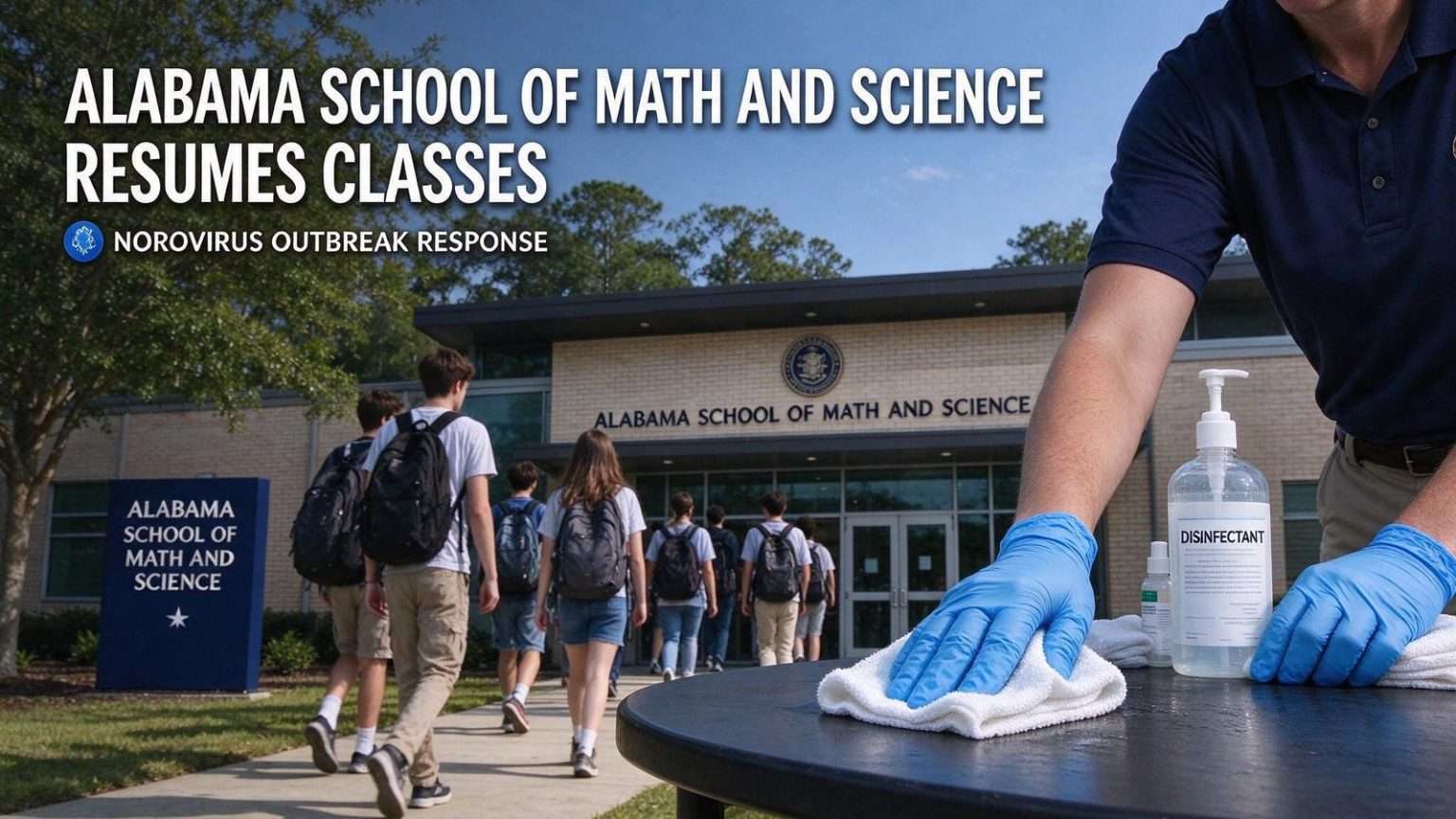
Classes have resumed at the Alabama School of Math and Science following a norovirus outbreak that sickened more than 30 students and forced the residential campus to shut down for more than a week. The episode was one of the more disruptive illness outbreaks to hit a Gulf Coast school in recent memory, made especially challenging by the school’s unusual structure: unlike a traditional high school, ASMS houses nearly all of its students on campus, meaning a contagious stomach bug can move through the population the way it does on a cruise ship.
School officials said the illness first appeared among students at the midtown Mobile campus in mid-August, right as the new school year was getting underway, and within a day was spreading quickly enough that administrators decided to send the school’s roughly 250 boarding students home rather than risk a wider outbreak. The decision emptied dormitories that normally operate at full occupancy and turned the start of the semester into a crash course in outbreak management for administrators, staff and parents alike.
Testing conducted with the Mobile County Health Department confirmed the cause as norovirus, sometimes known as the Norwalk virus, a highly contagious gastrointestinal illness that has periodically caused outbreaks aboard cruise ships and in other close living quarters. The virus spreads through contaminated food, water and surfaces, and through direct contact with infected individuals — and it takes only a tiny number of viral particles to infect someone, which is why it moves so fast through dormitories, cafeterias and shared bathrooms.
“It spread like wildfire”
ASMS President Monica Motley said the school initially hoped to reopen after about a week, but the return date was pushed back several days after additional students reported symptoms once they were already home. “It spread like wildfire,” Motley said, adding that she did not want to reopen the school prematurely and risk another wave of illness. The delay meant students spent longer away from campus than anyone planned, but it also meant the school was not reopening into an active chain of infection.
The nature of the school made the shutdown logistically complicated. ASMS draws students from across the state of Alabama, so sending them home — and bringing them back — meant coordinating transportation for hundreds of families spread across dozens of counties. During the shutdown, the school arranged free charter bus transportation to get students home and back to campus once it reopened, removing a cost burden that could have kept some students stranded in Mobile or at home.
While the students were away, the campus itself got a thorough scrubbing. Two cleaning companies were brought in to sanitize dormitories and common areas, including bagging laundry, wiping down mattresses and disinfecting surfaces throughout the buildings. Students were given sanitization supplies upon their return, an attempt to keep hygiene practices front and center as the community reassembled.
Hunting the source
Health department investigators initially focused on the school’s cafeteria as a possible source of the outbreak but ultimately ruled it out. That outcome is common in norovirus investigations, where the original source is frequently never pinpointed. Motley said no definitive origin point has been identified, though officials suspect the virus may have entered the community through a single infected person shortly after students arrived for the new school year.
That scenario — one asymptomatic or early-symptomatic carrier introducing the virus into a population that has just gathered from across the state — mirrors how norovirus outbreaks typically begin in dormitories, military barracks and cruise ships. Students converging on a campus from different communities carry different exposures with them, and the first weeks of a residential term are exactly when such introductions happen.
In total, about 33 students were affected and no staff members became ill, she said. The absence of staff cases, in a building where employees interact with students throughout the day, suggested the containment measures — early dismissal, isolation of sick students before they left, and aggressive cleaning — prevented the outbreak from reaching the adults who run the school.
A school built for close quarters
The Alabama School of Math and Science is a public residential high school in midtown Mobile that serves gifted tenth- through twelfth-graders from across the state, many of whom live on campus during the school year because their home districts are hours away. Students eat together, study together, sleep in shared dormitories and see each other in the same classrooms every day — precisely the environment in which a virus like norovirus does its best work.
Motley credited staff and parents with responding quickly to isolate sick students and prevent the outbreak from becoming worse. The first days of any such outbreak are the most consequential: recognizing that a stomach illness is more than routine, notifying the health department, and making the call to empty the campus before the virus runs its course through every hallway. In this case, officials said, the decision to send students home came within a day of the illness spreading quickly, a timeline that likely kept the final case count lower than it might otherwise have been.
Norovirus outbreaks typically resolve within a few days for each individual — the illness causes vomiting, diarrhea and stomach cramps that are miserable but generally pass without lasting harm — but the virus’s environmental persistence is what makes it so disruptive in institutions. It can survive on surfaces for days or weeks, resist many common disinfectants, and reinfect people who touch a contaminated doorknob or shared surface and then their mouth. That resilience is why the school’s response emphasized deep cleaning of dormitories and common areas rather than simply waiting out the illness.
The return to campus
With students screened, buses scheduled and campus disinfected, classes resumed more than a week after the first students fell ill. The school’s academic calendar absorbed the disruption, and administrators turned their attention to making sure the reopened campus stayed healthy — sanitization supplies distributed at the door, heightened cleaning routines and continued communication with the Mobile County Health Department.
The episode also served as a broader reminder for schools and institutions across the Gulf Coast. Norovirus appears reliably every year in settings where people live and eat in close quarters — schools, day care centers, nursing homes and, famously, cruise ships sailing out of Gulf ports. Health officials advise that the most effective defense remains the unglamorous one: frequent, thorough hand-washing with soap and water, staying home while symptomatic and for a couple of days after symptoms stop, and immediate cleaning of contaminated surfaces with appropriate disinfectants.
For ASMS families, the outbreak made for an unusual start to the school year — students sent home on chartered buses within days of moving in, a week and a half of uncertainty, and a return to a scrubbed campus stocked with sanitizer. But the school’s leadership framed the outcome as proof that its emergency response worked: an outbreak that could have swept through 250 students in close quarters instead sickened a fraction of them, left staff untouched, and ended with classes back in session and the semester still ahead of them.
What norovirus investigations look like
When the Mobile County Health Department’s epidemiology team joined the investigation, the work followed a familiar playbook. Investigators interviewed sick students about what they ate and where they had been in the days before falling ill, mapped the timing of symptoms to see how the infection moved through dormitories, and sampled to confirm the pathogen. Food service operations are always the first suspect in a closed-population outbreak, since a single contaminated dish can sicken dozens in one meal — which is why the cafeteria came under scrutiny early, and why ruling it out mattered so much to the school’s reopening plans.
With the cafeteria cleared and no definitive origin identified, the working theory settled on person-to-person introduction — a single infected individual arriving with the student body at the start of the year. It is the least preventable scenario, since a person carrying the virus may not yet show symptoms, but it is also the scenario that containment measures address best: identify the sick quickly, isolate them, and interrupt the surface-to-hand-to-mouth chain that norovirus depends on.
The costs of a campus closure
Closing a residential school is far more disruptive than canceling a day of classes. Dormitories are students’ homes for much of the year, and an abrupt departure mid-semester touches everything from meals to medications to instructional schedules. The school’s free charter bus arrangement addressed the largest burden — getting roughly 250 students across the state and back — but families still scrambled to rearrange work schedules and childcare around an unplanned extension of summer.
Institutional outbreaks also carry reputational weight. Schools and universities that handle them transparently — prompt notification of parents, regular updates, visible cooperation with health authorities — generally emerge with their credibility intact. ASMS’s communication of the confirmed norovirus diagnosis, the revised reopening timeline and the cleaning measures gave families a factual picture of what was happening inside the campus gates.
Administrators say the episode is now a case study the school will carry forward. The lessons are the ones public health officials preach every season: hand hygiene, early reporting of symptoms, prepared cleaning protocols and clear communication. None of it could stop the first infected student from arriving, but together those measures decided how far the virus got — and in a dormitory community of 250, containing an outbreak to 33 cases with no staff illnesses counts as a successful defense.