Grayson Capps Reflects on Record Store Day and a Decade of ‘If You Knew My Mind’
Singer-songwriter Grayson Capps visited Fairhope's Dr. Music for Record Store Day, marking a decade since his debut album If You Knew My Mind.
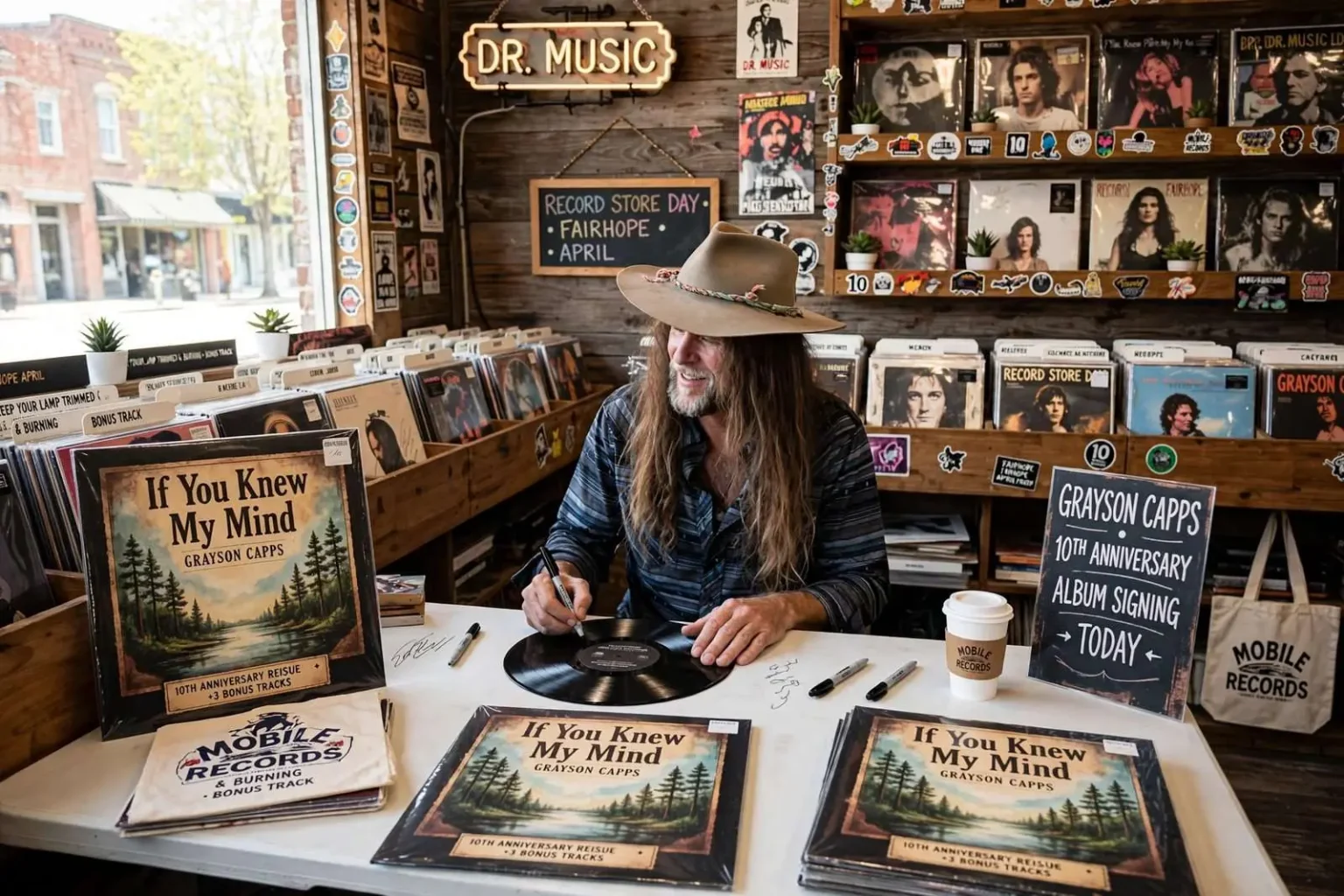
Record Store Day brought audiophiles out to Mobile-area shops this spring, with limited-edition vinyl drawing crowds to stores such as Mobile Records and Dr. Music in Fairhope. Among the musicians meeting fans was Grayson Capps, who appeared at Dr. Music to sign copies of the tenth-anniversary rerelease of his debut album, If You Knew My Mind. The annual event, observed at independent record stores across the country, has become one of the busiest shopping days of the year for the vinyl trade, with special pressings, in-store performances and artist appearances pulling collectors out of their homes and back into the racks.
The reissue adds three bonus tracks not found on the original pressing, including Capps’ take on “Keep Your Lamp Trimmed and Burning.” The song, he said, was one of the first he learned to play slide guitar on, and holds personal meaning. “Keep Your Lamp Trimmed and Burning was one of the first songs I learned to play slide on. I love Mississippi Fred McDowell and that song. I probably first heard John Mooney play it when I lived in New Orleans, and it has stuck with me ever since,” Capps said. The tune, a blues standard associated with the Mississippi hill country tradition, ties the reissue back to the musical lineage that shaped Capps as a player.
Local acts including The Volks and Black Titan performed at Mobile Records during the day’s events, giving shoppers live music on both sides of the bay. Both Capps and Black Titan are alumni of the SouthSounds Festival, the regional music showcase that has helped spotlight Lower Alabama talent. The festival, centered on downtown Mobile, has built a reputation as a launching pad for area bands, and the sight of two of its alumni headlining separate record store stages on the same afternoon said something about the depth of the local scene.
Drawing From Lower Alabama and New Orleans
Capps said the distinct culture of the Southeast shapes his writing, though he does not set out to emphasize those qualities deliberately. He described his inspiration as rooted in the place he knows best. “I draw my inspiration mostly from LA (Lower Alabama) and New Orleans, LA, because it is what I know, and it’s what moves me,” Capps said. The two regions, separated by a couple of hours of Gulf Coast highway, have supplied the characters, landscapes and moods that run through his songwriting, from the piney woods and bayous of Baldwin County to the bars and backstreets of the Crescent City.
Capps’ own path runs through both places. He spent years in New Orleans as a working musician before settling on the Alabama side of the bay, and the gravitational pull between the two shows up in a catalog that blends blues, folk, rock and country storytelling. His move to Lower Alabama placed him in the middle of the Eastern Shore’s creative community, where Fairhope’s long tradition as an artists’ colony provided a natural home. The town on Mobile Bay has drawn writers and painters for more than a century, and its small commercial district, where Dr. Music sits, has remained stubbornly friendly to independent businesses.
A decade after the album first appeared, Capps said he would not change a thing about it. “I would not change a thing. I continue to consider IYKMM to be one of my finest, most cohesive pieces of work to this day,” he said. Few debut albums earn that kind of retrospective endorsement from the artist who made them, and the tenth-anniversary rerelease gives listeners who missed the original pressing a chance to hear the record as it stands, plus the bonus material that rounds out the session.
The album’s durability mirrors the broader revival of vinyl as a format. Records that once seemed destined for the bargain bin are being reissued, celebrated and collected by a generation of listeners who never stopped valuing the physical artifact — the sleeve, the liner notes, the act of dropping a needle. Record Store Day channels that enthusiasm directly to the independent shops that anchor it.
Why Record Stores Still Matter
Capps also spoke to the value of Record Store Day for independent shops and the artists who rely on them, urging listeners to support local record stores so they stay open. “We need to support our local record stores as much as possible to keep them open,” Capps said. For working musicians, the independent store is more than a retail outlet. It is a place to sell albums on consignment, to post a show flyer, to meet the fans who buy tickets, and to find the audience for the next record. When a store closes, an entire neighborhood of musical connection goes with it.
The economics behind that appeal are straightforward. Independent stores compete against streaming services and big-box retailers on price, but they offer what neither can: browsing crates staffed by people who know the music, in-store performances, and a direct line between local artists and local listeners. Events like Record Store Day concentrate that value into a single afternoon, and shops such as Mobile Records and Dr. Music use the occasion to remind the community what would be lost without them.
The day also gave the Mobile area a rare double bill of homegrown music, with The Volks and Black Titan playing one stage while Capps signed records across the bay in Fairhope. For the shops, the combination of exclusive vinyl, live sets and artist appearances turned a Saturday into a destination event, the kind of foot traffic that carries into the following weeks. For the musicians, it was a chance to be present for the physical exchange their work depends on — signing a copy, shaking a hand, talking about the songs.
For Capps, the afternoon closed a circle that began ten years earlier with the release of If You Knew My Mind. The record that introduced him as a solo artist is now a reissued anniversary edition, sitting in the same racks that hold the Fred McDowell records he learned from, in a store a short drive from the Baldwin County home where much of his writing takes shape. Lower Alabama and New Orleans, LA — the two landscapes he calls his inspiration — met in the grooves, and on this Record Store Day, in the middle of a crowd flipping through vinyl, they met again in person.
The blues lineage behind the bonus track runs deep. “Keep Your Lamp Trimmed and Burning” is a gospel-blues standard passed down through the Mississippi hill country, and McDowell’s rendition is among the most celebrated. Mooney, a New Orleans guitarist who absorbed McDowell’s slide style directly, carried the song into the bars and clubs of the Crescent City, where a young Capps heard it and filed it away. That a decade-old debut would carry a McDowell song as bonus material says a great deal about the foundations beneath Capps’ own writing, which leans on the same raw, unpolished blues DNA.
The connection between the record stores and the regional festival circuit is closer than it might appear. SouthSounds has historically spread its stages across downtown Mobile venues, and the festival’s emphasis on Gulf Coast acts gives bands like The Volks and Black Titan an annual audience they would otherwise spend years building one gig at a time. Record Store Day functions as a smaller, year-round cousin of the same idea — a single day when the community is invited to show up for its own musicians. Capps’ appearance at Dr. Music and the Mobile Records performances put the two worlds side by side.
Fairhope itself added to the day’s appeal. The Eastern Shore town has cultivated an identity as a haven for independent businesses, artists and writers since its founding more than a century ago, and its walkable downtown draws visitors from Mobile and across Baldwin County on weekends. A signing at Dr. Music pulls music fans who might never cross the bay for a bar show, and it puts Capps in front of an audience that knows him as a local figure as much as a touring act. Mobile Records, across the water in the city proper, offered the same atmosphere in a different setting.
The tenth-anniversary format has become a familiar ritual in the reissue economy, and it works because debuts occupy a singular place in an artist’s story. If You Knew My Mind arrived before audiences knew what to expect from Capps as a solo writer, and the record answered the question in full. A decade of touring, additional albums and a permanent home in Lower Alabama later, the songs have aged into what the artist himself considers a cohesive whole — and on Record Store Day, the people who kept the record alive got to tell him so, one signed copy at a time.