
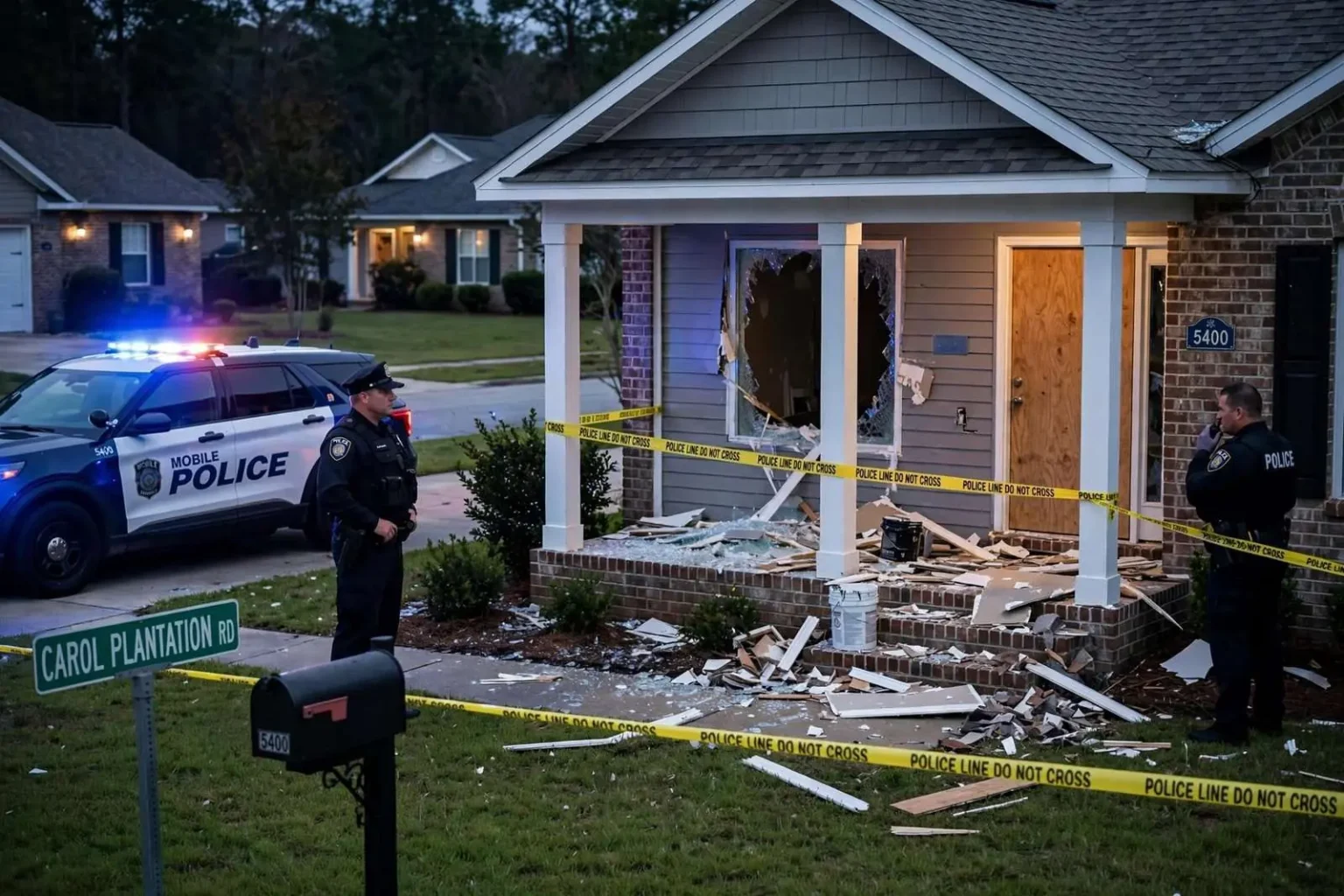
Four people have been arrested in connection with the vandalism of a recently remodeled home in the 5400 block of Carol Plantation Road in Mobile, according to the Mobile Police Department.
Officers responded to the home just before 9 p.m. Tuesday, Aug. 11, after a report of a burglary. When they arrived, the homeowner told police the remodeled house had been vandalized by unknown people. The call brought officers to a residential stretch of Carol Plantation Road in west Mobile, an area of established neighborhoods that runs between the Moffett Road and Airport Boulevard corridors north of Cottage Hill Road.
Investigators worked the scene and were able to identify and detain suspects at the location. The arrests came the same night as the initial report, a timeline that reflects both the responsiveness of the officers first on scene and the work of the investigators who processed the vandalism before the evening was out.
Four people were arrested and booked into Mobile County Metro Jail: Alexis Smith, 27, of Prichard, charged with first-degree criminal mischief; Shyloh Rafsanjani, 26, of Theodore, charged with third-degree burglary; Tracy Adcock, 38, of Irvington, charged with third-degree burglary; and Mikel Holladay, 24, whose address was not listed, charged with third-degree burglary and use or possession of drug paraphernalia.
The defendants come from communities spread across Mobile County — Prichard to the north, Theodore and Irvington to the south — rather than from the neighborhood where the home sits. All four were booked at Metro Jail, the county’s primary intake facility, where arrestees are held pending an initial appearance before a judge.
Mobile police have not released additional information about a possible motive or the extent of damage to the home. The department also has not said whether the suspects knew the homeowner or how the group came to be at the residence, questions that typically become clearer as the case moves through the court system and evidence is tested at preliminary hearings.
All four remained in custody at Metro Jail following their arrests and are presumed innocent unless and until proven guilty in court. That presumption is the starting point of every criminal case in Alabama, and charges at this stage are accusations, not findings — the state must still prove each element of each offense beyond a reasonable doubt.
The Charges and What They Require
The mix of charges in the case maps onto two separate sections of Alabama’s criminal code. First-degree criminal mischief applies when a person intentionally damages property and the loss is $2,500 or more — a threshold that, if proven, matches the scale of damage to a house that had recently undergone a full remodel.
Criminal mischief charges are graded by dollar amount in Alabama: the first-degree felony applies to damage of $2,500 or greater, a second-degree misdemeanor covers damage above $500, and the third-degree offense covers lesser amounts. A first-degree conviction can bring a prison sentence measured in years, which is why prosecutors treat major vandalism cases — spray paint, broken fixtures, destroyed interior work — as more than a nuisance matter.
Third-degree burglary, the charge against three of the four defendants, is a felony that applies when a person knowingly enters or remains unlawfully in a building with the intent to commit a crime inside. Prosecutors do not have to prove that anything was stolen; unlawful entry combined with criminal intent is enough, which is how a vandalized house can generate burglary charges even when the alleged object was destruction rather than theft.
The paraphernalia charge against the fourth defendant is a misdemeanor, but it matters in practice: a conviction carries potential jail time and fines, and it signals that officers found drug-related items during the encounter that night. Charges of this kind are often resolved alongside the more serious counts as a case works its way through plea negotiations or trial.
What Happens Next in Court
For each defendant, the path runs through Mobile County’s district court first. Arrestees appear before a district judge for an initial appearance, where bail is set and the charges are read. In felony cases, a preliminary hearing follows, at which the state must show probable cause before the case is sent to a grand jury for indictment.
If indictments are returned, the cases move to Mobile County Circuit Court, where felony matters are tried before a judge or jury. The Mobile County District Attorney’s Office will make charging decisions along the way, and defendants may negotiate plea agreements, have charges dismissed for lack of evidence, or proceed to trial. The timeline from arrest to disposition in a felony case in Alabama commonly runs many months.
Each defendant will also answer for the conditions of release set at the initial appearance. Remaining in custody at Metro Jail means a judge found bail conditions — or statutory holds — that kept the arrestees confined while the case proceeds, an outcome that hinges on the severity of the charges, any criminal history and the circumstances of the arrest.
About the Mobile Police Department
The Mobile Police Department is the law enforcement agency responsible for policing Alabama’s third-largest city. MPD investigates crimes ranging from property offenses to violent felonies, and it routinely asks members of the public to share tips that may aid an investigation.
The department operates through precincts and specialized units — including property crime investigators who handle burglary and vandalism cases like this one — and its patrol officers are typically the first to document a scene, gather witness accounts and identify suspects before passing cases to detectives. The department works alongside the Mobile County District Attorney’s Office, which prosecutes state criminal cases, and with state and federal agencies on matters that cross jurisdictional lines.
Residents can report non-emergency information through the department’s tip line and through national crime-reporting programs. Anonymous tips — including those made through regional crime stoppers channels, which can carry cash rewards for information leading to arrests — are a recurring part of how property crime cases are closed in Mobile County, particularly when witnesses are reluctant to come forward.
For homeowners, the case is a reminder that property crimes against residences — especially homes that appear vacant, under construction or newly remodeled — are among the most common calls for service in growing suburban corridors. Police departments across the region advise residents to report suspicious activity around unoccupied homes immediately, since early calls give responding officers the best chance of detaining suspects, as happened on Carol Plantation Road the night of Aug. 11.
About Alabama’s Courts
Alabama’s judicial system includes trial courts, the Court of Civil Appeals and Court of Criminal Appeals, the state Supreme Court, and a network of district and circuit courts that handle the bulk of the state’s criminal and civil business at the local level.
Mobile County’s own bench is among the busiest in the state. Its district courts handle misdemeanors, preliminary hearings and felony first appearances, while circuit courts take up indicted felonies, major civil suits and appeals from the district level. The county’s judicial system also includes specialty docks and programs aimed at easing caseload pressure, but felony vandalism and burglary prosecutions generally follow the standard track from booking through grand jury to trial.
The Court of Criminal Appeals, sitting in Montgomery, reviews criminal convictions from the circuit courts — the venue where any appeal in this case would eventually land if a defendant is convicted and chooses to challenge the outcome. Appeals on issues ranging from the sufficiency of the evidence to the admissibility of a search can add years to a case, which is why the presumption-of-innocence timeline stretches well beyond an arrest.
Property Crime in Growing Corridors
Carol Plantation Road sits in a part of west Mobile that has filled in steadily over the past several decades, as the city’s growth pushed west and south along the Airport Boulevard and Cottage Hill Road corridors. Homes there range from decades-old brick ranch houses to newer construction, and turnover and renovation are common — a dynamic that creates both the remodel work visible at the center of this case and the opportunities that sometimes attract vandalism to properties in transition.
Police departments nationally report that residential burglary and vandalism investigations turn heavily on early evidence: witness recollections, surveillance footage from doorbell and security cameras, and physical evidence from the scene. The proliferation of home security cameras across Mobile County neighborhoods in recent years has changed how these cases develop, giving investigators a starting point that did not exist a generation ago.
Community involvement remains the other pillar of closure in property crime cases. Neighborhood watch groups remain active across west Mobile, and police credit resident reports — of unfamiliar vehicles, of people lingering around vacant homes — with interrupting many property crimes before they are completed. A report called in promptly, as the one from Carol Plantation Road was, gives dispatchers and patrol officers their only real chance to catch suspects nearby.
The four arrests in this case arrived within hours of the initial call, which is far from typical in vandalism cases, where suspects are often identified days or weeks later through tips and video evidence. The speed of the response reflects a scene that officers reached while those responsible were still present — the best-case scenario for a property crime investigation, and one that leaves prosecutors with the strongest possible set of facts to work from.
As the case proceeds, outcomes will turn on what the evidence gathered that night supports. The charges are accusations for now, the defendants remain entitled to the full protections of the court system, and the facts that emerge in court — about motive, about the extent of the damage, about how the night unfolded — will determine where each of the four cases ends.


