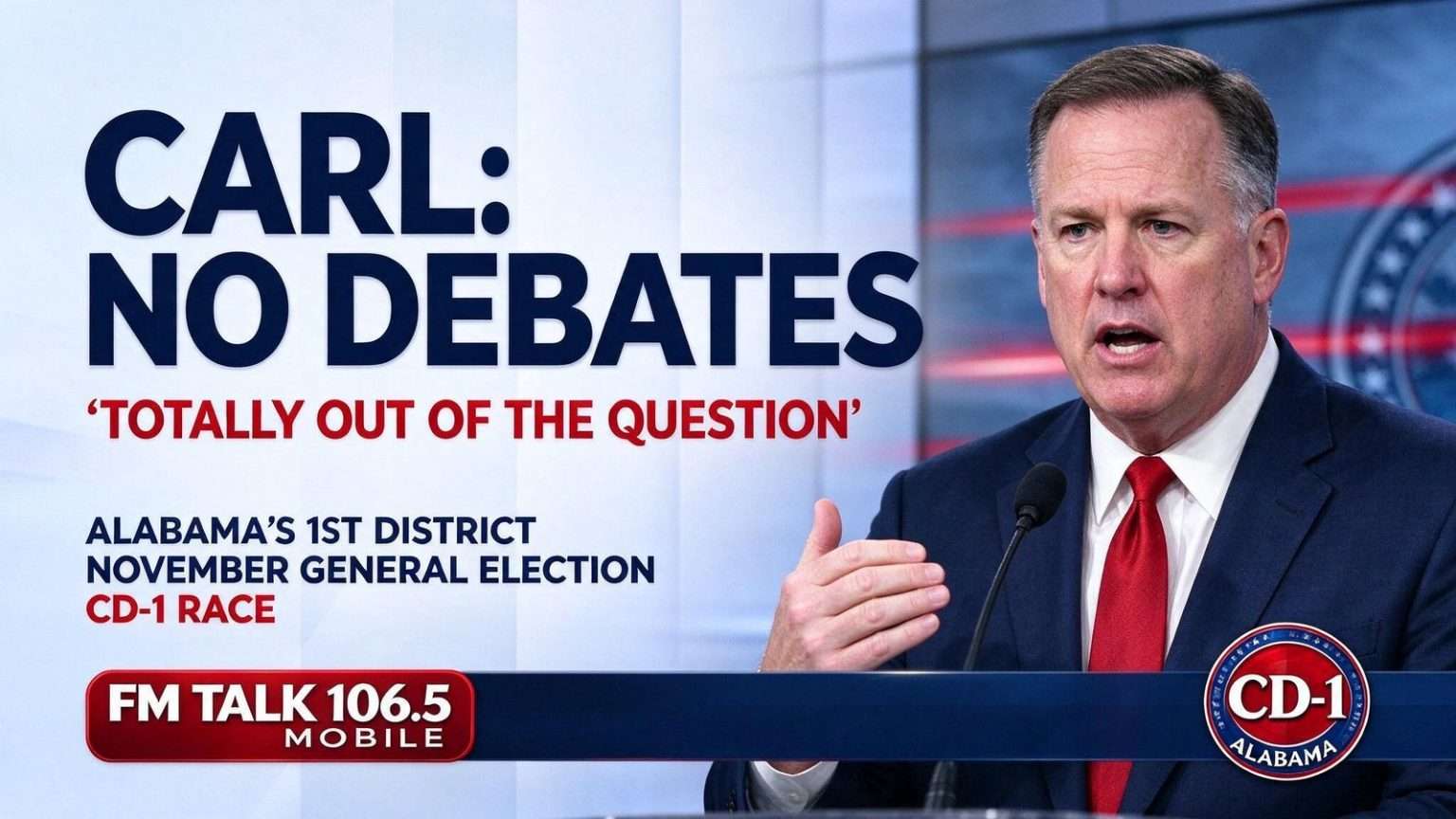
Republican CD-1 nominee and former U.S. Rep. Jerry Carl reiterated that he will not take part in any debates ahead of November’s general election for Alabama’s 1st Congressional District, doubling down on a position he had already staked out with a refusal directed at Democratic nominee Clyde Jones. The announcement came during an appearance on Mobile radio station FM Talk 106.5’s “The Jeff Poor Show,” where Carl laid out his reasoning in blunt terms.
“I’m not going to spend $1,300,000 to get my name ID for a no-name to get on my back and ride,” Carl said. “I have no intentions of doing a debate. If you look, there are so many races that the Democrats are so weak in, and that’s the first thing they’re screaming. He’s reading straight from the Democrat playbook, and you know he can sit and call me names all he wants to. That’s fine. I’m fixing. It’s not my first rodeo, but a debate is totally out of the question.”
Carl added that he sees no reason to elevate his opponent’s profile. “I have no intention of giving him free airtime based on my efforts that I’ve spent the last 15 years developing,” he said, referring to the name recognition and political relationships he built across the district during his years in public life.
The Political Math Behind the Refusal
Debate refusals from front-running candidates are a familiar feature of safe-district politics, and Carl’s explanation followed the standard logic: a candidate who enters a general election with a substantial financial and name-recognition advantage gains little from sharing a stage, while an underfunded challenger has everything to gain from the exposure. A single televised or radio debate would give Jones a platform before an audience Carl would otherwise never share, and the incumbent argued that his campaign’s significant investment — the $1.3 million figure he cited — was built to win the seat, not to promote his opposition.
Carl earned the endorsements of President Donald Trump, U.S. Sen. Katie Britt, House Speaker Mike Johnson and House Judiciary Committee Chairman Jim Jordan during his August Republican primary victory, a slate of backing that reflected both his establishment standing and his alignment with the party’s national leadership. Those endorsements, combined with the district’s strong Republican tilt, made him the heavy favorite heading into the fall campaign.
A District That Favors Republicans
Alabama’s 1st Congressional District covers the state’s entire Gulf Coast region, including Mobile, Baldwin County and the Florida border counties, and it has been held by Republicans for decades. The seat’s voter registration leans heavily Republican, and Democratic nominees have struggled to approach competitiveness in recent cycles. That structural advantage is central to Carl’s calculation — in a district where the general election outcome is rarely in doubt, a debate offers the challenger the kind of attention that the campaign dynamics would not otherwise provide.
Carl is a Mobile native whose political identity was built over 15 years in local public life before his service in Congress. He previously served as a Mobile County commissioner, where he oversaw road projects, infrastructure funding and county administration — experience he frequently cites when discussing his familiarity with the district’s needs.
The Road to November
Carl faces Democrat Clyde Jones in the Nov. 3 general election, and with debates ruled out, the campaigns’ remaining avenues to reach voters will be advertising, retail politicking and the district’s traditional fall campaign calendar. For his part, Jones has called for public debates as a chance to present his case directly to voters, a request Carl dismissed in the radio interview as a predictable ask from a campaign that needs the visibility more than his own.
Whether the refusal becomes an issue in the race itself remains to be seen. Challengers typically criticize debate avoidance as evidence of an incumbent dodging accountability, while front-runners argue that voters already know them and that debates in safe districts change nothing about the outcome. In Alabama’s 1st District, where the Republican nominee has not faced a genuinely competitive general election in years, Carl is betting that voters will judge him on his record rather than on his absence from a debate stage — and, given the district’s makeup, the wager is one he enters as a clear favorite.
The radio interview on FM Talk 106.5 is itself a familiar venue for Gulf Coast politics. “The Jeff Poor Show” is a staple of Mobile’s political talk scene, regularly hosting state and local officeholders and candidates, and appearances there reach the engaged Republican primary electorate that dominates the district’s politics. For Carl, using the platform to shut down debate speculation serves a double purpose: it removes a recurring question from his own press availability and signals to supporters that his campaign strategy is set heading into the fall.
Carl’s references to his “last 15 years” of effort speak to the arc of his career in Mobile County government, where he served multiple terms as a county commissioner representing the area’s western communities. County commission work in Alabama involves road-building, budgeting and economic development, and Carl built his reputation on infrastructure projects and constituent service before making the jump to federal office. That local base, reinforced by the Trump endorsement in the primary, forms the core of the name identification he says a debate would only give away for free.
What a Debate Refusal Means in Practice
In practical terms, Carl’s decision means the 1st District race will not feature the head-to-head format that voters in competitive districts often use to compare candidates. Local media organizations typically host one or two general election debates or forums each cycle, and invitations to those events will presumably go unanswered or declined by the Republican nominee. Jones, for his part, can still appear alone at civic forums, church gatherings and candidate nights across Mobile and Baldwin counties, though the audience for such events without an opponent present is limited.
The dynamic also shapes media coverage. Without debates, coverage of the race leans on advertising, endorsements and campaign events rather than on direct exchanges over policy. In a district where the outcome is widely expected to favor the Republican nominee, that suits Carl’s approach: limit the race’s newsworthiness, run out the clock, and ride the district’s partisan lean to a second term.
Looking Toward November
The Nov. 3 general election will decide the seat, and Carl enters the fall campaign with the advantages that matter most in Alabama’s 1st District: incumbency or near-incumbent name recognition, a financial edge, national endorsements and a voter base that has consistently elected Republicans to the seat. Jones’s campaign will continue pressing for debates and public appearances, arguing that voters deserve to hear both candidates, while Carl’s campaign proceeds on the assumption that its resources are better spent on direct voter contact than on shared stages.
History suggests the strategy is low-risk. Candidates in safe districts routinely skip general election debates without consequence, and the practice has become common enough that voters in such districts rarely treat a refusal as a scandal. The controversy, if any, will come from the challenger’s side, which has every incentive to keep the subject alive. For now, Carl’s position is unambiguous: no debates, no shared stages, and a campaign that will spend its million-dollar war chest reaching voters on its own terms between now and November.
The endorsements Carl collected during the August primary illustrate the coalition he assembled on his way to the nomination. President Donald Trump’s backing carried particular weight in a district where the former president remains broadly popular, and the support of U.S. Sen. Katie Britt tied him to the state’s newest statewide leadership. House Speaker Mike Johnson and House Judiciary Committee Chairman Jim Jordan rounded out a list that spans the GOP’s institutional and conservative wings, giving Carl credibility both with party regulars and with the activists who dominated the primary electorate.
That primary victory is also the context for his spending figure. campaigns in the 1st District’s August contest spent heavily on advertising across the Mobile and Pensacola media markets, which overlap much of the district, and Carl’s reference to $1.3 million reflects the scale of investment required to build and hold name identification in a media market that stretches across state lines. From his perspective, that investment is an asset to be defended rather than a platform to be shared — which is the essence of his objection to debating a opponent he describes as a “no-name” seeking a free ride on his visibility.
Jones’s Case for Debates
From the Democratic side, Clyde Jones’s request for debates follows the challenger’s playbook in any lopsided district: use free media and public forums to bypass the advertising gap and speak directly to voters. Debates give an underfunded candidate the one setting where money matters least and where a strong performance can generate earned media coverage across the district’s newspapers, television stations and social feeds. Jones has argued that residents of the 1st District deserve to hear both candidates address the issues facing the Gulf Coast, from coastal insurance costs to infrastructure and economic development, regardless of what the polling says about the likely outcome.
Carl’s answer to that argument is essentially a wager on voter familiarity. Having served in Congress and spent years before that in Mobile County government, he argues that the district already knows him and his record, and that a debate would not inform voters but only elevate an opponent they would otherwise rarely see. It is a calculation that front-runners have made in this district before, and one that challengers have consistently criticized without success.
The District’s Political Geography
Understanding the race requires understanding the 1st District itself. Covering the southern tier of Alabama — Mobile and Baldwin counties along the coast, plus Washington, Monroe, Clarke, Conecuh, Escambia and Butler counties to the east and north — the district is anchored by the Mobile metropolitan area and the Baldwin County boom towns, and its economy runs on the Port of Mobile, shipbuilding at the Austal and Bollinger yards, aerospace, agriculture and the tourism industry along the Gulf beaches. Registration in the district favors Republicans by margins that have made general elections little more than a formality for the seat in recent cycles.
Against that backdrop, Carl’s debate refusal is less an anomaly than a reflection of the district’s political reality. The contested election in the 1st District is the Republican primary, and having won that contest with national backing, the nominee’s general election strategy is conventionally cautious: protect the lead, avoid unforced errors, and spend resources on turnout rather than on persuasion.
The Nov. 3 election will test whether that approach holds, but the fundamentals point in Carl’s favor. With debates off the table, the campaign’s remaining weeks will be fought through advertising and ground game, and voters will hear far more from the Republican nominee’s ads than from any stage shared with his Democratic opponent. Carl, for one, made clear on the radio that this is exactly as he intends it — a race run on his terms, ending in what he expects will be another term representing South Alabama in Washington.