
Anti-toll group urges members to attend Wednesday MPO meetings on Bayway project
Anti-toll activists are urging supporters to attend Wednesday's Mobile and Eastern Shore MPO meetings as debate over the Bayway bridge project continues.
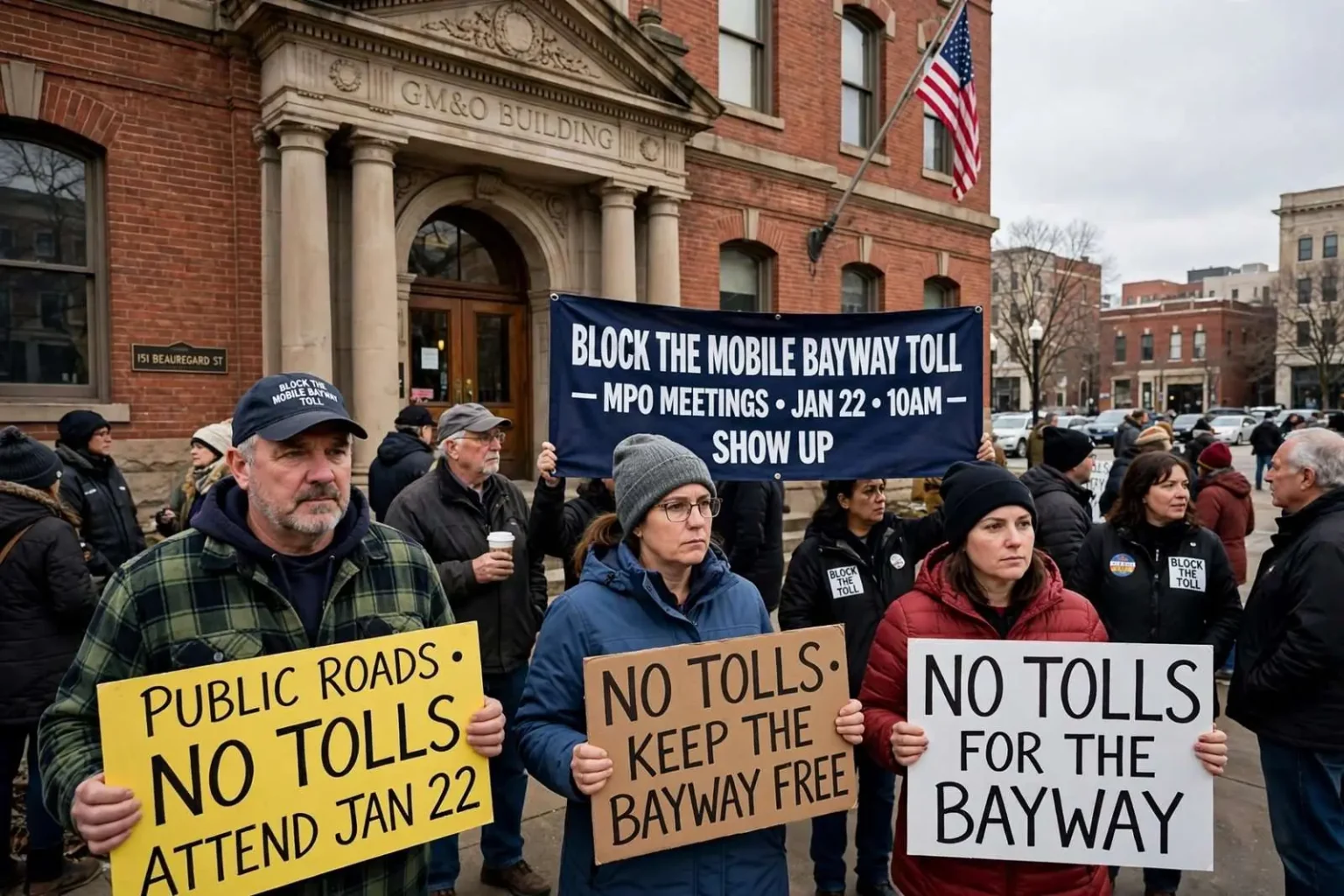
MOBILE, Ala. — Toll opponents are asking their supporters to show up Wednesday to remind leaders on both sides of the bay that they remain ready to fight tolls on any new road project. The mobilization comes as both the Mobile and Eastern Shore metropolitan planning organizations prepare to meet, and as word circulates of a preliminary proposal for a non-tolled alternative to the defunct Mobile River Bridge and Bayway plan. For a movement that has already reshaped transportation politics on the Gulf Coast, the meetings represent the next round in a fight that shows no sign of cooling.
The Eastern Shore Metropolitan Planning Organization effectively killed the Mobile River Bridge and Bayway project last year after public opposition to a proposed toll. Now, both the Mobile and Eastern Shore MPOs are scheduled to meet on Jan. 22, and the Facebook group “Block the Mobile Bayway Toll” has asked its members to attend the meetings to remind officials they oppose any toll. The group says it wants to keep the pressure on as new proposals emerge — a pointed response to the possibility that the project could return in a different form.
How the Bayway Project Fell
The Mobile River Bridge and Bayway project, as envisioned by the Alabama Department of Transportation, would have added a new interstate bridge span across the Mobile River and rebuilt the Jubilee Parkway — the Bayway — along Mobile Bay. To fund the massive construction bill, planners proposed tolling both the new bridge and the rebuilt Bayway, a financing model that immediately ran into fierce resistance from daily commuters, Baldwin County residents and South Alabama drivers who cross the bay for work, school and medical care. Public meetings drew overflowing crowds, an opposition movement organized online, and elected officials found themselves confronting a transportation issue that dominated local politics.
The decisive moment came at the Eastern Shore MPO, whose membership includes Baldwin County’s municipal and county leaders. After months of public pressure, the organization voted against including the tolled project in its long-range transportation plan, a move that effectively removed the federal funding pathway for the project. Without MPO endorsement, the tolled version of the bridge and Bayway rebuild could not advance — a rare example of regional planning bodies halting a marquee state project outright, and one that opponents across the country have cited as a model for grassroots transportation fights.
What the MPOs Are and Why the Meetings Matter
Metropolitan planning organizations occupy a powerful but little-understood position in American transportation. Federal law requires that federal highway and transit dollars flow through MPO-endorsed plans, giving the boards — composed of mayors, county commissioners and transportation officials from each urbanized area — an effective veto over large projects. The Mobile MPO governs planning for Mobile County’s urbanized area, while the Eastern Shore MPO covers the Baldwin County communities along the bay’s eastern shore, including Daphne, Fairhope, Spanish Fort and Baldwin County government.
Because the Mobile River Bridge and Bayway project sits between the two organizations’ territories, both boards had to endorse it for it to proceed. That structure is exactly why the anti-toll group is urging members to attend both meetings on Jan. 22 rather than just one. A single favorable vote in either organization could reopen the door to a tolled project; sustained attendance keeps every board member aware that the opposition remains organized, attentive and ready to vote again in the next election.
Both meetings are set for 10 a.m. The Mobile MPO will meet at the GM&O Building on Beauregard Street, the historic railroad depot in downtown Mobile that now houses city agencies. The Eastern Shore MPO will meet at the Daphne City Council chambers at Daphne City Hall, putting the two sessions on opposite sides of Mobile Bay within the same morning. Opponents planning to attend both will cross the bay — the very crossing at the center of the dispute — to make their presence felt in each chamber.
A New Proposal Emerges
Last week, reports surfaced about a proposal from Eastern Shore MPO member and Daphne Mayor Dane Haygood for an alternative expressway project that may be discussed at Wednesday’s Eastern Shore MPO meeting. Haygood has said the idea is very preliminary but that they would like to pursue a project without a toll. The existence of the proposal — and its explicit non-toll framing — shows how thoroughly the anti-toll position has reshaped the regional conversation: a year after the tolled plan collapsed, any new proposal must start by promising not to charge drivers for the crossing.
Preliminary does not mean imminent. Transportation projects of this scale move through years of feasibility study, environmental review, funding identification and design before ground breaks, and an early concept floated by a single MPO member is a long way from a funded program. But for the opposition group, the proposal is precisely the kind of development it wants to monitor in person — both because a replacement project could reintroduce tolls in a future iteration, and because decisions about billions of dollars in regional infrastructure should not be made without the public watching.
The Group Behind the Pressure
The Facebook group “Block the Mobile Bayway Toll” has grown into the organizational center of the anti-toll movement, coordinating attendance at public meetings, sharing updates on MPO agendas and keeping members informed about statements from elected officials. The group’s request that members attend the Jan. 22 meetings follows the playbook that proved so effective during the original Bayway fight, when crowded public hearings signaled to officials that opposition extended well beyond a handful of vocal critics.
The group says it wants to keep the pressure on as new proposals emerge. That phrasing captures the strategic reality: the fight over the Bayway is no longer a single project battle but an ongoing effort to shape every future proposal for the I-10 crossing. By packing both MPO meetings, the group aims to establish a permanent principle — no tolls on any new road project — before planning discussions advance further.
The Bayway itself carries real significance for daily life on both sides of the bay. The Jubilee Parkway spans Mobile Bay along Interstate 10, linking Mobile’s eastern suburbs to Baldwin County’s fast-growing communities. Thousands of commuters make the crossing every day, and the drive between Mobile and the Eastern Shore is a routine part of life for families with jobs, schools and relatives spread across the two counties. Any change to how that crossing is paid for touches nearly every household in the region, which is why the toll debate generated such broad and durable participation.
Why Both Sides of the Bay Are Watching
Mobile officials have their own reasons to follow the process closely. The city’s business community has long argued that the region needs additional cross-bay capacity, citing congestion on the existing Bayway and the vulnerability of a single interstate route to accidents and weather closures. The Port of Mobile, one of the busiest on the Gulf of Mexico, depends on freight moving efficiently along I-10. The question that divided the region was never whether the crossing matters — it was whether drivers should pay a toll each time they use a rebuilt or expanded version of it.
That distinction explains the political geometry of the Jan. 22 meetings. Officials who opposed the toll have not necessarily opposed infrastructure investment; they have opposed the funding mechanism. Haygood’s preliminary expressway concept, described as toll-free, fits that distinction. Whether it can attract the hundreds of millions of dollars such a project would require, without toll revenue, remains the central unanswered question — and exactly the kind of question opponents intend to ask in person.
What Attending a Meeting Accomplishes
MPO meetings are public sessions, and attendance does more than fill chairs. Board members take note of who shows up, and a well-attended meeting changes the tone of every discussion that follows. During the height of the original Bayway fight, opposition speakers filled comment periods, and the visual of a packed room became part of the record on which the Eastern Shore MPO’s decisive vote rested. The Block the Mobile Bayway Toll group is asking members to recreate that dynamic at both venues on Wednesday morning.
For residents planning to attend, the logistics are simple: the Mobile MPO convenes at 10 a.m. at the GM&O Building on Beauregard Street in downtown Mobile, while the Eastern Shore MPO meets at the same hour in the Daphne City Council chambers at Daphne City Hall. Members who can attend only one session still serve the group’s purpose; members who attend both send the message that the opposition is coordinated across county lines.
The Road Ahead for the Crossing
The Jan. 22 meetings will not settle the question of how — or whether — the region builds its next cross-bay link. They will, however, establish the political conditions under which any future plan moves forward. The Eastern Shore MPO’s vote last year demonstrated that public pressure can stop a tolled project; Haygood’s preliminary concept suggests that future proposals will arrive pre-shaped by that pressure, promising toll-free construction before detailed planning even begins.
Toll opponents intend to keep it that way. By showing up Wednesday — at the GM&O Building in Mobile and the Daphne City Council chambers on the Eastern Shore — the “Block the Mobile Bayway Toll” group plans to remind the region’s transportation leaders that the coalition that killed the tolled Bayway remains assembled, watching and ready to fight tolls on any new road project. Both meetings begin at 10 a.m., and both are open to the public. For a region still deciding the future of its most important crossing, Wednesday’s sessions are where that future starts taking shape.


