Tim James Brings His Campaign for Governor to a Mobile Living Room
Republican candidate for governor Tim James was the beneficiary of an October 2009 reception in Mobile's Delwood neighborhood, with former U.S. Rep. Sonny Callahan among the special guests.
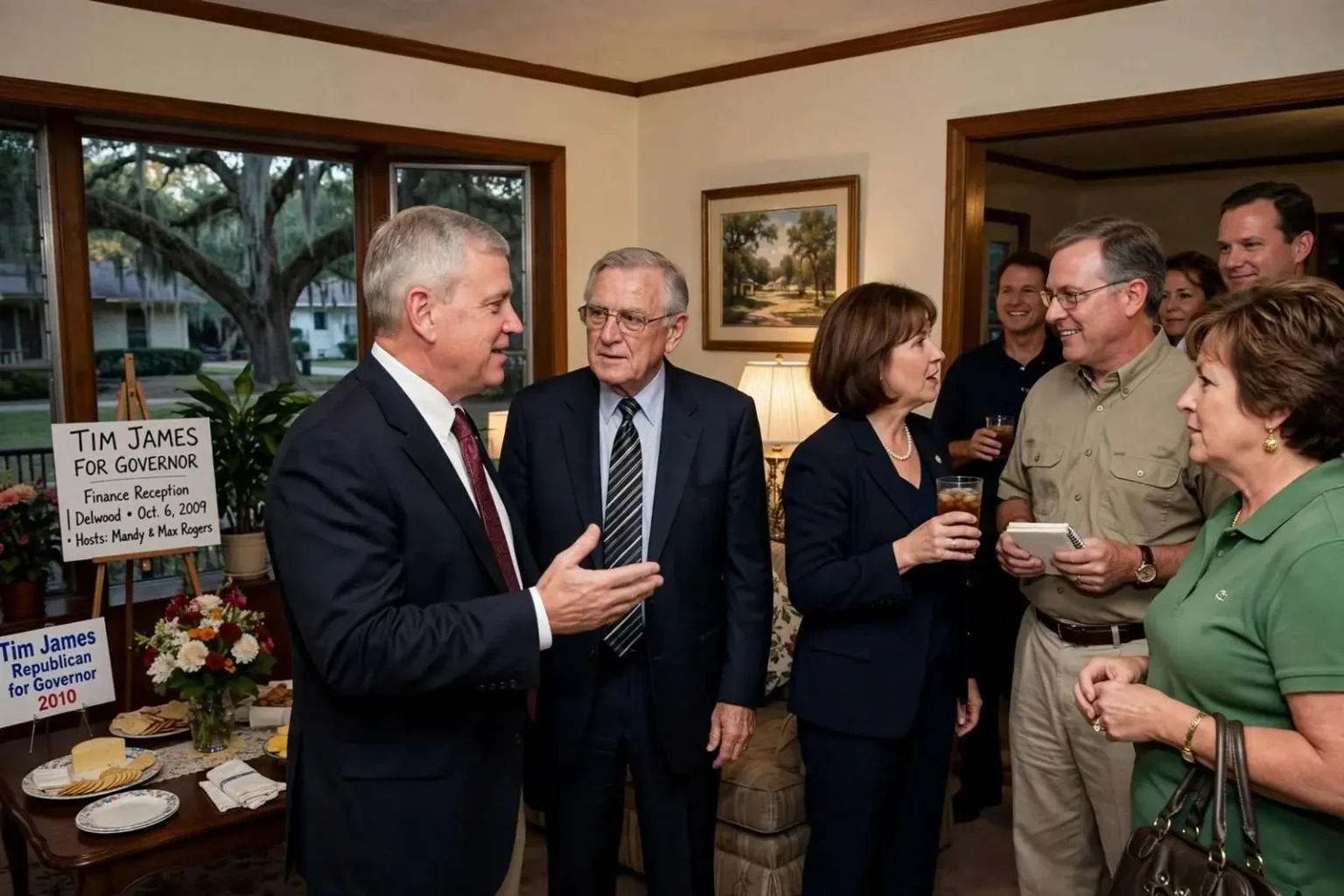
Republican gubernatorial candidate Tim James took his 2010 campaign into one of Mobile’s most established neighborhoods in early October 2009, with a fundraising reception at the Delwood home of Mandy and Max Rogers. The event, scheduled for 5:30 to 7:30 p.m. Tuesday, Oct. 6, listed former U.S. Rep. H.L. “Sonny” Callahan and his wife, Karen, among its special guests — a significant endorsement of presence, if not of formal words, from the man who represented Alabama’s 1st Congressional District for nearly two decades and who remained one of the most durable figures in Mobile Republican politics.
The living-room reception is a fixture of Alabama politics, and it is more than a courtesy. A candidate who cannot fill a supporter’s home with a hundred donors in October will not fill a general election in November, and the early fall season is when campaigns find out which names on their wish lists will actually write checks. Home receptions also do work that television cannot: they put a candidate in a position to be interrogated, face to face, by the state’s most attentive and most generous class of voters.
Callahan’s appearance carried its own weight. His congressional service made him a fixture of south Alabama’s Republican establishment, and his presence at a Tim James event — a man who had spent decades fielding requests from every ambitious politician in the district — told the room that this candidate had passed some unspoken test. Endorsements of presence cost the endorser nothing on paper, but in Mobile’s tight-knit Republican circles they are read closely and remembered.
Delwood itself set the tone. The neighborhood of mature oaks and mid-century homes has long been home base for Mobile’s professional Republican class, and hosting the event there placed James squarely in the social geography of the donors he needed. For an out-of-town candidate, the venue choice would have been a calculation; for a campaign courting Mobile’s establishment, it was a statement that the courtship was going well.
Three tiers, one long list
The invitation set out a familiar structure of giving. Members of the finance committee were listed at $1,000, the host committee at $500 and the sponsor committee at $250. The combined rosters ran to well over 100 names and touched most of the neighborhoods where Mobile’s Republican money has traditionally lived.
Among the finance committee names were state Sen. Rusty Glover; David Head Sr. and David Head Jr. and their families; Edward and Ann Leatherbury; Greg and Susie Leatherbury; Edward and Knox McMurphy; and Abby and Scott Stimpson. The host and sponsor lists carried names such as Larry Brock, Bill Harvey, John Ladd, Jimbo Mostellar, Joe Colingo, Chris Dyas, Hunter George and Jimbo Yance, along with dozens of others drawn from the city’s legal, medical and business communities.
The tiered invitation is a studied instrument. Listing donors by level publishes a pecking order that gently pulls the next tier of prospects upward — a supporter who gave $250 to a rival may give $1,000 to appear on the next invitation. The families and couples listed jointly reflect how Mobile’s giving works: through households and social networks rather than lone checkbooks, with the same names recurring across campaigns, boards and benefits for decades. A roster like this one is simultaneously a fundraising result and a display of force aimed at the other campaigns watching.
The names themselves mapped the city’s economy. Law firms and banks, physicians’ practices, contractors and commercial real estate — the industries that fund Alabama campaigns — were all represented, many of them by multiple members of the same firm or family. For the James campaign, published lists of that kind serve a second purpose beyond gratitude: they give wavering donors a visible bandwagon to join, and they put polite pressure on peers who have not yet chosen a side in the primary.
Who Tim James was
James entered the race with one of the most recognizable surnames in Alabama politics. His father, Fob James, served as governor twice — first as a Democrat, elected in 1978, and again as a Republican, elected in 1994 — and the family name carried both affection and baggage depending on the audience. The elder James’s two governorships had spanned a party switch and two political eras, and Alabamians of a certain age remembered both the father’s plainspoken style and the controversies that trailed his administrations.
The younger James campaigned as a businessman rather than a career politician. He was known along the Gulf Coast in particular for his role in developing the Foley Beach Express, the toll road that carries traffic from Baldwin County’s interior toward the beaches, and he made private-sector experience and a promise of lean government the core of his message.
The Beach Express gave the message a concrete landmark. Before the road opened, beach-bound traffic from Foley, Robertsdale and points north funneled onto overloaded state highways through Foley’s intersections; the toll bridge offered a straight shot south and, in the process, reshaped development patterns in southern Baldwin County. To voters who used it, James was not a theorist of private enterprise but a man who had built something they drove on — an argument few politicians in the field could match. It also came with a complication: tolls are rarely popular, and the road gave rivals a ready example whenever the campaign talked about privatization and user fees.
The name, meanwhile, cut both ways. Fob James loyalists in the GOP base needed no introduction to the family; younger voters and critics associated the name with the old guard’s fights. The campaign’s job was to make Tim James a known quantity in his own right — a task the Mobile reception was designed to advance, one living room at a time.
By the autumn of 2009, the campaign had already been live for months. James had traveled the state through the summer building the county committees that an Alabama primary runs on, and the fall season of receptions and barbecues was when those committees translated into money. The Oct. 6 event sat in the middle of that rhythm: close enough to launch for the committees to be staffed, far enough from the primary for the checks to matter over a long campaign.
A crowded field on the coast
The Mobile reception was one skirmish in a broader competition for the same finite pool of coastal Republican donors. Bradley Byrne, the former chancellor of the state’s two-year college system and a resident of the Eastern Shore, was courting many of the same families; State Treasurer Kay Ivey and former Riley cabinet member Bill Johnson were also in the field, and other candidates would follow.
The overlap was unavoidable. A statewide campaign is won on television and organization, and both cost money that flows disproportionately from a handful of Alabama’s donor-rich communities — of which Mobile is among the most reliable for Republicans. When four or five candidates draw from the same neighborhoods, the competition becomes as much about social standing as policy: whose invitation arrives first, which couple hosts, and whose name a respected family will put its own name beside.
What made Mobile County unusually valuable to all of them was not only its money but its reliability. In Republican primaries the county turns out in numbers that can decide a close statewide race, and its donor networks — overlapping through Mardi Gras societies, church rolls, law firms and the chamber of commerce — can be activated quickly by the right host.
That activating power is the real currency of an event like the Rogers reception. A single well-connected host can assemble, in one evening, the lawyers, physicians and business owners whose giving and whose neighborly persuasion ripple outward through the community. In a low-turnout primary, where the total vote may be decided by margins smaller than Mobile County’s turnout alone, an organized county operation is not a nice-to-have; it is close to the whole game.
The economics explain the urgency. A competitive statewide primary requires millions of dollars, most of it spent on the media markets a candidate must buy from January onward, and contributions gathered in the fall fund the advertising that introduces the candidate statewide. Every week a campaign’s finance operation idles, a rival’s is compounding. That is why the same families found multiple invitations in their mailboxes that season, and why each campaign counted the rooms it filled as closely as the polls it commissioned.
The Rogers reception, arriving in the first week of October, was an early move in that contest. The 2010 primary was still eight months away, but the practical business of a statewide campaign — assembling committees, calling in obligations, and persuading a neighborhood that a candidate is worth its Tuesday evening — was already well underway.
For Callahan, whose long congressional career gave him standing with generations of Mobile Republicans, lending his name to the guest list was a signal in itself. In a primary where every candidate claimed the conservative label, endorsements of that sort were among the few currencies that could still distinguish one from another. The labels would blur over the months ahead; the guest lists would not.