Downed Power Line Sets Vehicle Ablaze in Saraland During Tornado Warning
An energized power line set a vehicle on fire in Saraland during a tornado warning; firefighters had to wait for the utility to cut power.
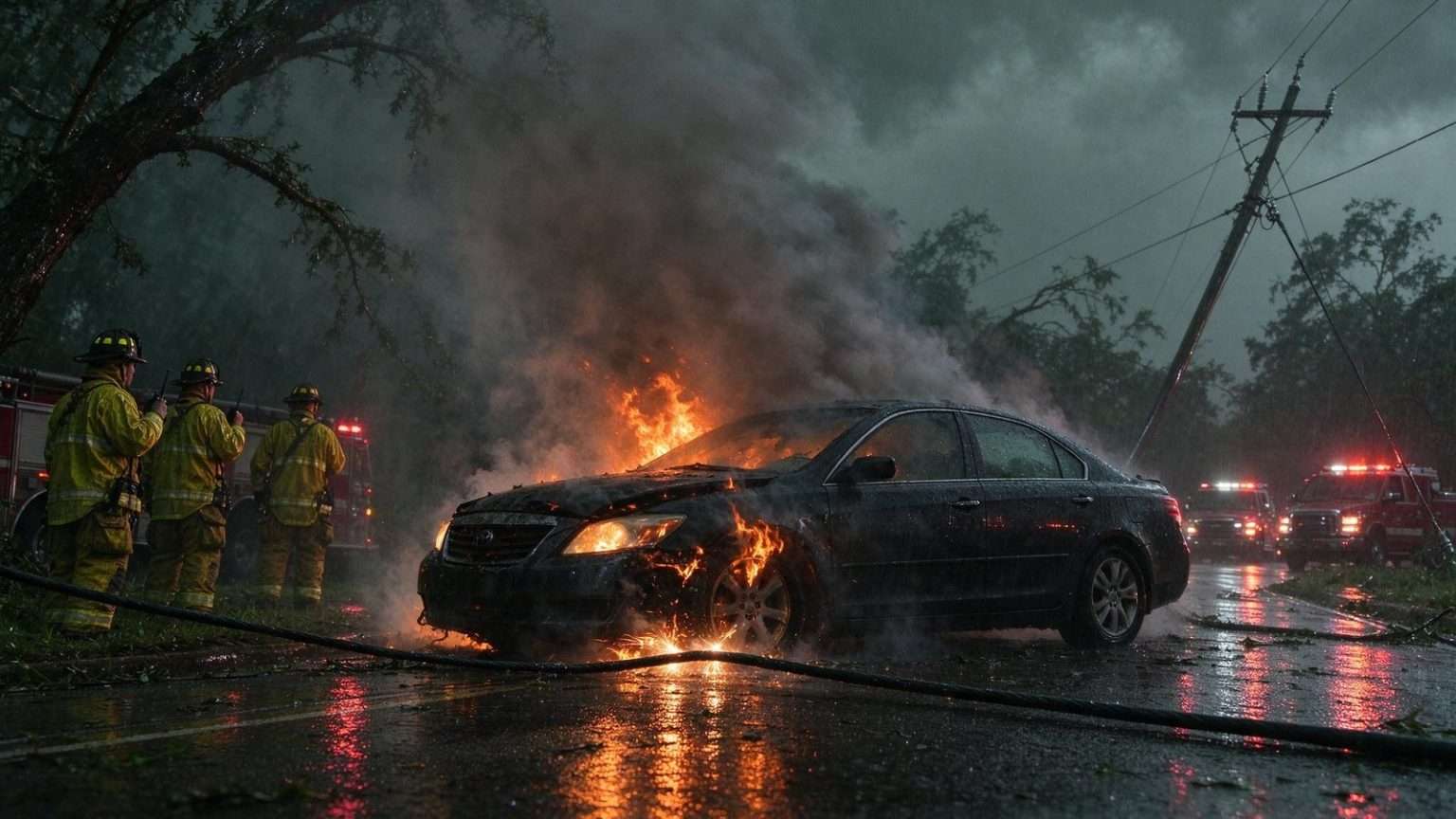
Firefighters in Saraland spent part of Sunday morning watching a vehicle burn instead of putting it out, and the reason was a hazard most drivers never think about. A downed power line had ignited the vehicle as a tornado warning swept through the area, and the fallen lines were still energized when crews arrived. Until the power company cut electricity to them, attacking the fire directly was not an option.
The incident unfolded during a round of severe weather that pushed tornado warnings across the Mobile area Sunday morning. Storms of that strength routinely bring down trees, limbs and utility lines across the region, and every fallen line has to be treated as live until a utility crew confirms otherwise. That safety rule is exactly what slowed the response at the burning vehicle in Saraland.
When firefighters reached the scene, they found the vehicle already burning in contact with the fallen line. Because electricity can travel through the vehicle, through the ground around it and through anything touching it, crews stood back and protected the surrounding area while they waited for the power company to arrive and de-energize the line. Only after the current was cut could they safely move in and knock down the flames.
An Unusual Obstacle for Firefighters
Fires involving energized electrical equipment are among the most dangerous calls a fire department can answer. Water conducts electricity, and a hose stream aimed at a live line, or at a vehicle in contact with one, can carry current back toward the hose team. Firefighters are trained to establish a perimeter, keep bystanders far away and hold their position until the utility confirms the line is dead.
That standby period can feel agonizingly slow to anyone watching a vehicle burn, but it is a deliberate calculation. A car or truck can be replaced. A firefighter or a bystander who steps into an energized zone cannot be brought back. Departments across Mobile County follow the same protocol, coordinating with the utility’s dispatchers so crews are positioned to attack the fire the moment the power is cut.
Saraland’s location makes calls like this a recurring feature of severe weather season. The city sits along Interstate 65 in northern Mobile County, where tall pines, utility poles and fast-moving Gulf storm cells intersect. When warnings are issued, high winds and saturated ground combine to topple trees onto lines, and each of those incidents ties up fire and utility crews until the hazard is cleared.
A Morning of Storm Problems Across the Region
The vehicle fire was one of several weather-related problems reported across the Mobile area during Sunday morning’s severe weather. Tornado warnings rolled across the region as the storm line moved through, and emergency dispatchers logged a steady stream of calls involving downed trees, blocked roadways and damage to electrical infrastructure. For fire and law enforcement agencies from Mobile to Saraland, the morning became a sequence of triage decisions rather than a single emergency.
A tornado warning is not the same thing as a watch, and the distinction matters for how residents respond. The National Weather Service office in Mobile issues a warning when radar indicates rotation or when trained spotters report a funnel or damage on the ground. At that point, the storm is considered an immediate threat to life and property in the warned area, and residents are expected to take shelter immediately rather than wait to see the storm.
The Gulf Coast sits squarely in a corridor where such warnings are a seasonal fact of life. Cooler continental air moving over warm, humid air masses off the Gulf of Mexico creates the instability that powers squall lines and embedded rotation. Those setups can develop quickly, sometimes in the pre-dawn and morning hours when people are driving to work or church, which is precisely the condition that puts vehicles on the road as lines come down.
During Sunday morning’s event, the combination of wind and rain-soaked ground proved enough to bring lines down in Saraland and elsewhere across the Mobile area. Each downed line creates two emergencies at once: the immediate physical hazard where it fell, and the outage that follows as the utility isolates the damaged section of its grid.
Why Crews Wait for the Utility
Power lines that fall during a storm do not always go dead when they hit the ground. Utility systems are designed to detect faults and attempt automatic reclosing, which means a line that appears inert can be re-energized without warning minutes or even hours later. The arcs that accompany energized lines can jump to nearby objects, ignite dry material and turn an ordinary traffic incident into a lethal one.
That is why the fire service treats the power company as an essential partner on these calls rather than an afterthought. Utility crews carry the switching equipment and the system knowledge needed to open the right circuit safely, and firefighters are trained not to improvise around them. In Saraland on Sunday, the wait ended the right way: the power company cut electricity to the fallen lines, the crews moved in, and the vehicle fire was knocked down without injury.
The aftermath for the vehicle itself was likely a total loss. Electrical fires that burn unattended in a fuel-fed vehicle for any length of time consume wiring, interior materials and fluid lines, and the heat they generate can ignite grass, mulch or nearby structures. In this case the fire was contained to the vehicle, but the margin between that outcome and a larger fire on a stormy morning was thin.
What Residents Should Do Around Downed Lines
Sunday’s fire in Saraland is a reminder that downed lines are a public hazard long before responders arrive. Any line on the ground should be considered energized, no matter how harmless it looks, and nothing should touch it: not vehicles, not fences, not tree limbs, not standing water nearby. Residents who see a fallen line are urged to stay away and call 911, then let the utility know so the outage can be logged and dispatched.
The danger zone around a live line is larger than most people assume. Electricity can fan out across wet ground, and a vehicle in contact with a line can electrify its body and the soil beneath it. If a line falls across a car while people are inside it, the guidance is to stay inside, warn others to keep away, and call for help rather than step out. Only if fire or another immediate threat forces an exit should anyone leave, and then by jumping clear without touching the vehicle and the ground at the same time.
Storm cleanup brings its own risks in the hours after warnings expire. Homeowners clearing limbs near service lines, generators running too close to houses, and drivers moving stranded branches out of the road all put people back in contact with the same hazard that confronted firefighters in Saraland. Patience during that window is the single most effective safety measure a resident can exercise.
The Broader Picture for Mobile County
The timing of the fire added another layer of difficulty. Severe weather drives call volume up across every agency at once, and a morning when tornado warnings are active is the worst possible time to commit a fire engine to a fixed position. Dispatchers in Mobile County must weigh every incident against the possibility that the next report will be a structure fire, an injury wreck or a person trapped by a fallen tree, all while the storm line is still moving through.
Incidents like Sunday’s vehicle fire also show how one storm cell can cascade through a community’s emergency systems. A tree falls, a line drops, a vehicle ignites, and a fire crew that would otherwise be available for the next call spends its morning standing by for the power company. Multiply that pattern across a county during a tornado-warned morning, and the strain on first responders becomes obvious.
Local agencies have long emphasized preparation as the counterweight. That means having multiple ways to receive warnings, knowing where to shelter in the home, keeping vehicles off the road when warnings are active when possible, and reporting outages and line damage promptly so utilities can prioritize repairs. None of those steps prevents every downed line, but they shorten response times and keep residents out of the danger zones.
For Saraland, the outcome of Sunday morning’s incident was the best version of a bad situation: a vehicle lost, but no injuries, and a fire contained once the power was cut. For the rest of the Mobile area, it stands as a practical lesson in the arithmetic of severe weather. The storms will bring lines down again, crews will wait for the utility again, and the residents who understand why will be safer for it.