Prichard Responded to 2009 Trash-Collection Complaint
After a Prichard resident reported that trash had not been collected on her street for more than two months, the city said it would complete pickup by the following Monday.
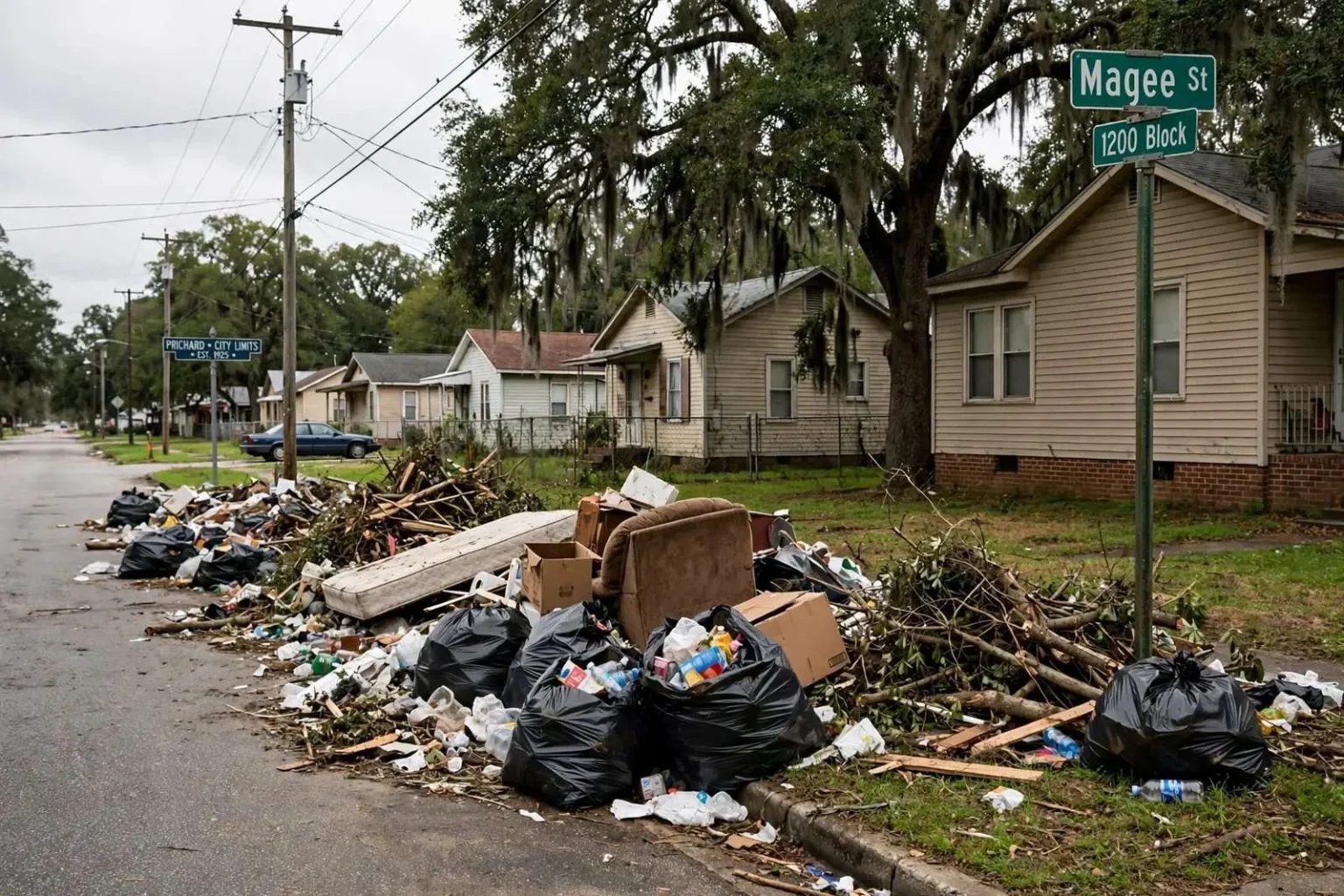
A Prichard resident raised concerns about uncollected trash in September 2009, saying waste had remained on her street for more than two months, prompting a response from city officials about the state of garbage collection in the Mobile County municipality. The complaint, documented in a local news report at the time, put a spotlight on one of the most basic services a small city provides — and on how quickly promises of pickup can matter to the people waiting on them.
According to the account, the city said the neighborhood had been included in a citywide cleanup campaign and that collection had occurred within the previous month. That statement conflicted with the resident’s description of waste sitting on her street for more than two months, a discrepancy the report documented without resolving. After the report, officials said trash on Magee Street would be picked up by the following Monday at the latest, giving the resident a concrete commitment after weeks of uncertainty.
The episode reflects a single 2009 service complaint and does not establish longer-term collection performance in Prichard. But it captures a familiar dynamic in small-city government: a resident’s complaint, an official’s explanation, conflicting timelines and a fast response once the matter became public. For the people on Magee Street, the distinction between “collected last month” and “sitting for two months” was the difference between a problem and a promise.
Prichard’s service challenges
Prichard, a city of roughly 27,000 residents just north of Mobile, has long faced challenges delivering basic municipal services on a limited budget. Incorporated in 1925 and once a thriving industrial suburb tied to shipbuilding and manufacturing along the Mobile River basin, the city saw its population and tax base shrink in the decades after World War II as industries closed and residents moved outward. By the 2000s, Prichard was working to maintain streets, sanitation, police and fire service with some of the leanest revenues of any municipality its size in Alabama.
The city’s financial pressures became a statewide story during the same era. Prichard’s underfunded employee pension plan ran out of money and stopped paying benefits to retired workers in 2009 — the same year as this complaint — and the city entered bankruptcy proceedings, its second in a dozen years, as it fought to restructure its obligations. The pension dispute dragged through federal court for years and consumed the attention of city leadership, even as day-to-day services like trash collection continued under tight budgets.
How trash collection worked in Prichard
Like many small Alabama cities, Prichard historically provided residential garbage and trash collection through a mix of in-house crews and contracted services. Garbage — household waste in carts or bags — typically ran on a fixed weekly schedule, while trash pickup — bulk items, yard debris, limbs and furniture — often ran on separate cycles or through periodic cleanup campaigns. Those cleanup campaigns, like the one city officials cited in responding to the 2009 complaint, are common across Mobile County municipalities as a way to clear accumulated bulk waste without requiring every household to make a special request.
The system depends heavily on communication. When a cleanup route passes a neighborhood, residents expect the debris left at the curb to go with it, and when it doesn’t, weeks of waiting can follow while the request moves through a city’s public works chain. Cities of Prichard’s size often have limited public works staff to log, schedule and confirm collections, which is how a missed street can sit for weeks before someone with the authority to fix it hears about it — and why a local news report can move a request to the top of the pile faster than a phone call.
The September 2009 complaint
The account of the Magee Street complaint documents conflicting statements about the timing of collection and the city’s immediate response. The resident’s description — more than two months of waste on the street — and the city’s position that the neighborhood had been included in a cleanup campaign and collected within the previous month could not both be fully true, and the report presented both without adjudicating between them. What is documented is what came next: officials committed to having the trash on Magee Street picked up by the following Monday at the latest.
That kind of commitment is the standard currency of local service journalism. A report documents a gap between what residents experience and what a city says, the city responds with a timeline, and the outcome hinges on whether the trucks actually arrive. In this case, the report preserved the city’s promise but did not publish a follow-up confirming the pickup — which is why the account stands as a record of the complaint and the response rather than a verdict on either.
What a single complaint can and cannot show
As a historical matter, the Magee Street episode is best understood for what it is: a documented service complaint from September 2009, an official explanation, and a specific commitment to act. It does not establish how well Prichard collected trash across the city, over the year, or in the years since, and it does not identify which description of events was accurate. Cities of Prichard’s size handle tens of thousands of collections a year, and a single missed or delayed route — however frustrating to the residents involved — is not a statistical measure of performance.
At the same time, the episode illustrates why sanitation is among the most visible services a city provides. Roads can go unpaved for years and many residents notice only when they drive on them; water systems run underground; but trash sits where everyone can see it, attracting odor, rodents and complaints that spread block by block. Missed collection is the kind of failure residents experience directly and immediately, which is why public works departments across Alabama treat cleanup campaigns and bulk-item routes as politically sensitive operations that are judged route by route.
The broader picture in 2009 Prichard
The complaint arrived during a difficult stretch for the city. The pension crisis that broke into public view in 2009 strained Prichard’s finances and reputation for years, and the bankruptcy filing that followed added legal costs to budgets already stretched thin. Through that period, the city continued providing core services — police, fire, sanitation — while officials worked to stabilize finances under state oversight and court orders.
Prichard’s leadership has changed repeatedly in the years since 2009, and the city has continued efforts to improve services and rebuild its economy, including commercial redevelopment along its major corridors. The Magee Street complaint remains a snapshot from that harder era: one street, one resident, one promise of Monday pickup — and a reminder that in small-city government, the most routine services are often the ones residents judge most closely.
Resident services in Mobile County’s small cities
Prichard is one of several small cities in Mobile County that provide their own sanitation service rather than leaving it to county government or private haulers. Neighboring Chickasaw, Saraland, Satsuma, Creola and Citronelle each operate their own public works departments or contracts, with service quality often differing from street to street and city to city. Residents in unincorporated areas rely on the Mobile County commission and contracted haulers, which means the answer to “when will my trash be picked up” can involve a completely different government within a few blocks.
That patchwork is a legacy of the county’s development pattern, in which communities incorporated during the 20th century to control their own services and zoning. For residents, the practical effect is that municipal responsiveness matters greatly: a missed bulk pickup in a small city is reported to city hall rather than a national hauler’s call center, and the response depends on the staff and systems a city of 27,000 can maintain. The 2009 Magee Street episode shows both the weakness and the strength of that arrangement — complaints can languish, but a single call to the right office can also produce a specific, dated commitment.
How cleanup campaigns work
The citywide cleanup campaign officials referenced in their response is a standard tool for Alabama municipalities. Typically scheduled in phases, a campaign designates neighborhoods for concentrated pickup of bulk items — appliances, furniture, limbs, brush and accumulated debris — that do not fit the normal weekly garbage route. Cities announce the schedule in advance, ask residents to place items at the curb by a deadline, and then run trucks through the area until the accumulation is cleared.
Campaigns succeed or fail on execution. If a truck misses a street, or if items placed out after the deadline are skipped, the debris can sit until the next campaign — which may be months away. That is how a resident can reasonably report waste sitting for two months while a city can reasonably say a cleanup passed through the neighborhood within the past month: both statements can describe the same interval, depending on whether the items at the curb were on the route that day. Clear schedules, posted deadlines and a working complaint line are what keep the two accounts from diverging, and the Magee Street report suggests that in September 2009, at least on one street, they had.
As for the outcome, the documented record ends with the city’s commitment: trash on Magee Street would be picked up by the following Monday at the latest. For the resident who raised the concern, that was the resolution the report captured — a specific date after more than two months of waiting. The episode remains what it was when it was preserved: a historical account of one neighborhood’s service complaint, the city’s response, and the ordinary but essential work of keeping a small Alabama city clean.