Tough Local Schedules Sharpen Area High School Football Teams
Competitive schedules across the Mobile and Baldwin County area help strengthen local high school football teams.
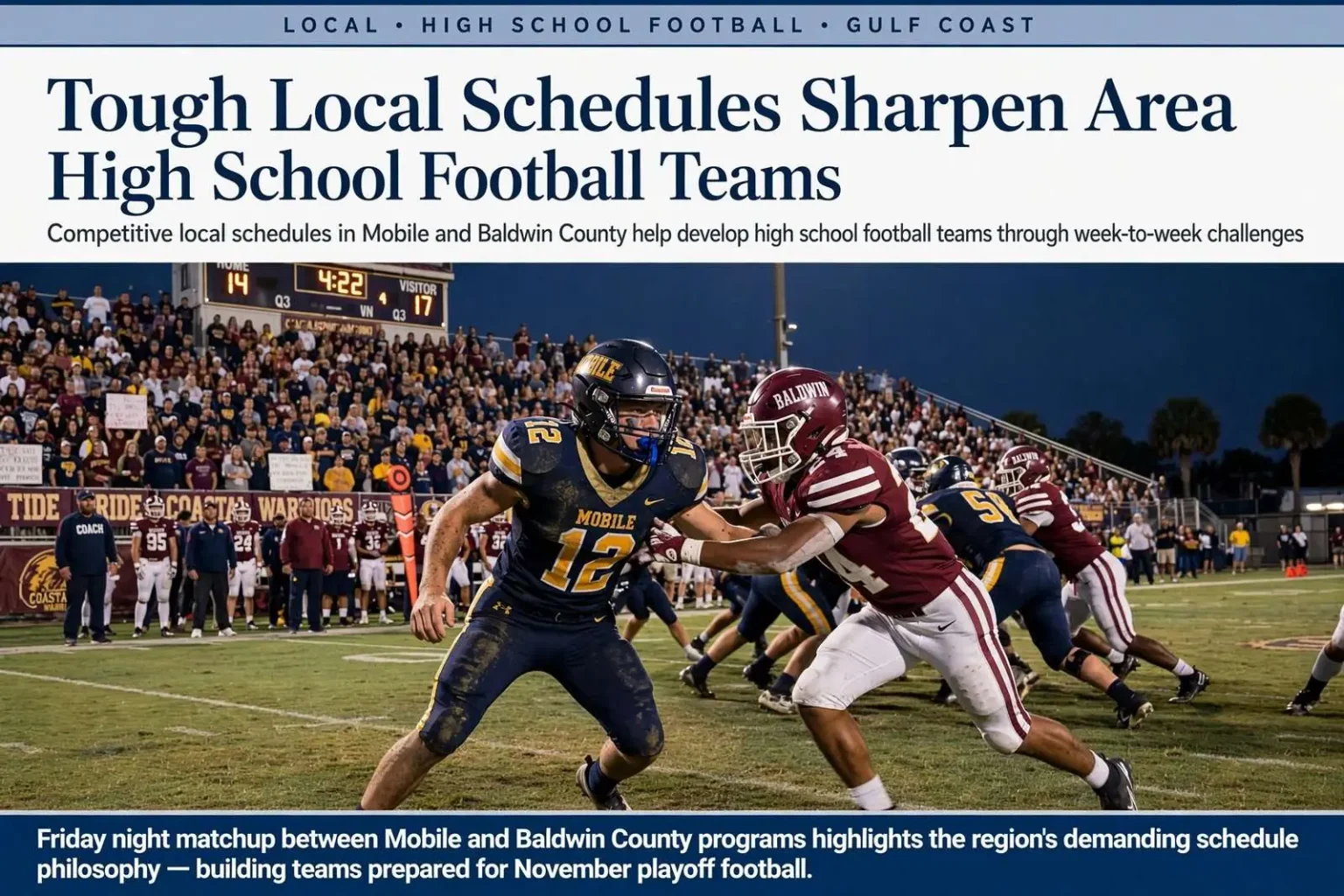
Competitive local schedules in the Mobile and Baldwin County area help develop high school football teams, giving programs the kind of week-to-week challenge that can strengthen them over the course of a season. On the Gulf Coast, where high school football occupies a central place in community life and where the density of talented programs is among the highest in Alabama, the schedule a team plays is never an afterthought. Coaches in the area build non-region slates with the same care they bring to game plans, seeking opponents that will expose weaknesses in September so those flaws can be fixed before the games that decide championships in November.
The logic behind a demanding schedule is straightforward, and it shapes rosters long before the first Friday night. Teams that cruise through soft early-season opponents arrive at region play untested, while teams that have faced quality opposition have already been forced to play at speed, correct mistakes under pressure, and develop the depth that a physical season demands. Players learn the difference between practicing hard and playing hard, and that education happens fastest against opponents who punish every missed assignment. By the time the postseason arrives, the teams still playing are almost always the ones that were tested early and often.
The Mobile and Baldwin County area offers that kind of opposition at nearly every turn. Within a short drive of downtown Mobile, a coach can find programs with storied histories, private school powers with deep rosters, fast-growing suburban programs in Baldwin County that have won state championships in the past decade, and public school teams that reload rather than rebuild. That concentration of quality means area coaches rarely have to leave the region to find a hard game, and many of the season’s most anticipated matchups are between schools separated by a few miles or a single trip across Mobile Bay.
How the Schedule Shapes a Season
An Alabama high school football schedule divides into two kinds of games, and each serves a different purpose. Region games are the ones with direct stakes, because the Alabama High School Athletic Association uses region records to determine which teams qualify for the state playoffs and how they are seeded. Non-region games, filling out the rest of the calendar, are where coaches exercise their judgment, and on the Gulf Coast that judgment usually favors toughness. A non-region loss to a strong opponent stings, but it teaches; an easy win against overmatched competition feels good in the moment and often costs a team in October.
Playing tough opponents weekly changes how practices run, too. Teams facing quality opposition cannot afford weeks of complacency, and coaches use the rhythm of a hard schedule to keep attention sharp through the middle of the season when fatigue and distraction set in. Game plans require more detail, because strong opponents take away a team’s best plays and force adjustments. Young players develop faster when they are pushed into meaningful snaps early, because a hard schedule leaves little room to wait for experience to accumulate gradually. All of that development compounds across a season, which is why coaches who compete in demanding leagues describe their teams as a different group in November than they were in August.
The physical toll is the other side of the ledger, and every coach who schedules toughness carries it in mind. Weeks of physical games accumulate in banged-up shoulders, ankles, and knees, and depth charts get tested in ways that softer schedules do not force. Programs respond with year-round strength and conditioning, careful practice structures that limit full-contact reps, and rosters built with the expectation that backups will play meaningful snaps. Managing that balance, tough enough to sharpen a team without breaking it, is one of the defining skills of coaching in a region where nobody gets an easy Friday.
The Regional Football Landscape
The football culture that surrounds Mobile and Baldwin County high schools is among the richest in the country relative to its population. The region has produced generations of college and professional players, and the annual recruiting attention that Gulf Coast programs receive reflects the talent that comes through area middle schools every year. Mobile’s heritage runs deep, from the public school programs that have filled stadiums on theaghill for decades to the private schools whose teams have won titles across multiple classifications. Baldwin County’s growth has added a second center of gravity, with the Eastern Shore’s suburbs and the county’s coastal communities building programs that compete for and win championships.
That landscape means the area’s teams face a double test each season. The region race alone determines the playoffs, and region opponents know each other intimately, having met year after year with playoff positioning on the line. But non-region games against fellow area powers add another layer, because beating a strong cross-county opponent carries weight in the eyes of playoff seeding committees, fans, and the college recruiters who track how prospects perform against the best available competition. A strong showing against a quality opponent in September can do as much for a team’s profile as a region win, which is why the area’s marquee non-region matchups draw the crowds they do.
The games also carry meaning for the communities around them. Friday nights in Mobile and Baldwin County bring together generations of former players, families whose names have been attached to programs for decades, and student sections that fill their sides of stadiums long before kickoff. When two strong programs meet, the buildup starts early in the week and the game becomes the centerpiece of the community’s weekend. That atmosphere is part of what makes tough schedules valuable beyond wins and losses, because the games that test teams the hardest are often the ones the community remembers longest.
What Toughness Produces
By the time the playoffs begin, the difference between teams that were tested and teams that were not shows up in specific, observable ways. Tested teams handle adversity on the field, a turnover, a long touchdown allowed, a tough call, without the game slipping away, because they have already been through it. Their players play with composure in loud environments, having done it repeatedly. Their depth holds up in the fourth quarter because meaningful snaps have been distributed across the roster. Their coaches have already seen how the team responds to being hurt on offense or exposed on defense, and the fixes have been installed weeks earlier.
College recruiters, who follow Gulf Coast football closely, draw their own conclusions from a demanding schedule. Statistics compiled against weak opposition carry less weight than performance against quality opponents, and recruiters watch how prospects compete when the game is on the line late. A demanding schedule gives the area’s best players a stage for exactly those moments, which is one more reason programs embrace difficult slates. The region has seen its share of players rise up recruiting boards on the strength of big performances in high-profile games, and the pattern repeats every season.
There is also a quieter benefit that shows up after the final whistle of the season. Players who spend a year competing at a high standard carry those habits into whatever comes next, whether that is college football, another sport, or life beyond athletics. Coaches talk about the lessons that only hard competition teaches, accountability to teammates, preparation as a weekly discipline, resilience after failure, and those lessons land most firmly on teams that were tested all season. In that sense, the tough schedules that define Gulf Coast football are not just a competitive strategy. They are part of what the game is for.
The season ahead will put that philosophy to work again across Mobile and Baldwin County, as programs test themselves against the deepest concentration of quality opposition the region can provide. Some of those tests will end in losses, and the teams that learn from them will be better for it by the time the standings matter most. That is the bargain that tough scheduling offers, and on the Gulf Coast, where football means as much as it does and the opposition is as good as it is, it is a bargain that local coaches keep making every season, in pursuit of the kind of November football that only a hard-earned season can produce.
The history of the area’s programs gives those matchups their weight. Mobile’s football heritage stretches back more than a century, to the early days of the sport in Alabama, and the city’s programs have been winning state titles across classifications for generations. Baldwin County’s rise is a more recent story, tied to the county’s explosive growth, but its programs have quickly built resumes that stand alongside anyone’s, with multiple championships and deep playoff runs over the past two decades. The two counties together produce a schedule environment that few areas of the state can match, and the teams that come out of it arrive in the postseason with a shared understanding of what playoff football demands.
Preparation for that kind of schedule begins long before August. Offseason programs across the area run through weight rooms, summer passing leagues, and 7-on-7 competitions that keep players developing year-round, and coaching staffs use the spring and summer to evaluate the personnel that will carry the load in the fall. Two-a-days and fall camp install the schemes that region play will stress, and by the time the opener arrives, the season’s first real answers start emerging. Teams in this part of Alabama treat those early weeks as the proving ground they are, because everyone involved knows that the schedule will not offer a gentle introduction.
Communities reward that ambition with support. Stadium attendance across the area remains among the strongest in the state, booster programs invest in facilities that keep pace with the competition, and local coverage of the teams extends from Friday night recaps to recruiting updates that follow area players to college campuses. The connection between tough schedules and that community support runs in both directions: fans turn out for games that matter, and games against quality opponents matter most. Programs that schedule ambitiously give their communities more of the games that define a fall, and the communities respond by filling the seats those games deserve.
In the end, the equation that Gulf Coast coaches accept every season is a simple one. Soft schedules produce comfortable Septembers and early exits, while hard schedules produce bruised Septembers and teams that know who they are when November arrives. The Mobile and Baldwin County area has chosen the second path for as long as its teams have taken the field, and the results, in playoff appearances, in championships, and in the players the region sends to the next level, have justified the choice year after year. The stretch ahead will test that formula again, week after week, one hard Friday night at a time.