Local High School Volleyball Enters 2026 Season With New Alignments
New alignments and setups are in place for local high school volleyball as teams head into the 2026 season.
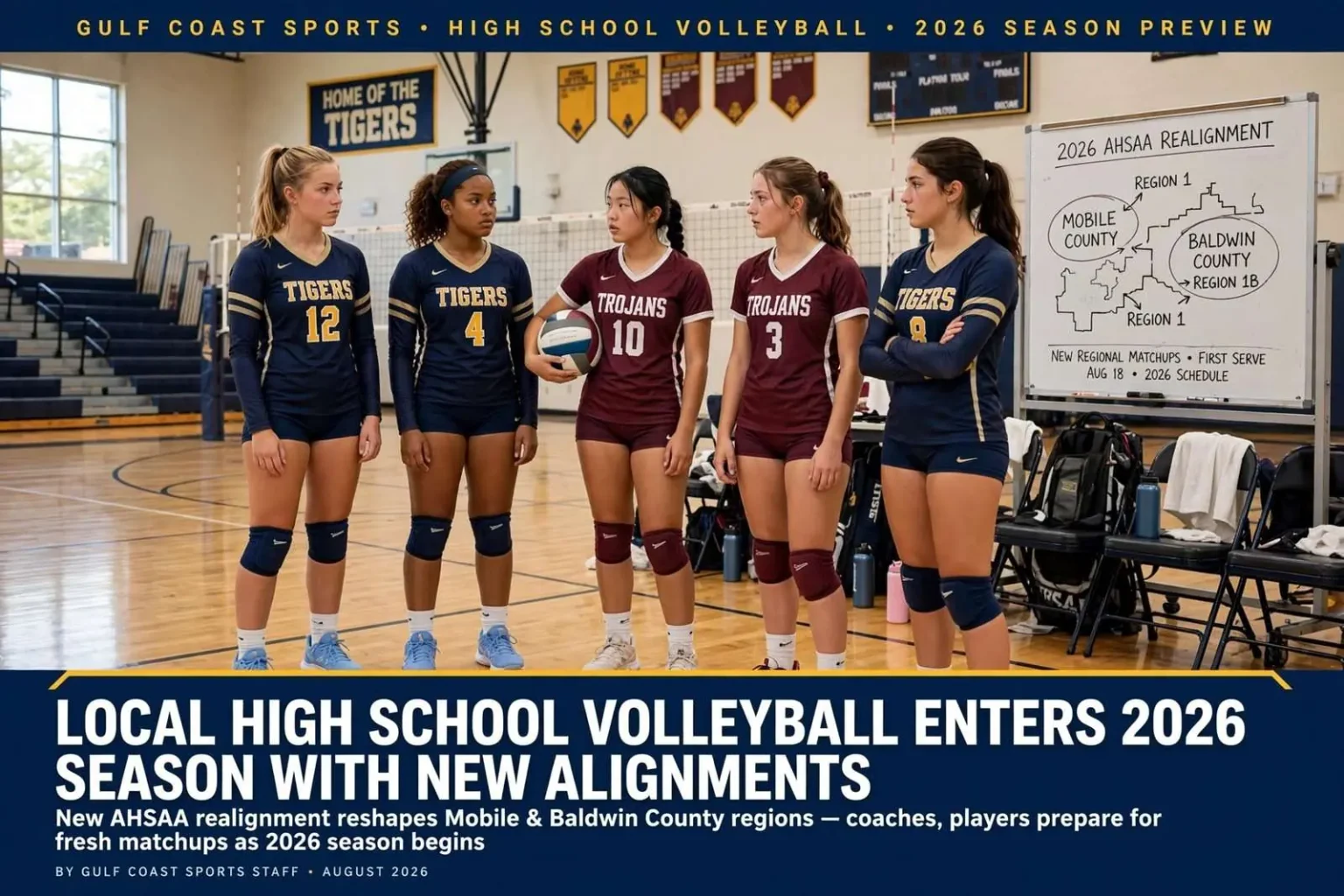
Local high school volleyball is heading into the 2026 season with a fresh look, as new alignments and setups take hold for area teams across Mobile and Baldwin counties. Every realignment cycle reshapes who plays whom, which programs share a region, and how the road to the postseason is drawn, and the latest changes give coaches, players, and fans a new map to learn before the first serve. For a sport that has grown steadily in participation and popularity across the Gulf Coast, the new season arrives with the kind of competitive uncertainty that makes early-season results worth watching closely.
Alignment changes in Alabama high school sports come from the classification and realignment process run by the Alabama High School Athletic Association, the governing body that organizes competition for member schools across the state. The AHSAA groups schools into classifications based on enrollment, with the largest schools competing in Class 7A and the classifications descending from there, and within each classification schools are assigned to regions or areas that determine regular-season competition and postseason qualification. When enrollment numbers shift and schools open, close, or move, the association redraws those assignments, and teams that spent years building rivalries within a region suddenly find new opponents on the schedule.
For volleyball, those shifts matter as much as they do in any sport. Region play determines seeding and qualification for postseason tournaments, so a redrawn region can change a program’s entire competitive outlook. A team that once faced a region loaded with established powers may find a more open path, while a program that enjoyed a favorable draw may inherit a gauntlet. Coaches spend the offseason studying the new landscape, adjusting non-region schedules to prepare for the opponents that will decide their fate in October, and players quickly learn which matches carry extra weight.
The Area Landscape in 2026
The Mobile and Baldwin County area has long been one of the deeper volleyball regions in the state, with programs at every classification capable of making postseason runs. Mobile’s large public schools have historically anchored the upper classifications, competing against private school programs with strong club pipelines, while Baldwin County’s fast-growing communities have built programs to match their expanding enrollments. The Catholic school programs in the area have been particularly prominent in the sport, and the region’s club volleyball scene, which feeds travel teams and year-round training, gives local high schools a talent base that many parts of Alabama lack.
New alignments change not only who is in each region but how many teams survive into the postseason from each one. Regions that consolidate powerhouses produce playoff races with little margin for error, where a single loss in region play can mean traveling for a first-round match or missing the postseason entirely. More balanced regions produce crowded standings and tiebreaker scenarios that keep fans doing arithmetic late into the season. Players feel those dynamics in every region match, because the standings follow them from August through the end of the regular season.
The 2026 season also arrives with the usual turnover that makes each volleyball year distinct. Graduation reshapes rosters annually in a sport where a single dominant class can carry a program for four years, and every realignment cycle coincides with new setters, hitters, and defensive specialists stepping into larger roles. Programs that returned experienced lineups approach new regions with confidence, while rebuilding teams get the benefit of a reset, facing opponents who have less film and less history against them. The combination of new alignments and new personnel is why coaches consistently describe season openers as the most revealing matches on the schedule.
What Realignment Means for Programs
For established programs, realignment is both a challenge and an opportunity. Teams that have built sustained success do so partly through familiarity, knowing their region opponents’ tendencies, rotations, and key players year after year. A new region erases that library of knowledge and demands fresh scouting. At the same time, powers benefit from the competitive test that new opponents provide, because the strongest programs use difficult region matches as preparation for the postseason, where the state tournament field at every classification is filled with teams that survived similarly demanding roads.
For emerging programs, new alignments can accelerate growth. A program that has invested in youth leagues, middle school feeders, and club partnerships measures itself against the region it is assigned to, and a more attainable path to playoff experience can change a team’s trajectory. Postseason appearances matter for more than the matches themselves. They build the culture that attracts younger athletes to the sport, they justify investment in facilities and training, and they give a program the kind of visibility in its community that fills gymnasiums the following season.
Travel is another practical consequence of realignment that players, parents, and athletic departments feel directly. Region assignments determine bus routes across Mobile County and the Mobile Bay, and a region that stretches across the bay means ferrying teams through tunnel or bridge traffic on weeknights for matches that begin in the late afternoon. Athletic directors work through those logistics every two years when the new cycle begins, and families adjust to the rhythms of away matches that may sit farther from home than the previous cycle’s schedule ever required.
How the Season Unfolds
Volleyball’s place in the Alabama high school calendar gives it a demanding rhythm. The season begins in the heat of August, often overlapping with the opening of football season, and runs through the fall with tournaments, tri-matches, and region play packing the week. Teams routinely play multiple matches in a single evening at tri-matches and tournament stops, testing depth and endurance in ways that single-game sports do not. By the time the postseason arrives, the programs still standing are the ones that managed rosters, rotations, and expectations through the longest stretch of the schedule.
The postseason structure in each classification funnels teams through regional tournaments toward the state finals, where champions are crowned in Birmingham in the final rounds of the season. Reaching that stage requires surviving a region race whose difficulty the new alignments have redrawn, then navigating tournament brackets against opponents teams may never have faced in the regular season. Coaches talk about peaking at the right time, and in volleyball that phrase has a technical meaning: passing, serve-receive, and hitting efficiency tend to come together for teams that have been tested repeatedly, which is why demanding regions often produce the deepest postseason runs.
Individual milestones and team achievements accumulate along the way. Kills, assists, digs, and aces pile up across a season’s worth of matches, and the area’s leading players build the statistics that earn all-region recognition and attention from college programs. Volleyball recruiting in Alabama runs heavily through club season in the winter and spring, but a strong high school season against a demanding region schedule adds to a player’s case, and college coaches do track how prospects perform when their teams face the best competition on the new alignment’s calendar.
The 2026 season begins, then, with familiar names in new places and the whole geography of local volleyball redrawn. Fans will need a few weeks to learn which matchups carry the stakes that the old rivalries once held, and coaches will need until the region races tighten to know exactly where their teams stand. That process of discovery is part of what a realignment year offers: nothing is assumed, every region match tells everyone something new, and by the time the postseason arrives, the story of the 2026 season will be one that no previous alignment could have written.
The area’s volleyball tradition gives the new alignments a rich backdrop. Programs across Mobile and Baldwin counties have combined for a long list of state championships over the decades, with the sport’s strongest local dynasties building winning streaks and title hauls that rank among the most impressive in state history. Baldwin County’s private school programs in particular have set the standard, with one Daphne school holding a state record for volleyball championships, while Mobile’s Catholic and public school powers have traded runs of their own. Every season’s new alignment is measured against that history, because the programs being reshuffled are the same ones that have defined championship volleyball on the Gulf Coast for a generation.
The sport itself has changed in ways that shape how every program approaches a realignment year. Rally scoring keeps every point in play and compresses the margin for error, best-of-five matches reward depth across a long evening, and the libero position has created a specialist role that has reshaped defensive lineups since it was introduced. Club volleyball has grown alongside the high school game into a year-round pipeline, with area players training through the winter and spring and showcasing for college recruiters at tournaments across the Southeast. High school coaches now build programs around that calendar, blending club-trained specialists with multi-sport athletes and fitting their schemes to the personnel each class brings.
Communities across the two counties have invested in that growth. Gymnasiums have been renovated and built as school systems expanded, youth leagues feed the high school rosters, and attendance at big matches has grown with the sport’s profile. Playoff matches in volleyball carry the same intensity as those in any sport on the Gulf Coast, with student sections, traveling families, and matchups that divide neighboring communities. A realignment year redirects some of that energy to new matchups, giving players and fans who may never have shared a gymnasium before a reason to build new traditions on top of the ones they keep.
What remains constant beneath the new alignments is the way the sport measures its teams. Volleyball keeps score in small increments, and close matches turn on serve-receive passing, net play, and composure in the final points of a set. The programs that thrive in any region, whatever its makeup, are the ones that train those fundamentals relentlessly and keep them steady in gyms that get loud late in a deciding set. The 2026 alignments will test different combinations of teams against one another, but the standards by which the season will be judged, region titles, deep postseason runs, and championship contention, remain exactly where the Gulf Coast’s best programs have always set them.