
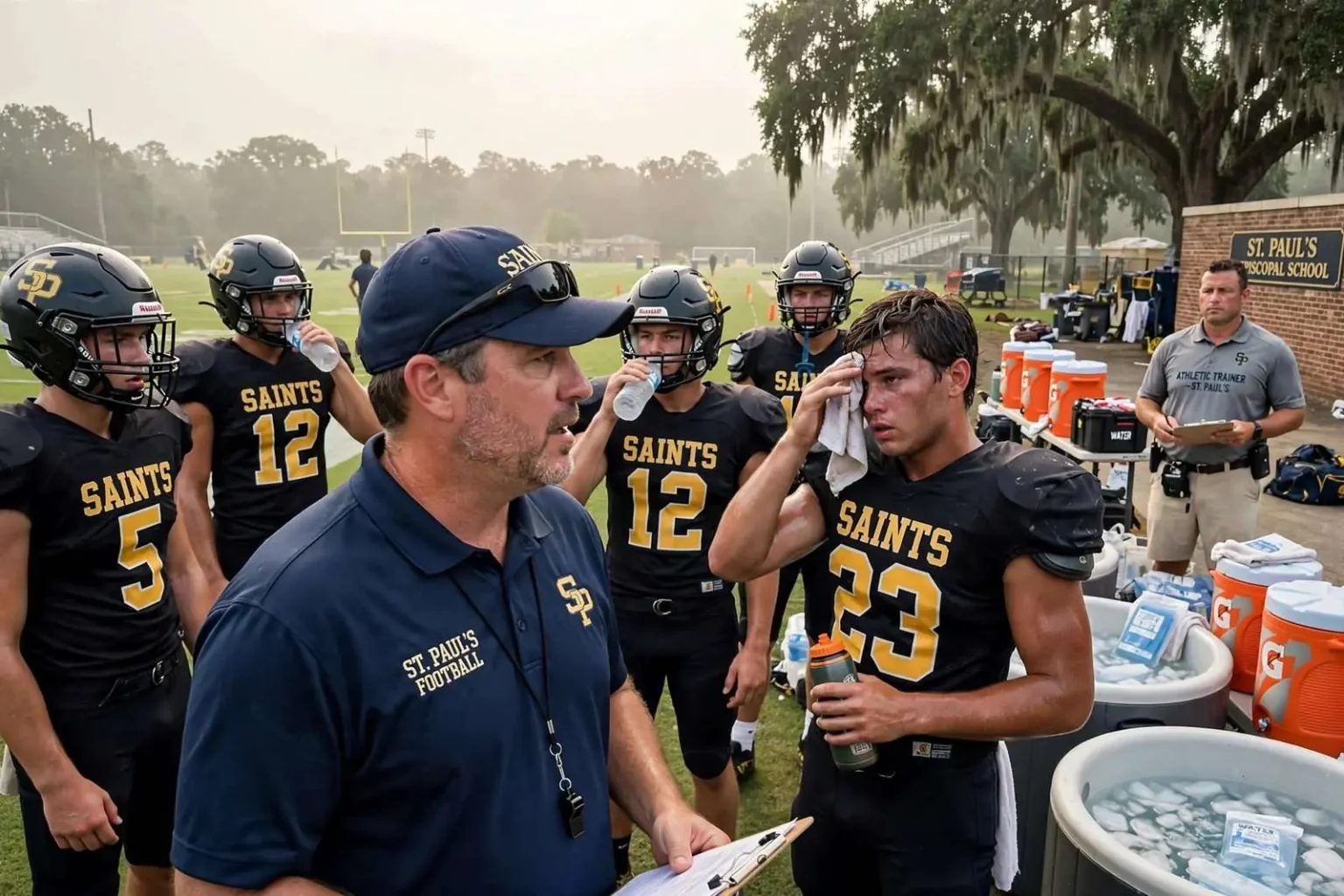
MOBILE, Ala. — High school football returns this weekend, and teams across the Gulf Coast are finishing their final preparations before their first games of the season. At St. Paul’s Episcopal School, that preparation means readying for both the opponent and the punishing August heat.
Head football coach Ham Barnett said hot conditions are nothing new for players who grow up and play football in Mobile.
“If you grew up in Mobile, Alabama, you understand that it is going to be hot, especially in August,” Barnett said. “We’ve got to get our kids acclimated because it’s going to be hot on Friday too.”
The opening weeks of a Gulf Coast football season unfold in some of the most unforgiving conditions in high school sports. August humidity along Mobile Bay pushes heat indices well above the actual temperature, and early-season kickoff times rarely bring relief before the fourth quarter. Coaches across the region treat the calendar itself as part of the game plan — and Barnett’s program has built its summer around that assumption.
Barnett said the Saints have spent the summer getting used to practicing in the heat, but the program has also made adjustments to help players handle the conditions. One key change was shifting the schedule earlier.
“I mean, we’re acclimated and we’ve been in it all summer long,” Barnett said. “Something we’ve changed though, this summer we moved everything up an hour early, so we started at 7 a.m., and so that helped us a lot.”
He said last week was the team’s first week practicing in the afternoon after spending much of the summer working out earlier in the day.
“It was a little different, but you know when you’re outside all the time, you kind of get used to it,” Barnett said.
The deliberate march from dawn workouts to afternoon sessions is a controlled ramp toward game conditions. Players cannot go straight from an air-conditioned summer to a Friday night in August humidity; they build tolerance in stages, and the final week before the opener is when the program closes whatever gap remains between practice and game-day conditions.
Safety measures remain a priority
Even with players acclimated to the heat, Barnett said safety precautions remain part of every practice. St. Paul’s has a full-time trainer, provides frequent water breaks and builds in rest time throughout practice. Ice baths are also ready in case a player becomes overheated.
“We have a trainer full time here as well. We get plenty of water breaks. There’s a lot of rest time during practice,” Barnett said. “And of course, if a kid gets overheated, which we have had happen in the past, then we have ice baths ready to go for them as well.”
The acknowledgment that heat illness has happened before is the norm rather than the exception along the Gulf Coast, where every program has a story about a player who pushed past his limits in August. Modern heat-safety practice treats such incidents as moments to manage, not scandals to hide — cool the body fast, evaluate thoroughly and return the athlete only when he is cleared.
The structure of practice reflects the same caution. Barnett said practices typically last around 90 minutes to an hour and 40 minutes, limiting how long players are outside at one time. Shorter, more intense sessions accomplish more than marathon workouts in the heat — and they leave time for the recovery that lets athletes train again the next day.
He added that spending the summer outdoors means his athletes experience the heat differently than someone who stays inside most of the day.
“I think the normal citizen sits inside all day, and so we’re not going to do that. We’re going to be outside,” Barnett said. “We’ve been acclimated to it. We’re used to it, and people ask me all the time, ‘How do you do this when it’s so hot?’ Well, we do it all the time, and so we’re used to it.”
Acclimation is not a slogan but a physiological process. Over days and weeks of gradual exposure, the body sweats earlier and more efficiently, retains electrolytes better and learns to moderate effort — adaptations that arrive only with time spent in the conditions themselves. That is why the summer calendar matters more than any single hot afternoon: the adaptations Barnett relies on were built one 7 a.m. practice at a time.
Still, being accustomed to the conditions does not mean coaches let their guard down, he said.
“Our kids are in really good shape right now, and I feel really comfortable about our training staff as well,” Barnett said. “And our coaches really do a great, great job of keeping their eye on the student athlete.”
A football tradition in heat country
St. Paul’s is one of Mobile’s established private-school programs, with a football tradition that has produced playoff runs and college players over the years. The school’s program operates in one of the deepest football regions in the country: the Gulf Coast produces top recruiting classes annually, and Mobile’s public and private schools share a rivalry landscape that stretches back generations. In that environment, the August heat is the common denominator — every opponent the Saints face this weekend has spent the same summer adapting to the same humidity.
The heat also shapes the football culture itself in ways outsiders sometimes miss. Two-a-days have largely given way across Alabama to more carefully managed single practices, weight-room windows and walk-through sessions, reflecting a statewide shift toward heat-safety standards adopted after years of attention to exertional heat illness. The state’s high school association imposes practice restrictions during the hottest stretches of August, and programs like St. Paul’s have adjusted their schedules to build in compliance without sacrificing preparation.
With the season opening this weekend, Barnett said getting players used to the heat is also part of preparing them for what they may face on game night. A team that trained at dawn but plays at dusk still needs the resilience the summer built — the ability to play a fourth quarter in conditions that would flatten a spectator.
For the Saints, he said, the heat is part of football on the Gulf Coast — and so is preparing for it. The Friday-night lights of September in Mobile arrive with a ceiling of humidity and a roster full of players who spent August earning the right to play in it.
The trainer’s watch
A full-time trainer is the quiet backbone of any Gulf Coast football program. On a practice field in August, the trainer’s job is part medical, part meteorological: tracking wet-bulb conditions, watching for the earliest signs of heat exhaustion — dizziness, cramping, unusual fatigue — and making the call to pull a player before an incident becomes an emergency. Coaches set the schedule; the trainer guards the line the schedule cannot cross.
Water breaks and rest periods do more than cool bodies down. They create natural checkpoints where coaches and trainers can look each player over, and they teach athletes that hydration is part of the sport rather than an interruption of it. Players who learn those habits in August carry them through two-a-day weeks, jamborees and the October games when the heat lingers.
Ice baths stand at the ready as the program’s emergency brake. Cold-water immersion is the recognized first response for exertional heat stroke, the most dangerous heat illness, and the difference between minutes and seconds in cooling a player can be the difference between a scare and a catastrophe. Having the tub filled and the procedure drilled — as St. Paul’s does — is standard practice for well-run programs across the region.
Acclimation week by week
The Saints’ summer arc — 7 a.m. starts, then a first week of afternoon work just before the opener — mirrors the progression guidelines that football’s governing bodies recommend. Early-summer sessions in the coolest hours let athletes begin adapting without the added load of midday sun. As tolerance builds, practice moves later and pads come on, each step adding stress the body has already learned to handle.
The payoff arrives on game night. A player who has acclimated over eight weeks sweats earlier, paces better and holds form deep into a humid fourth quarter, while a player rushed into August competition risks the cramps and exhaustion that decide early-season games as often as any scheme does. Coaches across Baldwin and Mobile counties speak about heat readiness the way northern coaches speak about cold-weather preparation — as a competitive edge built in the offseason.
There is also a cultural dimension. Players raised on Gulf Coast football grow up hearing that everyone plays in the same weather, and the shared endurance of summer practice becomes part of a team’s identity. By the time the season opens, the hardship of August is a credential every player on the roster has earned together.
Barnett’s program pairs that toughness with vigilance: the same coach who talks about being “used to it” is the one who moved practices an hour earlier, shortened sessions and keeps ice baths filled. On the Gulf Coast, both halves of that approach are simply what preparation looks like before the first kickoff of the season.