Richardson Wants District 1 Residents to Steer Mobile Capital Spending
Mobile Councilman Fred Richardson planned to poll District 1 residents on how to spend $3 million in capital improvement funds set for 2016.
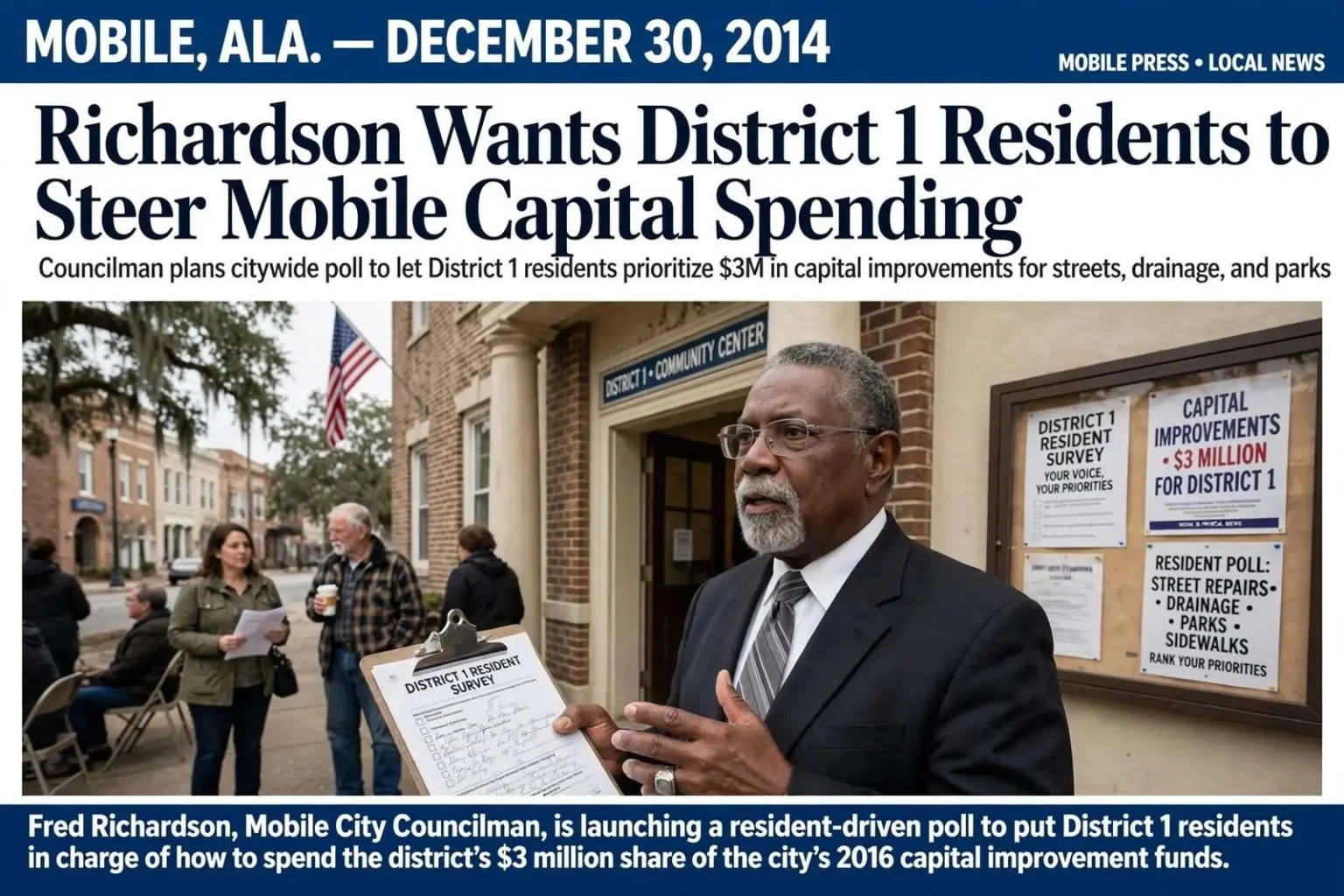
As 2014 drew to a close, Mobile City Councilman Fred Richardson laid out a plan to put residents of District 1 squarely in the driver’s seat when it comes to deciding how their part of the city should spend its share of upcoming capital improvement dollars. Richardson said the power rests with the people who live in the district, and he intends to act on that belief quickly. His plan was to hit the ground running right after the first of the year by polling every single resident about their personal priorities and wishes for the district’s future.
The approach reflected Richardson’s long-standing style as one of the council’s most vocal members. Representing District 1, which covers much of downtown Mobile, portions of the city’s historically Black neighborhoods, and communities stretching toward the city’s northern limits, he built his tenure on visibility at neighborhood meetings and a willingness to press city hall on matters residents raise with him directly. A resident-driven poll, in his view, would convert that grassroots input into an official priority list the city could act on.
Beyond individual input, the councilman encouraged residents to take part in districtwide meetings aimed at building a shared action plan for the year ahead. The goal, he said, was to give neighbors a direct voice in shaping local priorities rather than leaving those choices solely to officials at Government Plaza. Town-hall style planning sessions have become a familiar tool for cities distributing discretionary infrastructure money, and Richardson wanted District 1’s process to be thorough enough that the resulting list would carry real weight when the council divided up funds.
The $3 Million Per District Plan
A key focus of that effort is money already set aside for neighborhood needs. The City Council recently approved a plan to devote $3 million per district to capital improvement projects in 2016, and Richardson wanted residents to help determine exactly how those funds would be used in District 1. The per-district allocation was designed to spread major projects across all seven council districts rather than concentrating spending downtown or in whichever part of the city had the most clout in a given budget cycle.
Capital improvement money typically pays for things like street work, drainage, parks and other physical upgrades that shape daily life in a neighborhood. In older portions of Mobile, the needs are substantial: streets that have gone decades without resurfacing, drainage systems that date to the mid-20th century, sidewalks that have crumbled or disappeared entirely, and park equipment that shows its age. Every district in the city has a backlog far deeper than its share of capital funds can cover, which is exactly why Richardson argued residents themselves should rank the competing demands.
Drainage in particular is a perennial concern in a city where heavy Gulf Coast rains are a fact of life. Low-lying neighborhoods in District 1 and across Mobile have historically dealt with street flooding during major storms, and drainage projects rank near the top of many wish lists even though they are expensive, invisible once completed, and less politically visible than a new park or repaved road. Richardson’s polling plan was meant to surface those priorities regardless of how photogenic they were.
By gathering feedback early, Richardson signaled he wanted a clear, resident-driven list of priorities in place well before the spending year arrived, giving the community time to weigh competing needs and reach consensus. Early polling also serves a practical purpose at city hall: projects need design work, engineering studies, and cost estimates before money can be spent, and a district that identifies its priorities in January is far better positioned than one that starts the conversation mid-budget-year.
District 1’s Place in the City
District 1 encompasses some of Mobile’s most historic ground. It includes downtown districts like Church Street East and portions of the Oakleigh area, neighborhoods with housing stock more than a century old, and communities such as Orange Grove and other areas north of downtown whose residents have long pushed for equal attention to streets, drainage, and public facilities. The district’s needs range from tourism-adjacent improvements downtown to basic infrastructure in residential neighborhoods that went decades with less investment than they sought.
Richardson, first elected to the council in the 1980s with service interrupted and later resumed, has made infrastructure complaints a signature issue, frequently citing specific streets and drainage ditches from the council podium. His constituents’ concerns typically include unpaved or deteriorating roads, chronic flooding, blighted properties, and the need for improved recreation centers — the same categories that dominate capital improvement conversations in cities across the South.
The per-district capital plan emerged from a council facing a finite pot of infrastructure money and seven members each accountable to distinct neighborhoods. Spreading $3 million to each district gave every member resources to point to, while preserving the council’s tradition of district autonomy — each council member effectively directs how the share is spent, subject to citywide approval of projects. That structure makes resident input especially consequential, since the district’s councilman is the decisive voice in the list.
A Broader Look Ahead for Mobile’s Leaders
Richardson’s remarks were part of a broader look ahead by Mobile’s leaders. His comments were the first in a planned series featuring all seven members of the City Council, each offering a forecast of goals and priorities for the coming year and a glimpse of how they intended to serve their respective districts across the city.
Such yearly previews have become a feature of Mobile government coverage, giving residents a chance to compare agendas across district lines. In the 2015 cycle, priorities around the council table included continuing the city’s street resurfacing push, funding the expansion of the Mobile Convention Center and related downtown development, public safety staffing, and quality-of-life spending in the neighborhoods. Each council member balanced citywide obligations with the local projects their districts expected.
The timing mattered as well. With the 2016 capital plan on the horizon, priorities voiced in early 2015 would feed directly into budget deliberations later that year. Cities operate on fiscal years, and capital projects require lead time for engineering and bidding, so district leaders who want shovels in the ground by the following year must have their lists settled months in advance. Richardson’s early-start strategy aligned with that reality.
What Resident Polling Can — and Can’t — Do
Polling every household in a council district is an ambitious undertaking. Successful efforts typically rely on a mix of mailed questionnaires, door-to-door outreach, online surveys, and the district meetings Richardson planned, with council staff and volunteers compiling results into a ranked list. The value is legitimacy: when a councilman can point to a documented resident consensus, competing claims from contractors, city departments, and other districts carry less sway.
The limits are familiar, too. Response rates skew toward the most engaged residents, and the loudest priorities — paving, parks, code enforcement — don’t always match the costliest needs like underground drainage. Experienced council offices pair surveys with engineering assessments so the final list balances popularity with feasibility. Richardson’s plan, whatever its method, aimed to make District 1’s spending decisions a documented conversation rather than a back-room allocation.
For residents of District 1, the message was straightforward: the district’s share of the city’s capital dollars would follow the priorities they expressed, and the process to capture those priorities was starting immediately after New Year’s Day. Richardson’s challenge to his constituents was to show up — at the polls he was planning, at the districtwide meetings, and in the ongoing conversation about what kind of neighborhoods they wanted the city to build.
How Capital Improvement Funding Works in Mobile
Capital improvement budgets are separate from a city’s operating budget, and the distinction matters for residents following the process. Operating money pays for salaries, fuel, and day-to-day services, while capital funds buy lasting physical assets — roads, sidewalks, buildings, equipment, and park facilities. Capital projects must usually be bid out under state procurement law, which adds months between a project’s approval and its construction, and small projects are sometimes bundled together to attract competitive bids.
In Mobile, the council’s per-district approach also created a measure of transparency that residents’ groups had long requested. Instead of a single citywide list assembled by the administration, each district’s projects could be traced to its council member’s priorities, making it easier for neighborhood associations to see whether their requests advanced. Richardson’s polling plan took that accountability a step further by rooting the list in documented resident response rather than office-hour requests alone.
The $3 million figure itself was meaningful context for the wish lists. A major drainage upgrade can consume a million dollars or more on its own, while a full street resurfacing project runs hundreds of thousands depending on length and condition. A district’s $3 million share could fund several mid-size projects or one large one — the kind of arithmetic that made resident prioritizing essential rather than ceremonial.
The Year Ahead for District 1
Richardson planned to carry the resident list into formal budget talks as the 2016 fiscal plan took shape. District 1 stakeholders — neighborhood associations, church congregations, business owners downtown, and parents who use the district’s parks — all had a stake in the outcome, and the councilman’s call for districtwide meetings was aimed at bringing them together around a single ranked agenda.
Whether every priority could be funded remained to be seen, but the process itself was the point. By starting with the people who live with the potholes, the flooded streets, and the aging recreation centers, Richardson argued the district’s money would go where the district wants it — and the record of resident input would stand as the measure of whether that promise was kept.