Daphne’s first traffic roundabout set to break ground on Baldwin County 13
Construction of Daphne's first traffic roundabout, at Baldwin County 13 and 64, was set to begin in January under a $1.17 million contract, the first of three planned.
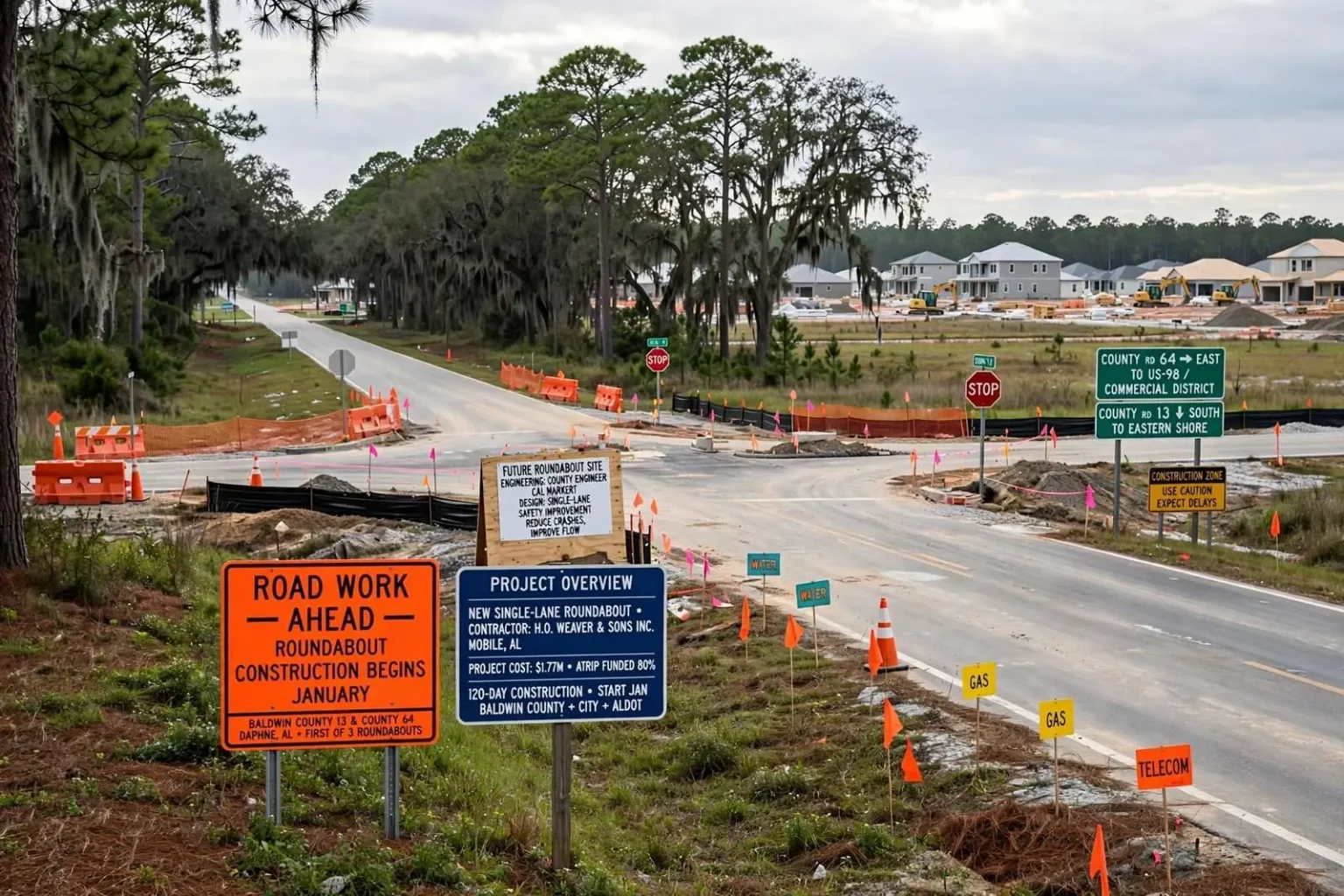
DAPHNE, Ala. — Drivers in Daphne were set to see a significant change at one of the area’s busiest intersections, with construction of a new traffic roundabout scheduled to begin in January. The circle, planned for the intersection of Baldwin County 13 and Baldwin County 64, was the first of three roundabouts envisioned for the corridor.
A Mobile-based contractor, H.O. Weaver & Sons Inc., won the roughly $1.17 million low-bid contract in November for the joint project involving the city of Daphne, the Baldwin County Commission and the Alabama Department of Transportation. The company was given 120 days to complete the work once construction started in early January.
The intersection sits in one of the fastest-growing parts of Daphne, where residential subdivisions feeding onto the county roads have pushed volumes well past what the original two-lane crossroads were designed to carry. Baldwin County 13 serves as a north-south spine connecting communities toward the Eastern Shore, while County 64 carries east-west traffic between growing neighborhoods and the commercial centers along U.S. 98 and beyond.
How the Project Was Funded
The overall cost of the project was expected to reach about $1.77 million. Roughly 80 percent of the construction cost was covered by a grant through the state’s Alabama Transportation Rehabilitation and Improvement Program, or ATRIP. The county and city agreed to split the remaining 20 percent along with engineering, design and other fees, with each side contributing about $215,959.
The funding split reflected the shared nature of the road network. Both the county and the city have jurisdiction over segments of the corridor, and the state grant program — created to help local governments tackle rehabilitation and safety projects that local tax bases could not fund alone — required local matching dollars as a condition of participation. Officials in both governments described the arrangement as the only practical way to deliver a project of this type, since neither the city nor the county could have justified the full cost from routine road budgets.
ATRIP drew its name and its mission from the state’s effort to rehabilitate aging roads and improve safety across Alabama’s 67 counties. The program funded hundreds of projects after its creation, from resurfacing and bridge work to intersection rebuilds like Daphne’s, and competition for the grants was stiff enough that local delegations lobbied hard for their share.
A Project Years in the Making
The Daphne roundabout had originally been slated to begin in early 2014, but right-of-way purchases and utility relocations pushed back the bid process. County officials said utility work was largely on schedule at the time, aside from one provider they were still waiting on before construction could move forward.
The delays were unglamorous but typical. Acquiring small slivers of land from adjacent property owners for the wider circular footprint takes months of appraisal and negotiation, and relocating buried utility lines — water, sewer, gas, telecommunications — must happen before construction equipment arrives, because no contractor can rebuild an intersection while live lines run through it.
Why a Roundabout
County Engineer Cal Markert said the single-lane roundabout would handle current traffic far better than the existing signal and would be even more effective as traffic grows in the years ahead. Before settling on the circle, officials had weighed other options, including adding turn lanes at the existing signal, but concluded that a roundabout would move vehicles more efficiently.
The engineering case for roundabouts rests on how they handle conflict points. A traditional signalized intersection asks drivers to stop and queue, metering flow in cycles that waste capacity whenever one approach is empty while another backs up. A single-lane roundabout replaces that with continuous, slower movement — drivers yield at entry, merge, and exit without ever coming to a full stop unless traffic demands it. Studies of converted intersections across the country have consistently found large reductions in injury crashes, because the circle removes the head-on and broadside collisions that make signal intersections deadly.
Markert cautioned that it could take six months to a year for drivers to adjust before the intersection reached its full potential. That adjustment period is a familiar feature of roundabout projects anywhere in the United States: drivers raised on traffic signals tend to approach their first roundabouts too fast or too hesitantly, and the intersection does not perform as designed until the local driving population has internalized the yield-at-entry rhythm.
Baldwin County pursued the design after research pointed to safety and capacity gains elsewhere, and county engineers had been cataloging intersections across the county where growth was outpacing the old two-lane crossroads. The County 13 and 64 intersection ranked among the candidates where a roundabout could deliver the biggest improvement for the money, and the ATRIP grant made the timing possible.
Part of a Larger Plan
The Daphne circle was the first of three roundabouts envisioned for the corridor, part of a broader approach to managing growth in an area where new subdivisions arrive faster than major road widening can follow. Widening a rural county road into a four-lane urban artery costs tens of millions of dollars and can take a decade of right-of-way acquisition; roundabouts offer a way to improve flow and safety at problem intersections for a fraction of that investment.
For Daphne residents, the construction schedule — 120 days from the January start — meant the work was designed to be disruptive for one season rather than years. Contractors rebuilding an intersection into a roundabout typically close or narrow approaches in phases, detouring through traffic onto parallel routes while the central island and circle pavement take shape.
Local officials pointed to the project as a model of intergovernmental cooperation: a city, a county and the state sharing a corridor, a contractor and the bill. If the roundabout performed as the engineering promised, the second and third circles on the corridor would follow, giving drivers on Baldwin County 13 a sequence of intersections that move steadily even as the traffic counts keep climbing.
What Drivers Should Expect
Once the circle opened, drivers would face rules different from anything else on their route: slow down on approach, yield to traffic already in the circle coming from the left, and never stop inside the circle itself. Pedestrians and cyclists would get shorter crossing distances than at a signal, since the splitter islands break each leg into two halves. Emergency vehicles would benefit too — the circle’s design keeps alternate approaches moving even when one is blocked, a resilience a dead signal cannot offer.
The six-month to one-year learning curve Markert described would test patience at first, but the payoff, county officials argued, would be an intersection that ages well — one whose capacity grows with the community around it instead of calling for another costly rebuild a decade down the road.
Growth Pressure on the Eastern Shore
The corridor project reflects the arithmetic of Baldwin County’s growth, which has made it one of the fastest-growing counties in Alabama for years running. Daphne, sitting on the Eastern Shore of Mobile Bay along the Interstate 10 corridor, has absorbed waves of new residents drawn by the school system, the waterfront and the short commute to Mobile. Each subdivision approved along the county roads adds a few hundred trips a day to intersections that were country crossroads a generation ago.
County 13 and County 64 carry that growth on pavement designed for lighter use. Morning and evening peaks had stretched delays at the signal, and crash histories at stop-controlled and signalized rural intersections were the data points that put the corridor on the county’s improvement list. Traffic engineers evaluating the site found the classic signs: increasing rear-end collisions at the signal, left-turn conflicts, and queues that spilled back toward driveways during peak periods.
The roundabout option addressed all three symptoms at once, which is why the county’s research into peer communities kept pointing back to the design. Communities across the Southeast that installed single-lane circles at previously signalized intersections reported smoother peak flow, fewer injury crashes and lower long-term maintenance costs — no signal equipment to replace, no power bills, and no dependence on detection loops buried in failing pavement.
H.O. Weaver & Sons, the low bidder, brought a long resume of Gulf Coast infrastructure work to the job, having operated out of Mobile for generations on road, utility and marine projects across the region. The 120-day completion window written into the contract reflected the county’s desire to finish the rebuild before peak summer traffic arrived on the corridor.
For the city of Daphne, the roundabout also carried an aesthetic and practical dividend for the entrance it provides to growing neighborhoods. Modern circles are typically landscaped at the central island, and the slower speeds they impose tend to calm traffic on the approaches — a feature residential developments near the intersection had reason to welcome.
As the first of the corridor’s three planned circles, the County 13 and 64 project would effectively serve as the demonstration case. If drivers adapted within the adjustment period the county engineer predicted, and if the intersection delivered the capacity and safety gains the research promised, the case for the remaining two roundabouts would essentially make itself — funded, like the first, through whatever combination of state grants and local matching dollars the county and its municipal partners could assemble.