University of South Alabama Mobile
Mobile Sends a Red-Clad Army to South Alabama’s First Bowl Game
Busloads of Mobile fans traveled to Montgomery to watch the University of South Alabama Jaguars play in their first-ever bowl game appearance.
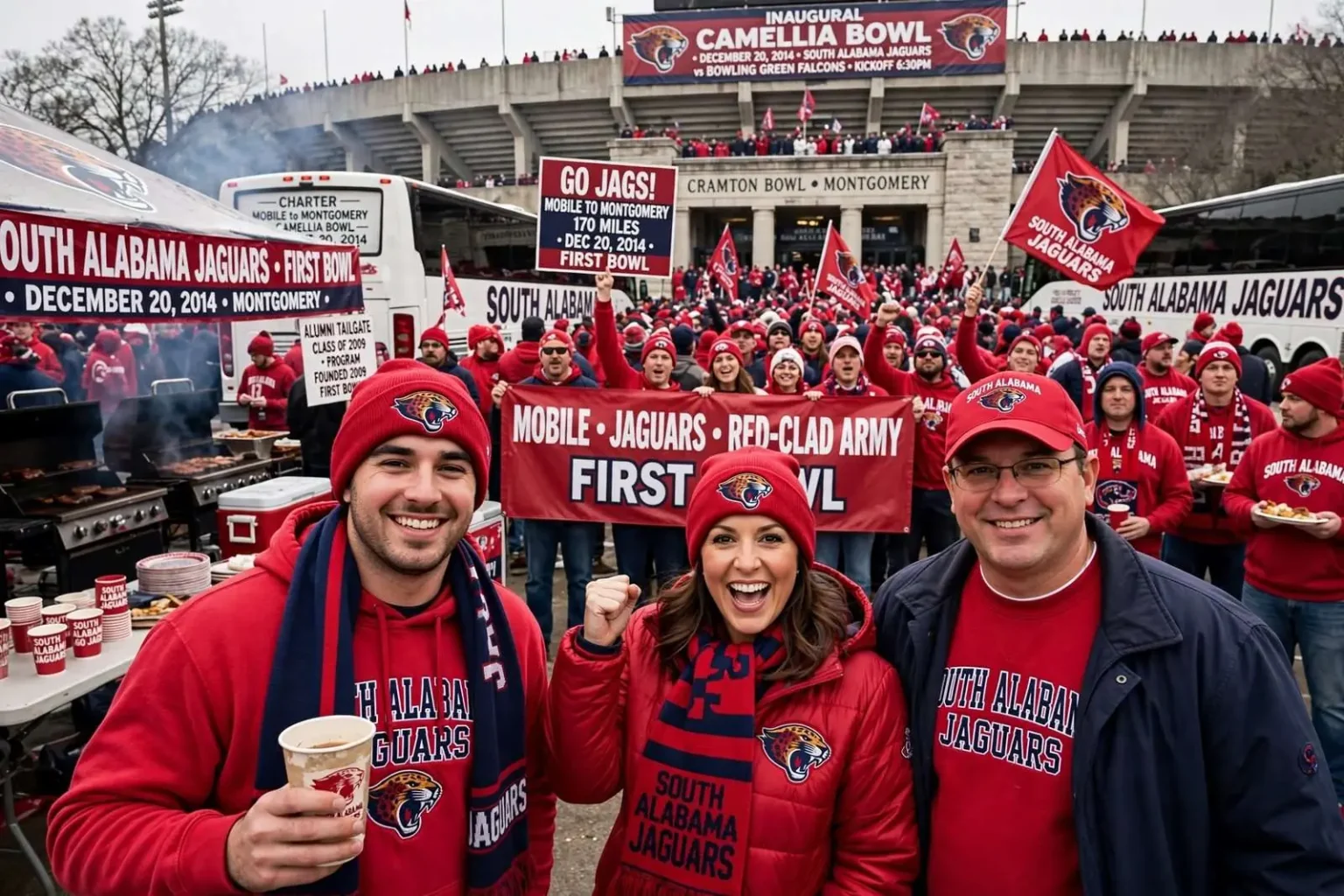
MOBILE — Mobile emptied out a little bit the Saturday before Christmas as busloads of University of South Alabama fans made the trip north to Montgomery, turning out in force for the Jaguars’ first bowl game appearance in program history.
The Jaguars met the Bowling Green Falcons at Cramton Stadium in the inaugural Camellia Bowl on Dec. 20, and the crowd that traveled from Mobile made its presence felt. Fans packed alumni tents wearing South Alabama red, working through plates of barbecue while buses rolled in from the Port City throughout the morning.
The roughly 170-mile journey up Interstate 65 became a shared pilgrimage for a program still young enough that its fans remember when there was no program at all. Football at South Alabama began as a club-level proposal in the late 2000s and moved with remarkable speed to varsity play, and by the 2014 season the Jaguars had reached the milestone every college program chases — a postseason bowl bid, with the national television audience and December tradition that come with it.
Longtime alumni described the turnout as one of the largest traveling crowds they had seen from the young program, drawing comparisons to the record-setting crowd that showed up when USA played Mississippi State. Several graduates said they were struck by how many people made the roughly 170-mile trip so close to the holidays, with buses filled well before kickoff and fans cheering together the whole way north.
A Milestone Years in the Making
Current students, freshly finished with fall semester finals, joined the celebration with a large tailgate near the stadium, treating the game as a milestone moment for a football program that only began play in 2009. The exam-to-bowl turnaround made the trip a reward in more ways than one, and students turned out in numbers that filled their sections alongside the alumni contingents.
University leadership echoed that sentiment on the sidelines, thanking Camellia Bowl organizers for the welcome Montgomery gave the visiting Mobile contingent and calling the experience especially meaningful for current students who had followed the program from its earliest seasons.
One of the students involved in the original 2009 push to bring football to the University of South Alabama said the atmosphere inside the stadium lived up to years of anticipation, praising Montgomery’s hospitality in hosting the first-year bowl game. For that generation of students — the ones who petitioned, fundraised and waited for a team that seemed a distant possibility at the time — the bowl appearance closed a loop that began with a campus campaign and ended in a postseason stadium in the state capital.
The Cramton Bowl, Montgomery’s historic mid-century stadium in the heart of the capital city, provided a fitting stage. The venue had hosted decades of Alabama high school championships and the storied Blue-Gray Football Classic before falling into disuse, and its revival as home of a new bowl game gave central Alabama a December football tradition of its own. For the inaugural edition, organizers matched a Mid-American Conference team in Bowling Green against the Sun Belt’s Jaguars, and the matchup drew a bowl-week crowd that filled a substantial share of the stadium’s seats with traveling Mobile fans.
The game itself gave the record crowd its drama. Bowling Green edged out a narrow victory, but the result did little to dim the occasion for the South Alabama faithful, who had spent years watching a program go from announcement to club team to FBS bowl participant in less than a decade — one of the fastest climbs in modern college football.
A Program That Moved Fast
Fans in the stands and on the concourse alike described the night as a proud moment for a program still in its infancy compared to longtime Southeastern programs. Attendance for the game was announced at just over 20,000 in a stadium with a 25,000-seat capacity, and organizers said South Alabama’s full ticket allotment sold out ahead of kickoff.
The sellout of the visiting allotment was the clearest measure of the Port City’s enthusiasm. Bowl game ticket allocations typically challenge smaller programs, whose traveling bases can be thin in their first postseason appearance; South Alabama’s allotment disappearing before Christmas week, with fans buying through the university’s ticket office in the days after the bid was announced, told organizers everything they needed to know about the program’s reach.
The trip also showcased the geography of the Jaguars’ fan base. Mobile’s position at the southern end of the I-65 corridor puts Montgomery within easy bus distance, and the caravan of charter buses, car pools and family trucks that flowed north on Dec. 20 drew from Mobile, Baldwin County and the coastal communities that have adopted the young program as their own. Alumni chapters and student groups organized much of the travel, packing buses with the kind of coordination more often seen at programs with a half-century of bowl history.
Inside the stadium, the Mobile contingent made itself heard. The red-clad sections behind the South Alabama sideline stayed loud through the afternoon, and the tailgate lots around the Cramton Bowl filled with the barbecue smoke and school-color banners of a fan base treating a first bowl trip the way older programs treat a championship — as the arrival of something they had waited years to see.
The Camellia Bowl’s organizers, for their part, used the inaugural game to showcase Montgomery’s downtown revitalization, with entertainment and events built around the stadium to give visiting fans a full bowl-week experience. The welcome extended to the Mobile visitors became a recurring theme of the Jaguars’ side of the trip, with university leaders and longtime fans alike praising the host city’s reception.
For many of the Mobile-area fans who made the trip, the sellout crowd underscored how quickly the six-year-old program has built a following back home. The bowl trip capped a milestone season for South Alabama football and gave Mobile-area fans a rare shared experience just days before Christmas, with many describing the trip north as a fitting way to close out the program’s most successful year yet.
The Jaguars’ first bowl appearance now stands as a marker in the program’s short history — the season the childhood promise of 2009 became a postseason reality, and the December Saturday when a good part of Mobile turned out in red, 170 miles from home, to watch it happen.
The comparison to the Mississippi State game carried weight for longtime followers. That matchup against an SEC opponent had produced the largest traveling crowd of the program’s early years, a benchmark that mattered because it measured the fan base against a marquee occasion. Reaching that benchmark again — for a bowl game, in the program’s first postseason appearance — suggested the excitement of 2014 was not tied to the novelty of an opponent but to a durable base of support across the Gulf Coast.
Football’s arrival at South Alabama remains one of the fastest program launches in the sport’s modern history. From the board’s decision to add the sport, through club-level seasons, into full NCAA competition and then into the Sun Belt Conference and FBS bowl eligibility, the program compressed a timeline that traditionally takes decades. Each step along the way was supported by the Mobile community — through ticket sales, booster contributions and the student campaign that started it — and the bowl trip gave those supporters their first postseason dividend.
The timing of the game, five days before Christmas, shaped the character of the trip. Fans folded the bowl into their holiday plans, traveling up and back in a single day in many cases, and the pre-game barbecue tents had the feel of a family gathering as much as a tailgate. Students home from finals, alumni visiting family for the holidays and season-ticket holders who had not missed a home game since 2009 all converged on the same stadium in Montgomery with the same destination in mind.
The economic echo of the trip ran in both directions. Montgomery’s hotels, restaurants and downtown businesses welcomed an influx of visitors during one of the slowest retail weekends of the year, while back in Mobile, the sight of thousands of red-clad fans boarding buses became its own story — a visible demonstration that the Port City had embraced a football program that did not exist when many of its newest fans graduated high school.
For the Bowling Green side of the inaugural matchup, the Camellia Bowl represented a different kind of December — a veteran Mid-American Conference program with a longer postseason pedigree facing a newcomer in its first bowl. The contrast between the two sidelines made the evening unusual by bowl standards: a young program’s milestone set against an established winner’s pursuit of another trophy, staged in a stadium Montgomery had restored expressly to bring postseason football back to the capital city.
The inaugural-game atmosphere gave both fan bases plenty to remember, from the pre-game ceremonies to the holiday-weekend crowd that filled most of the Cramton Bowl’s seats. As the final minutes played out, the Mobile sections stayed on their feet, saluting a season that had already delivered more than any in the program’s short history — and a group of traveling fans who had filled their team’s ticket allotment days before kickoff.