Federal Judge Upholds Order Requiring Mobile County to Issue Marriage Licenses
A federal judge declined to lift her order requiring Mobile County's probate judge to comply with a same-sex marriage ruling despite state pushback.
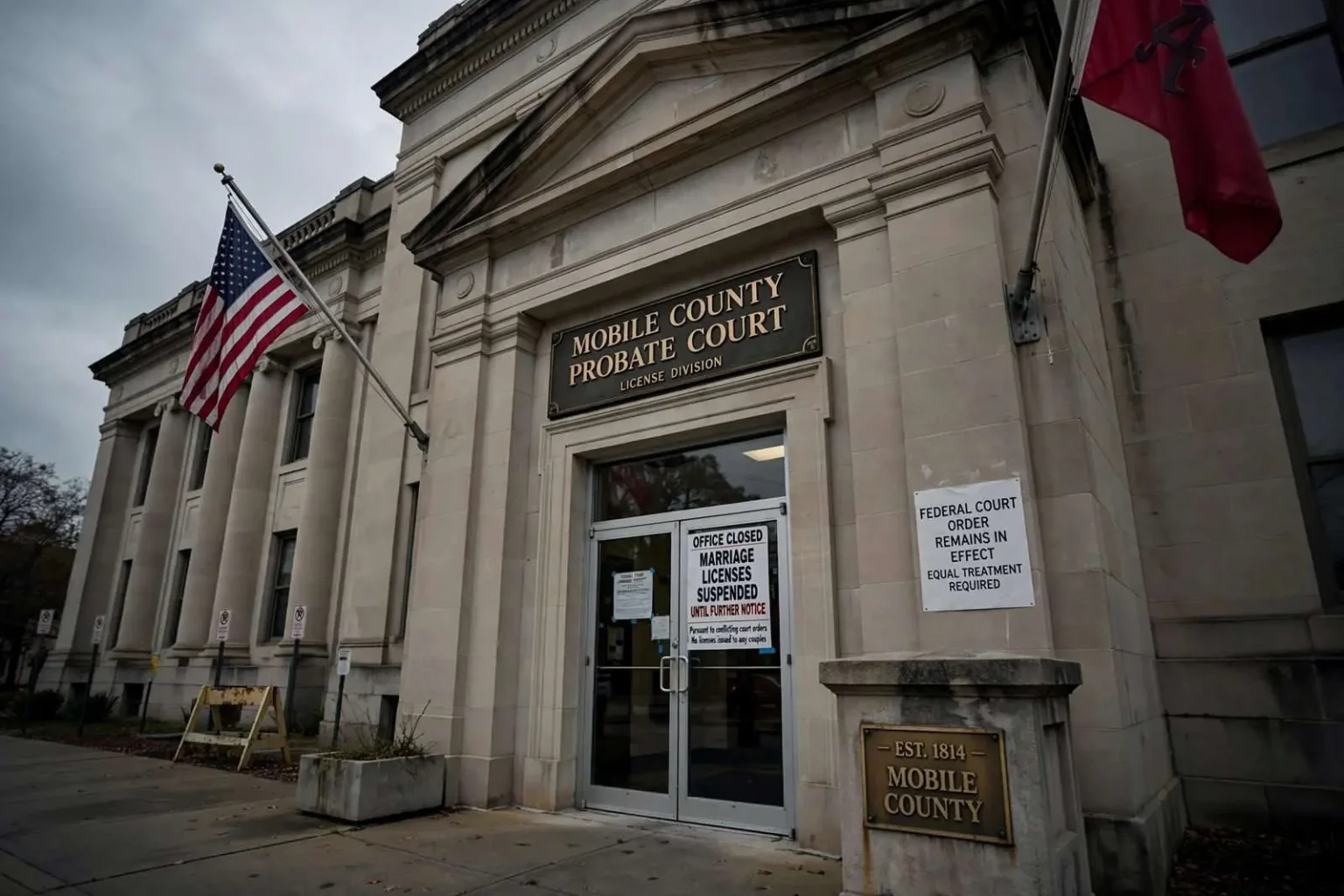
A federal judge declined to lift an order requiring Mobile County’s probate judge to issue marriage licenses to same-sex couples, keeping the county at the center of Alabama’s marriage law standoff even after the state Supreme Court issued a conflicting directive.
Attorneys for Mobile County Probate Judge Don Davis had asked U.S. District Judge Callie V.S. “Ginny” Granade to pause her earlier order in light of a subsequent Alabama Supreme Court ruling that specifically instructed Davis and other probate judges not to issue licenses to same-sex couples while the U.S. Supreme Court considered the broader issue nationally.
Granade rejected the request, finding that Davis had not shown he would be harmed by keeping her order in place or that he was likely to ultimately win the underlying case. The ruling kept in place the federal directive that has governed the Mobile County probate office since the fight began, even as the state court ordered the opposite conduct.
“Although the court would agree that the developments in these same-sex marriage cases has at times seemed dizzying, the court finds that Judge Davis has not shown that a stay is warranted,” Granade wrote in her ruling.
Caught between two courts
The decision left Davis caught between two conflicting court orders. On one side stood the Alabama Supreme Court, which had directed the state’s probate judges not to license same-sex marriages and to disregard the federal rulings on the question. On the other stood Granade’s federal order, backed by the authority of the U.S. Constitution as she read it, requiring the Mobile County probate office to treat couples equally.
His attorneys could not immediately be reached for comment following the ruling. The judge’s predicament was the practical expression of a legal system in which two courts of final authority in their respective spheres had ordered contradictory things, and no one — not the probate judge, not the couples, not the lawyers — could say with certainty how the conflict would be resolved before the U.S. Supreme Court ruled in the cases pending before it.
The Mobile County marriage license office had been closed to all couples, gay and straight alike, since early March as the legal conflict played out. The blanket closure meant that every couple in Mobile County seeking to marry — from couples planning weddings around the season to couples needing licenses for practical matters of property, insurance and children — had been turned away for weeks, because the office could not issue licenses to anyone without issuing them to everyone.
Plaintiffs welcome the ruling
Heather Fann, an attorney representing gay couples seeking marriage licenses in Mobile County, welcomed the ruling. “I think she’s just holding firm to her position that the same-sex marriage ban is unconstitutional,” Fann said, noting that as long as Davis continued withholding licenses from opposite-sex couples as well, he remained technically in compliance with the federal order.
That technicality has been the linchpin of the county’s posture since March. Granade’s order requires equal treatment, not a specific outcome for any couple; by suspending all licensing, Davis could claim he was obeying the federal court while still obeying the state court’s prohibition. The cost of that arrangement fell on every couple in the county, and Fann’s clients had watched their plans remain in limbo month after month.
For the couples who filed the underlying case, the ruling was a mixed verdict — reassurance that the federal court had not retreated from its reasoning, paired with frustration that the practical result, a closed office, had not changed. Their case began as a straightforward request for a license and became one of the test vehicles for the entire state’s conflict.
How the standoff unfolded
Granade had originally ruled in January that Alabama’s ban on same-sex marriage violated the U.S. Constitution, delaying enforcement of that ruling briefly to give the state a chance to appeal. After the 11th U.S. Circuit Court of Appeals and the U.S. Supreme Court both declined to intervene, her order took effect, and probate offices around the state faced the choice of complying or resisting.
What followed was an extraordinary season of defiance and confusion across Alabama’s 67 counties. Some probate judges began issuing licenses to same-sex couples immediately. Some closed their offices entirely, as Mobile County did. Others issued licenses selectively or sought their own court rulings. The Alabama Supreme Court then weighed in with its directive, ordering judges to stop issuing the licenses and explicitly rejecting the federal rulings — a state court telling its officers to disregard a federal constitutional judgment.
Into that breach stepped the state’s most prominent advocate of the prohibition, who had urged probate judges to stand firm, and the weeks of the conflict became a running tally of which counties were marrying couples on any given day. Mobile County, as the site of Granade’s courtroom and the case that started it, drew particular scrutiny, and the judge’s every filing became news across the country.
What the federal court found
Granade’s reasoning on the stay request tracked the ordinary legal standard: a party seeking a pause must show it will suffer harm without one and is likely to prevail in the end. Davis, she found, had shown neither. The closed probate office meant no one was being married in violation of the state court’s directive in any enforceable sense, while the couples’ underlying constitutional claim remained pending in her courtroom, where she had already concluded the ban could not stand.
The judge’s observation that events had seemed “dizzying” was an acknowledgment of the unusual posture — a sitting state supreme court openly instructing defiance of a federal ruling, and a probate judge navigating between them. But the phrase also carried a legal point: turbulence is not a basis for a stay. Federal orders do not evaporate because compliance has become politically uncomfortable.
Legal observers noted that Davis’s position, while politically precarious, was arguably the safest available under the conflict — compliant in form with both courts, at least while the office stayed dark. The danger lay in either direction: issue licenses in defiance of the state Supreme Court’s mandamus, or seek to defy the federal order and risk sanctions. Closing the office to everyone avoided both.
Everyone waits on the U.S. Supreme Court
Underneath the entire standoff was the reality that the U.S. Supreme Court had taken up the marriage question nationally, with a decision expected by summer in cases that would settle whether same-sex couples have a constitutional right to marry. Until then, Alabama’s conflict had no natural exit, and every county judge’s office in the state was operating under a cloud.
A national ruling for same-sex marriage would render the state court’s directive untenable, as probate judges would be bound by superior federal authority whether or not they agreed with it. A ruling the other way would vindicate the state’s prohibition and dissolve the federal orders. Either way, the drama in Mobile — like similar standoffs in other counties — was a holding action timed against the Supreme Court’s calendar.
For Mobile County couples, the practical reality remained unchanged by the latest ruling: the license office downtown stayed closed, wedding plans stayed postponed, and the paperwork for mortgages, insurance policies and adoptions stayed unwritten. Attorneys on both sides of the dispute continued to file as the calendar advanced toward June.
A county at the center
Mobile County’s role in the conflict was never accidental. It was Granade’s Mobile courtroom that struck the ban, Mobile’s probate office that became the test case, and Mobile’s couples who became the named plaintiffs in the litigation now winding through the system. The county’s name appears in case captions read by lawyers and judges nationwide as the marriage question made its final approach to the U.S. Supreme Court.
The latest order reinforced the frame of that role: the federal court would not be moved by the state court’s contrary command, and the probate judge’s duties under her order remain in force regardless of what officials in Montgomery prefer. Whether the county’s license window reopens before the Supreme Court rules — through a settlement, a further order, or Davis’s own decision — remained uncertain as the ruling left the parties where they started.
What is clear is that the “dizzying” sequence of orders Granade described has made Mobile County the place where Alabama’s marriage standoff is being most directly adjudicated, and that every development in the case arrives with consequences not just for the couples in her courtroom but for the probate offices of all 67 counties watching how the conflict is resolved.
Until the nation’s highest court speaks, the county’s license office remains a quiet downtown lobby, its counters dark to every couple, its future set by decisions being made in courtrooms neither the couples nor the clerks can reach.