Mobile Federal Court Sentences Man in Weapons Smuggling Case
A man was sentenced to 30 months in federal prison in Mobile for his role in a scheme to smuggle military-grade weapons to a Mexican drug cartel.
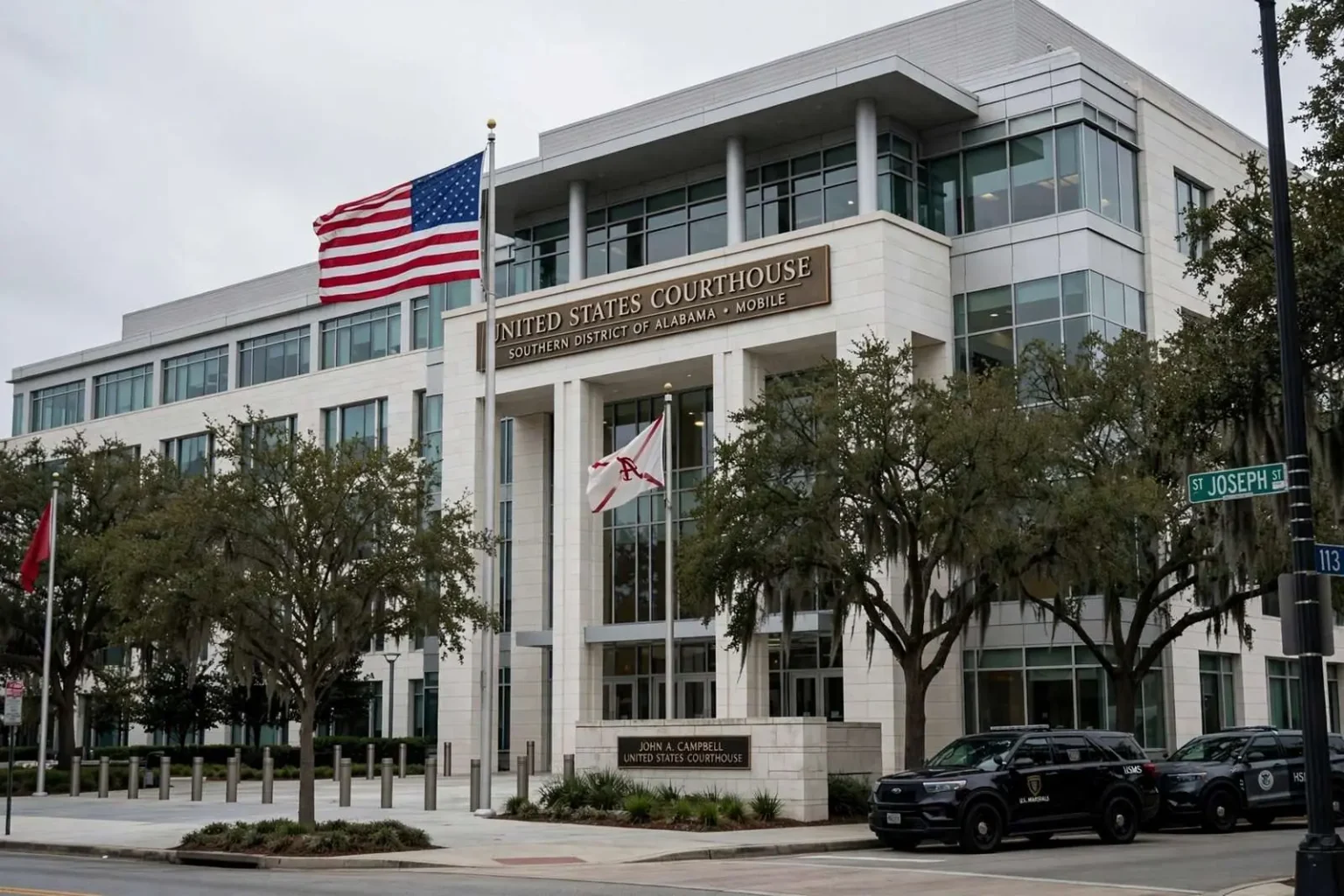
MOBILE, Alabama – A man was sentenced to 30 months in federal prison in Mobile after pleading guilty to a role in a scheme to smuggle military-grade weapons out of the city and into the hands of a Mexican drug cartel.
The sentencing took place in federal court in Mobile before the district’s chief judge. The defendant, a native of Mexico, pleaded guilty earlier in the year to conspiracy to export merchandise from the United States. Following his release from federal custody, he is expected to be turned over to immigration authorities for consideration of deportation.
He was one of five men originally arrested in connection with the smuggling plot, and his case was the last of the group to be resolved. The other four defendants had already been sentenced in prior years, with punishments ranging from probation and time served to prison terms as long as roughly four years — a spread that reflects the differing roles the men played in the conspiracy and the leverage built into federal plea negotiations.
The resolution closes the legal file on a case that began as a conversation between a would-be arms buyer and an undercover federal investigator, and that ended with the last of five defendants standing before Mobile’s chief federal judge to hear a sentence measured in months rather than the years the arsenal itself might have produced had it reached a cartel’s hands.
How the investigation unfolded
According to court records, the case originated from a 2010 investigation after one of the men involved discussed purchasing military weapons with an undercover Homeland Security investigator. The group ultimately arranged to buy a substantial cache of weaponry, including dozens of assault rifles, multiple grenade launchers, grenade projectiles and handguns, with the stated intent of delivering the arms to a Mexican cartel operating across the border.
Undercover arms investigations of this kind operate on a simple premise: federal agents position themselves as illicit sellers, and the buyers reveal their plans, their money and their accomplices one step at a time. No weapons actually moved toward Mexico, and every participant was negotiating with federal officers from the start.
The choice of Mobile as the meeting ground was no accident of geography for the defendants. Court records show one of the men traveled to Mobile in the fall of 2010 to meet with the undercover investigator, inspect the weapons and make a down payment toward the roughly $86,500 purchase price. Two other members of the group later traveled to Texas to complete the transaction with investigators posing as arms sellers, spreading the deal across two states and giving prosecutors in both jurisdictions a hand in the case.
Inspecting dozens of rifles and grenade launchers before payment, then sending delegates to finish the buy in Texas, followed the pattern of organized arms trafficking: trust is established incrementally, and each stage of the transaction tests whether the sellers are genuine. In reality, every stage was documented, recorded and staffed by federal personnel.
The charges and the outcomes
The conspiracy charge the defendants faced — export of merchandise from the United States without a license — is the statutory vehicle federal prosecutors use in arms trafficking stings, carrying sentences that hinge on the nature of the merchandise and each defendant’s role. Sentences across the five men ranged from probation and time already served to roughly four years, with the final defendant’s 30 months falling near the top of the group’s range.
Federal sentencing in a multi-defendant conspiracy assigns each participant a level of blame, and the judge weighing each case hears the prosecutors’ account of who organized, who paid, who traveled and who merely associate-tagged along. The four earlier sentences suggested that division of labor; the last man’s 30 months and expected deportation reflected his place in it.
The deportation expected after his release adds a consequence beyond the prison term. A non-citizen with a federal conspiracy conviction faces near-certain removal proceedings, meaning the resolution of his case carries him out of the country where the crime was planned — though federal authorities note that arms trafficking networks routinely replace deported operatives, which is why stings aimed at the buying side remain a priority.
Mobile’s place in the smuggling picture
The prosecution reflects the kind of cross-border smuggling cases federal authorities in Mobile have pursued in recent years, as the port city’s role as a shipping and logistics hub has occasionally made it a target for those seeking to move contraband, weapons or other illicit goods domestically and internationally.
Mobile’s port ranks among the busiest on the Gulf of Mexico, moving containers, bulk cargo and heavy equipment through a deepwater harbor connected to rail and interstate highways. That connectivity is the city’s economic engine, and it is also what interests federal investigators: a port city with container terminals, freight forwarders, rail lines and trucking corridors offers a smuggler more routes than an inland city ever could.
Homeland Security Investigations maintains a presence in Mobile precisely because of that traffic, working alongside Customs and Border Protection at the port, the FBI, the Bureau of Alcohol, Tobacco, Firearms and Explosives, and the U.S. Attorney’s Office for the Southern District of Alabama. Arms trafficking cases typically draw on several of those agencies at once, as the 2010 sting did, with an undercover investigator at the center and enforcement agencies surrounding the transaction.
The Southern District’s federal court has handled its share of such prosecutions — weapons deals, drug shipments and export schemes that use Gulf Coast infrastructure — and the judges of the district have developed the experience that complex multi-defendant cases demand. Sentencings like the one that closed this conspiracy are the visible end of investigations that run for years before a defendant ever appears in court.
The cartel arms pipeline
The case belongs to a broader federal effort aimed at the flow of American weapons toward Mexican drug cartels — a pipeline that has fueled cartel violence across the border and drawn sustained attention from U.S. law enforcement. Military-grade hardware such as grenade launchers commands particular concern, since it outclasses the armament of many local police forces in Mexico and escalates the violence cartels can inflict.
Because Mexican civilians cannot legally buy most of these weapons, the pipeline depends on buyers inside the United States — brokers who gather weapons through straw purchases, unlicensed deals and, in sting cases, attempts to deal with whoever appears willing to sell. Disrupting a buying cell before its purchase is completed is the intervention federal investigators prefer over chasing weapons after they have crossed the border, where tracing them back through the chain is slow and rarely recovers the arms.
The roughly $86,500 the group put toward the Mobile deal illustrates the scale at which such cells operate — dozens of assault rifles and grenade launchers for a five-man crew to move — and the sting’s design ensured that money bought evidence rather than ordnance. Every dollar paid to undercover agents became part of the record that sent five men through federal court.
The end of the file
With the last defendant sentenced, the 2010 sting’s ledger is complete: five arrests, five resolutions, and a cache of military weapons that never left the government’s control. The case stands as a template of how such investigations work — patience, an undercover agent willing to play the seller, and a prosecution team willing to wait years for each defendant’s day in court.
For federal authorities in Mobile, the message such cases send is deliberately public: the city’s port and logistics networks make it attractive to traffickers, and the agencies stationed there are watching. For residents, the case is a reminder that the global arms trade has touched south Alabama’s courtrooms — and that the transactions meant to feed it ended, in this instance, in a federal sentencing hearing on Government Street instead.
Inside a federal sting
Sting operations like this one are among the most resource-intensive tools in federal law enforcement, and they follow a discipline that unfolds over months. Investigators identify a subject through informants, complaints or online activity, then introduce an undercover officer or informant who can plausibly play the role the suspect is looking for — here, a seller with access to military-grade weapons. Every meeting after that is staged to build the record: conversations recorded, payments witnessed, weapons displayed for identification, and travel arranged so that each participant’s role is documented firsthand.
The result, when the case reaches court, is a prosecution built on evidence the defendants helped create — their own words, money and movements. Plea negotiations in such cases tend to be straightforward, which is why all five men in this conspiracy resolved their cases without trial, each pleading to the conspiracy charge that matched the transaction the record showed.
For the undercover personnel involved, the work carries real risk. Posing as an arms dealer puts a federal officer in rooms with people planning to arm a cartel, and the safety of those operations depends on planning that never becomes public. The court record captures the transactions; the operational details behind them remain with the agencies that ran them.
What the case cost — and what it prevented
Measured against the damage the arsenal could have done, the five sentences in the case read as modest: probation, time served, terms reaching roughly four years, and a final 30-month sentence with deportation expected. Prosecutors would respond that the measure of a sting is not the sentence but the shipment — dozens of assault rifles and multiple grenade launchers that stayed out of cartel hands because the sellers were federal agents all along.
Each arms case also produces intelligence that outlives the sentences: names of contacts, payment methods, routes and brokers that investigators in other districts can use. A buying cell unraveled in Mobile contributes to the larger map federal agencies maintain of how weapons move from American streets toward the border, one conspiracy at a time.
The case’s arc — a 2010 conversation, a fall inspection in Mobile, a Texas completion, and years of sentencings — shows the timeline at which federal justice operates. Multi-defendant conspiracies resolve in sequence as pleas are negotiated and defendants are sentenced in turn, and the last defendant’s hearing closes a file the first defendant’s arrest opened years before.
For Mobile, the file’s closure returns attention to the reality underneath it: this city’s docks, highways and rail lines connect it to the same networks federal investigators track from the Gulf to the border, and the agencies stationed here intend to keep the port city a place where such deals end in courtrooms rather than cargo holds.