Mobile Renames Stretch of Tennessee Street to Honor Rayfield Davis, Killed in Unprosecuted 1948 Slaying
Mobile has renamed a stretch of Tennessee Street for Rayfield Davis, a Black Brookley Field worker beaten to death in 1948 in a killing his admitted attacker was never prosecuted for, as a new History Museum of Mobile exhibit examines the case.
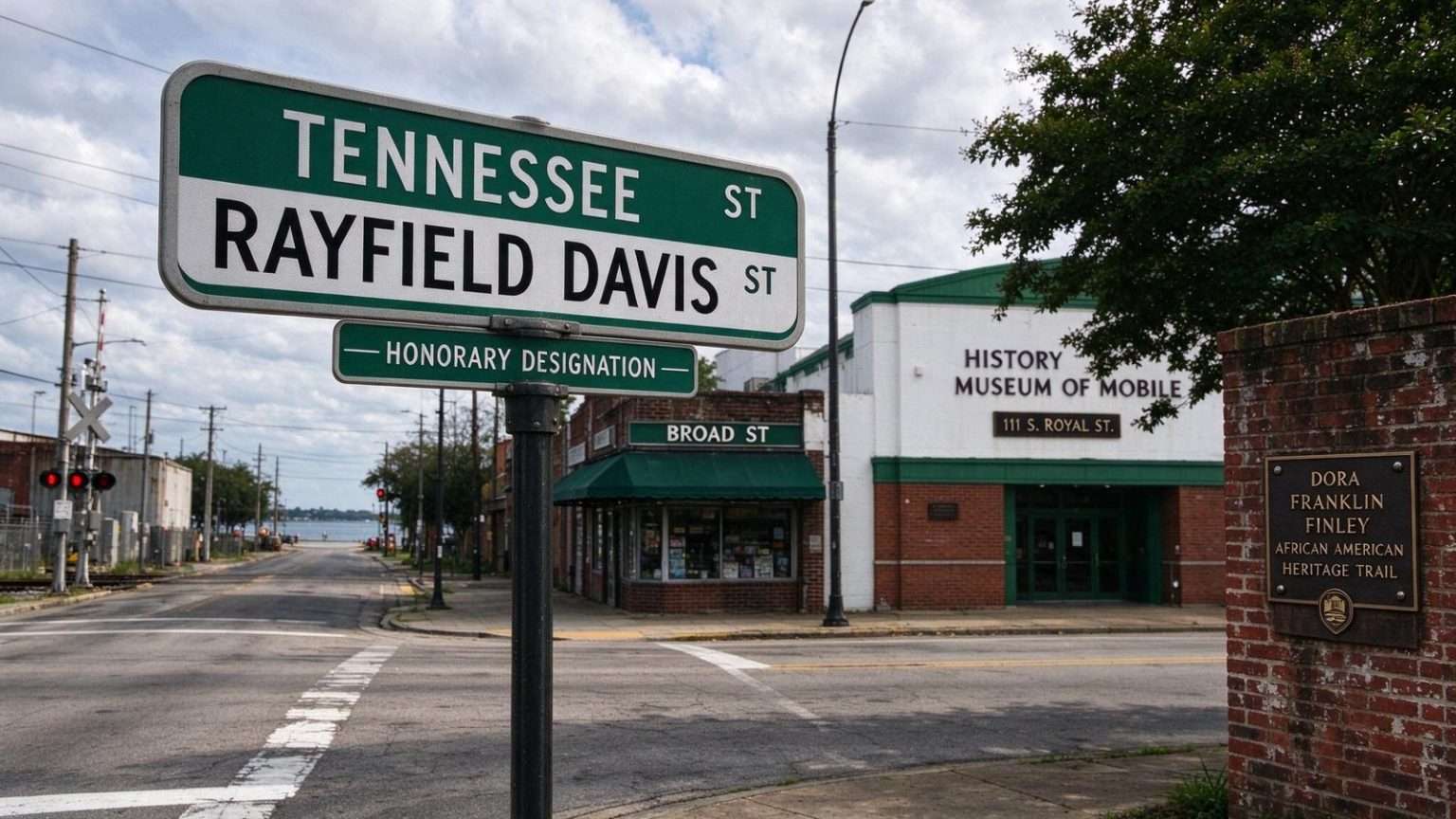
A short, easy-to-miss stretch of Tennessee Street near Mobile’s waterfront now carries a new name: Rayfield Davis Street, in honor of a 53-year-old Black Brookley Field worker who was beaten to death at the corner of Broad and Tennessee streets in March 1948. His killer, a young white mechanic who worked alongside him, confessed to the crime but was never charged. City and county officials joined members of the Davis family for a 10 a.m. dedication ceremony at the site, formally rechristening the roadway where Davis was found dying more than three-quarters of a century ago.
The street itself is a fragmented reminder of the era it commemorates — it begins near the water, disappears for several blocks, and reappears further inland, much like the pursuit of justice for Black Mobilians under Jim Crow. “We’re happy something is being done,” said Nichole Ulmer, Davis’ cousin, ahead of the ceremony. “When you think about what happened back then, we didn’t have very many rights, and to have this being publicized now makes everyone happy.” Ulmer, a financial analyst for Foley-based UTC Aerospace Systems, said her family’s roots run deep in the neighborhood where the killing took place. Her father still lives a block from the address where Davis once resided, and her sister lives nearby on Marine Street.
The drainage ditch where a dying Davis was discovered runs between their homes, a daily reminder of the family’s history in the area. Davis is buried a few blocks away, north and west of the railroad tracks, in Magnolia Cemetery. Decades of weather and neglect have left his headstone cracked and worn. “It was like somebody carved with a sharp instrument on a big piece of rock,” Ulmer said of the marker bearing her cousin’s name. Following the street dedication, the commemoration continued at the History Museum of Mobile, 111 S. Royal St., where Davis is one of six victims of racially motivated killings in Mobile featured in a new exhibit.
The exhibit was developed in partnership with the Civil Rights and Restorative Justice Project (CRRJ) at Northeastern University School of Law, a research initiative that investigates racially motivated killings across the Jim Crow-era South and works with victims’ families to document those cases. The exhibit remains on display through Aug. 30. Court and family records describe the killing this way: late on the evening of March 7, 1948, Davis stepped off a city bus near where the railroad tracks running alongside Tennessee Street cross Broad Street. He was talking with Horace M. Miller, then 20, a mechanic at the Coast Guard facility where Davis worked as a janitor.
In a signed confession, Miller said the two men had been drinking and that Davis invited him back to his home at 961 Tennessee St. Miller said Davis remarked that their “friend President Truman would soon make the negro more important than the white man,” and that the comment prompted him to beat Davis to death with his fists and feet. Miller turned himself in to police days later. A grand jury declined to indict him, finding his account of events legally excusable. According to Ulmer, Miller’s family quickly arranged for him to leave the area. “He’s killed a man and he’s scot-free, and his family’s going to throw him a party and get him out of town, and that’s where it died,” Ulmer said, describing Miller’s departure for Mississippi.
For decades, the Davis family’s knowledge of the killing amounted to little more than a fragment passed down orally — Ulmer’s mother knew only that a cousin had been killed at Broad and Tennessee. That changed roughly five years ago, when researchers with CRRJ reached out to the family with case records documenting what had happened. “[CRRJ] kept bringing up that normally old cases like that, the perpetrator has died, and lo and behold, this guy was still in Florida,” Ulmer said, recalling her shock at learning Miller was still alive at the time researchers located him. Both Ulmer and a CRRJ representative separately confirmed tracking down a Horace M. Miller of an age consistent with the case living in Pensacola, Florida.
When reached by phone, that Miller hung up without answering questions about the killing. In a subsequent call, a man matching that description and believed to be in his early 90s confirmed he had worked as a mechanic at Brookley in the 1940s, but said he knew nothing of any deadly altercation with Davis. “I just wanted to sit down with him to see if he’s remorseful about what happened, to see if he feels any different,” Ulmer said.
“To me, racism is a learned behavior, and I wanted to know, to sit and talk to him and see if he sowed that bad seed with his children.” Davis’ killer was never indicted or tried, though legal experts say prosecution under Alabama law would have been possible in the years after the crime. Federal civil rights prosecution, by contrast, was always a long shot in a case like this one.
“The federal government would have to proceed under either 18 USC section 241 or 18 USC section 242, and they were unlikely to do so because he didn’t appear to act under color of law nor was he part of a conspiracy,” CRRJ Restorative Justice Project Director Kaylie Simon said, referring to the federal statutes covering civil rights violations and conspiracy against rights. Simon said prosecution is not the only path toward accountability in cases this old, many of which involve defendants who are elderly or deceased by the time they come to light. “Imagine other forms of repair,” she said.
“The street sign and public knowledge can serve wider goals.” CRRJ’s Chelsea Schmitz, who worked on the Davis case years before the street dedication was finalized, wrote in an earlier assessment of the case that public recognition carries its own weight for families who have waited generations for acknowledgment. “This action… would ensure [Davis’] name is not forgotten,” Schmitz wrote. “Furthermore, this achievement would bring comfort to the family who would feel their relative had not died in vain.” The renamed stretch of Tennessee Street and the History Museum of Mobile exhibit together mark one of the more visible local efforts to publicly document Jim Crow-era racial violence in Mobile, an era in which killings of Black residents were frequently met with little or no legal consequence for those responsible.
For the Davis family, the recognition closes a chapter that spent decades as little more than a half-remembered family story.
A Ceremony of Healing — and an Apology
Family members and organizers described the Saturday commemoration as part of a healing process. Mobile Police Chief Lawrence Battiste used the moment to apologize for the era’s failures. “To apologize, particularly from my perspective as the chief of police, to apologize to the community for the injustices that were done to families of color during an era when they couldn’t always see what justice looked like,” Battiste said. According to a Washington Post report on the case, Horace Miller — the co-worker who killed Davis — is still alive. Family members say they are more interested in peace than prosecution.
“He’s 90 years old; I’m quite sure he’s suffered enough,” said Davis’ cousin Nichole Ulmer. “We forgive him as a family, and I’m just hoping and praying he’ll make peace with God.” The ceremony honored Davis and five other men killed in Mobile during the 1940s whose killers were never prosecuted. A historical marker dedicated to all six men is also planned for the Tennessee Street site as part of the Dora Franklin Finley African American Heritage Trail.
About the Researchers and the Law
The Civil Rights and Restorative Justice Project was founded at Northeastern University School of Law in 2007 by law professor Margaret Burnham. It researches racially motivated killings from the Jim Crow era and works with victims’ families to seek public acknowledgment and other forms of repair.
Congress addressed such cold cases in the Emmett Till Unsolved Civil Rights Crime Act of 2008, which directed the Justice Department and the FBI to review unsolved civil rights-era killings that took place before 1970.