Mobile Police Officer Raymond Williams Named January Officer of the Month
Mobile police officer Raymond Williams was named the department's officer of the month for January 2015, recognized for proactive patrol work across his hospital, school and residential beat.
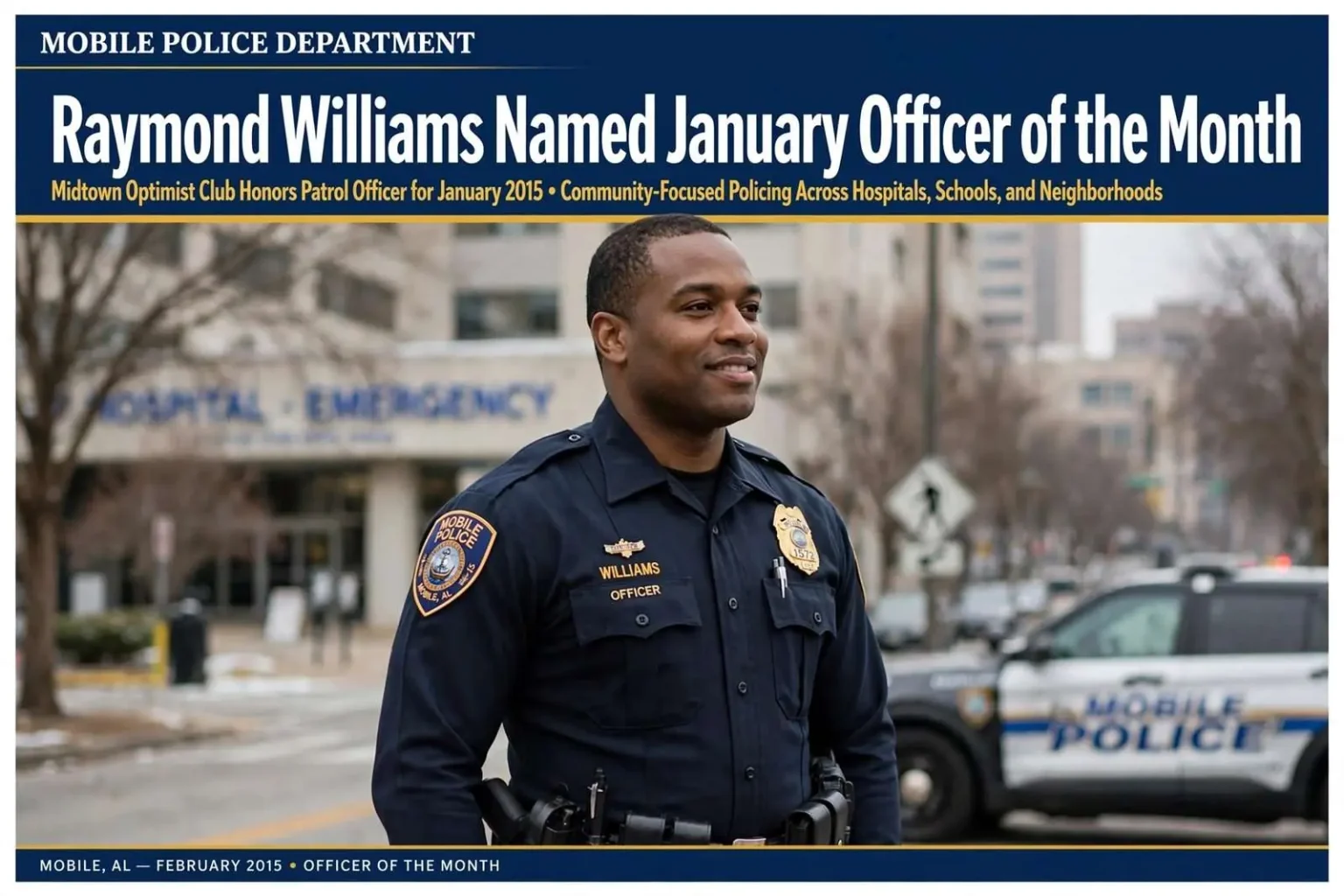
The Mobile Police Department has named Officer Raymond Williams its officer of the month for January 2015, recognizing his work patrolling a beat that spans hospitals, schools, businesses and residential neighborhoods. The monthly honor is sponsored by the Midtown Optimist Club, whose long-running partnership with the department has turned the award into a fixture of Mobile’s community-police calendar.
A beat that ranges across institutions as different as hospitals and schools demands range from the officer assigned to it. Hospital districts generate their own patterns of calls — disturbances, thefts, and welfare checks among patients, visitors, and staff — while school zones require the heightened awareness that comes with protecting children, and commercial corridors and residential streets each bring distinct rhythms of traffic, loitering, and property concerns. An officer who masters one of those environments can still struggle with the next; Williams’ recognition reflected a month of handling all of them.
According to his commanding sergeant, Williams’ willingness to engage directly with the diverse mix of locations on his beat sets him apart. He regularly makes contact with individuals loitering in areas he patrols, a proactive approach authorities credit with helping keep contraband and wanted suspects off Mobile’s streets. The method rests on a simple principle of patrol work: officers who know their beat’s normal patterns, and who talk to the people on it, recognize quickly when something — or someone — is out of place.
Proactive engagement of that kind is slower to produce headlines than a single dramatic arrest, but its effects accumulate. Regular contact builds the information network that alerts officers to emerging problems before they become emergencies, and the visible presence of an officer who stops and speaks routinely changes the calculus of those considering criminal activity in the area.
The January Numbers
The numbers from January illustrate the pace of his workload: 100 calls for service, 34 backup calls answered for fellow officers, three felony arrests, 33 misdemeanor arrests and 100 traffic citations issued. The volume of calls alone averages to more than three per day, before counting the backup responses that pulled him to other officers’ emergencies — a measure of the trust colleagues place in a patrol partner.
The enforcement mix tells its own story. Three felony arrests represent the most serious category of criminal case, while 33 misdemeanor arrests show a sustained, granular level of enforcement activity that keeps smaller offenses from escalating. The 100 traffic citations, matched to a beat that includes busy hospital entrances and school zones, reflect the daily discipline of moving vehicles safely through streets shared with pedestrians.
“Williams’ initiative and enthusiasm in performing his duties show a proactive police style which is an asset to the Mobile Police Department,” the department said in a statement announcing the honor. “His success is the result of professional demeanor and high-quality police work.” The statement’s emphasis on demeanor alongside output was deliberate: departments judge their officer-of-the-month candidates not only on statistics but on how the numbers were achieved, since heavy-handed enforcement can inflate arrest counts while eroding the community cooperation real policing depends on.
The Optimist Club’s Long Partnership
The Midtown Optimist Club, which has sponsored the officer of the month program for years as part of its broader mission supporting local youth and community programs, will honor Williams with a luncheon at noon on Tuesday, Feb. 10, at Azalea City Golf Course, 1000 Gaillard Drive. The luncheon format gives the honoree’s colleagues, family, and club members a chance to mark the achievement in person, a break from the shift rotation where the work itself was done.
Optimist International’s motto of bringing out the best in youth has historically pushed its local clubs toward programs that connect young people with positive role models, and public safety recognitions fit that mission. By underwriting the officer of the month award, the Midtown club supplies both the visibility and the celebration that department budgets rarely provide, and in return the police department gives the civic organization a regular occasion that reinforces its community presence.
The choice of Azalea City Golf Course, a longtime municipal course in the heart of the city, keeps the event accessible and local — appropriate for an award whose entire logic is neighborhood-scale. The February 10 luncheon fell within weeks of the January period being honored, preserving the recognition’s connection to the work rather than letting it drift into ceremony for its own sake.
What Officer of the Month Means
Recognitions like this one reflect a long-running partnership between Mobile’s civic organizations and its police department, intended to spotlight officers whose day-to-day work often goes unnoticed outside their assigned neighborhoods. Patrol work is the profession’s least glamorous and most consequential branch: the officer on a beat is the public’s most frequent experience of the police department, and the quality of those daily encounters shapes the city’s trust in the institution as a whole.
Monthly awards serve an internal function as well. Departments compete for attention against larger crises, and a formal recognition program gives command staff a structured way to signal what kind of policing they value. When the January honoree is cited for engagement and professional demeanor rather than raw arrest totals alone, the message to the rest of the force follows the same logic: the department rewards officers who do the unglamorous work well.
The award also documents the department’s institutional memory. Years of officer-of-the-month announcements create a running record of the individuals whose patrol work held neighborhoods together, and for the officers themselves, the honor lands at moments when the daily grind can make contribution feel invisible.
Midtown’s Beat as a Microcosm
The territory Williams patrols in January — hospitals, schools, businesses and residential blocks — amounts to a cross-section of urban life, and Midtown Mobile’s mix of medical institutions, schools, and older residential streets makes it one of the city’s most varied patrol zones. Traffic around hospital campuses, school dismissals that compress hundreds of vehicles into short windows, commercial parking lots that attract theft and loitering, and the quiet accountability of residential blocks all fall within a single shift’s responsibility.
Handling that diversity requires judgment as much as energy: the approach that works with a hospital visitor in distress differs from the one that works with a repeat offender on a commercial corner, and an officer who reads those situations correctly prevents most of them from becoming arrests at all. Williams’ January record — heavy enforcement alongside steady engagement — suggests a beat officer using both tools.
The recognition cycle that ends with the February 10 luncheon began, as it always does, with the ordinary work: 100 calls answered, 34 colleagues backed up, 36 arrests, 100 citations, and countless contacts with the residents of a Midtown beat. The officer of the month program exists to make sure that kind of month does not pass without the city noticing — and in February 2015, Mobile noticed Raymond Williams.
The Value of Beat Knowledge
Policing research and police tradition agree on the point that Williams’ January demonstrated: the officer who stays on one beat long enough accumulates knowledge no database provides. Knowing which business manager calls about the same trespasser every Friday, which apartment manager keeps order and which one ignores complaints, which corner’s loitering is harmless and which signals something worse — that map exists only in the head of a beat officer who engages with his territory.
Engagement is the active ingredient. An officer can drive the same streets for years and remain a stranger; the contact strategy Williams uses — approaching the individuals who gather where he patrols — converts presence into information. People talk to officers they recognize, and officers who listen learn which wanted individuals are moving through the area and where contraband is being traded, which is precisely how authorities describe his work helping keep both off the streets.
The method also carries risks that discipline manages. Contact work must remain respectful to succeed; an officer who alienates the residents he engages loses the flow of information that makes the strategy valuable. The department’s citation of Williams’ professional demeanor indicates the balance held: firm enough to deter, respectful enough to keep the neighborhood talking.
Civic Recognition as Public Safety Infrastructure
Partnerships like the one between the Midtown Optimist Club and the Mobile Police Department occupy an often-overlooked place in the public safety ecosystem. The club’s sponsorship converts the department’s internal judgment — this officer’s month was exceptional — into a community event with a date, a venue, and an audience. That translation matters because internal excellence programs rarely reach the public, while a luncheon at Azalea City Golf Course puts the department’s values on display in front of the civic leaders, families, and fellow officers who can carry the story further.
The Optimist clubs’ service mission has always targeted the same population that policing most affects — young people and families — and the officer of the month program gives that mission a concrete monthly expression. For the club’s members, honoring an officer is also an act of civic education: each luncheon spreads a specific, positive narrative about what good police work looks like in practice, at a neighborhood scale that residents can evaluate from their own experience.
The luncheon scheduled for noon on Tuesday, Feb. 10, at Azalea City Golf Course, 1000 Gaillard Drive, completed the recognition cycle that the department’s announcement began. By the time Williams returned to his beat that afternoon — hospitals, schools, businesses, and residential streets — the award had done its work: the city had a name and a story to attach to the officer many Midtown residents already knew by sight, and the department had marked another month of the quiet, measurable work that keeps a neighborhood running.