Baldwin County Seeks Private Operator to Revive Live Oak Landing
Baldwin County commissioners want a private company to run Live Oak Landing's general store, boat launches and a future campground.
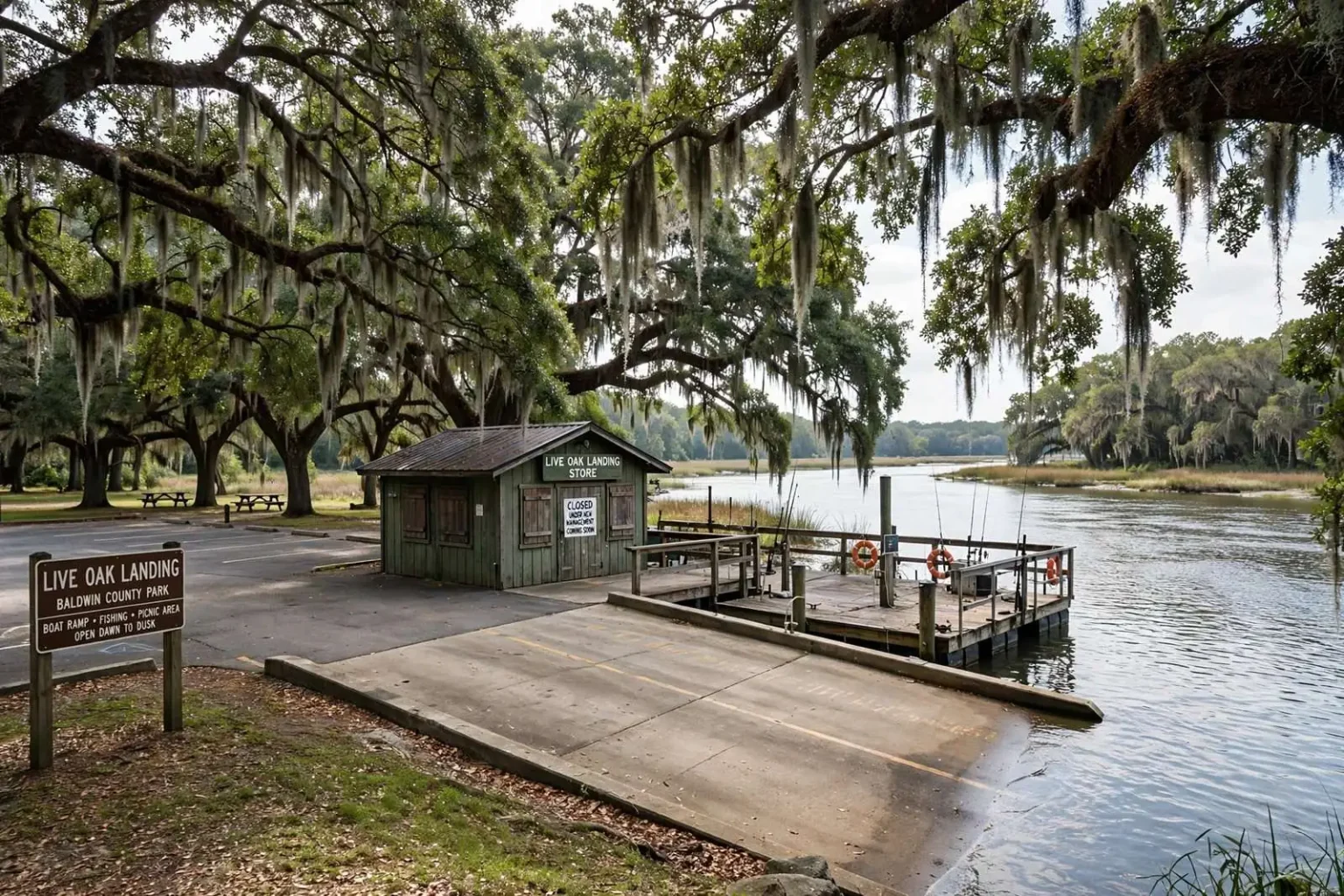
Baldwin County officials are looking to bring in a private operator to help breathe new life into Live Oak Landing, the county-owned riverside park north of Interstate 65 that reopened last year after a $1.2 million renovation but has yet to reach its full potential as a destination. The park, set along the river northeast of Mobile, offers boat ramps, fishing access and quiet stretches of shoreline shaded by mature oaks, but county leaders believe it has remained underused relative to what it could become.
County commissioners verbally agreed this week to issue a request for proposals seeking a private company to operate the site’s shuttered general store and manage its boat launches. The two operations form the core of the park’s day-to-day visitor experience: the launches are the main draw for anglers and boaters, while the store — closed since the renovation — was envisioned as the commercial heart of the property, a place where visitors could buy bait, supplies and refreshments during a day on the water.
Looking further ahead, officials also hope to bring in a private operator for a planned recreational vehicle and camping area, with the county now exploring grant opportunities to help fund that future campground. An RV park would give the property an overnight anchor that day-trip facilities cannot provide, turning Live Oak Landing from a few hours’ stop into a multi-day destination for the anglers, paddlers and birders who travel the region’s rivers.
A shift toward public-private partnerships
The approach marks something of a shift for Baldwin County, which has not historically pursued the kind of public-private partnerships more commonly seen in Mobile and other nearby municipalities. County government in Baldwin has traditionally built and run its own facilities, from parks to public safety buildings, relying on county employees to staff and maintain them. The Live Oak Landing plan signals a willingness to test a different model, one in which the county owns the asset while private operators with specialized experience handle the commercial operations.
County Commissioner Tucker Dorsey said the goal is to bring in outside expertise rather than have county employees running a retail store or RV park directly. “We want to make a return on our investment there,” Dorsey said, adding that the county hopes to have an operator in place before the 2016 spring season. The timeline would allow a new operator to be up and running ahead of the busy warm-weather months, when fishing activity and recreational boating on the river reach their peak.
Dorsey’s argument reflects a practical calculation. Retail operations and campgrounds succeed or fail on staffing, marketing and customer service — skills that private concessionaires develop over years of running similar facilities. By contracting those functions out, the county can keep its parks staff focused on maintenance and public access while putting the commercial side in the hands of people whose income depends directly on attracting visitors.
A careful approach for a public asset
Not every commissioner is fully on board with the pace of the plan. Commissioner Frank Burt Jr. said the county needs to proceed carefully in choosing a private partner, noting that while the county now owns the property, it ultimately belongs to the public, which needs to trust whoever ends up managing it. His caution reflects the questions that arise whenever a public property is handed to private management: what fees visitors will pay, what hours and services the operator will be required to maintain, and how the public’s access to the land will be protected.
Those questions will shape the request for proposals as it is finalized. A well-drafted agreement typically spells out the operator’s obligations in detail — maintenance standards, insurance, revenue sharing and the county’s right to oversight — so that the partnership serves the public rather than simply transferring a public asset to private profit. County officials have signaled that they intend to weigh applicants’ experience and financial strength carefully before selecting a partner.
How the county came to own it
The county purchased the roughly 30-mile stretch of riverside property northeast of Mobile in 2013 for $530,000, with the bulk of that funding coming through a $2.5 million grant from the federal Coastal Impact Assistance Program. The purchase was aimed at preserving land that had previously drawn interest from private developers, protecting the riverside corridor from the kind of intensive residential or commercial construction that has transformed other parts of fast-growing Baldwin County.
The Coastal Impact Assistance Program was created to help coastal states and their communities offset the impacts of offshore energy production, and it has funded conservation and public-access projects across the Gulf region. Using the grant to buy the Live Oak Landing property meant that one of the largest undeveloped riverfront tracts in the county would remain open to the public rather than being subdivided, and it gave Baldwin County a park of a scale few municipalities could assemble on their own.
After closing briefly for renovations in late 2013, the park reopened in February 2014 following more than $1.2 million in upgrades to boat ramps, a weigh station, fishing piers, floating docks and a 140-space parking area. The improvements were aimed squarely at the park’s core users — the bass anglers, crappie fishermen and recreational boaters who launch at the landing throughout the year — and the expanded parking gave the property room to handle tournament crowds on weekends.
More than $900,000 of that renovation funding came through the BP oil spill settlement process, money directed to projects that offset the loss of recreational use along the Gulf Coast after the 2010 spill. Restoring and upgrading public boat launches and fishing piers fit squarely within that purpose, since improved river access substituted for the coastal recreational opportunities that were disrupted during and after the disaster.
Exploring the next round of funding
County Engineer Cal Markert said additional oil spill funding could be tapped for the future campground project, and that officials are exploring several other federal grant sources as well. Campground construction — roads, pads, utility hookups and bathhouses — carries a significant price tag, and county officials have been deliberate about pursuing grant money before committing local funds to the build-out.
The county has also reached out to operators of the 5 Rivers Delta Resource Center to learn more about structuring similar public-private agreements. The Delta Resource Center, at the head of Mobile Bay where the Mobile-Tensaw Delta opens into the bay, has operated as a partnership serving paddlers, anglers and nature tourists, and its experience negotiating the boundary between public ownership and private operation offers a ready model for Baldwin County as it drafts its own agreements.
A quiet spot waiting to be discovered
For now, the park remains a quiet, largely undiscovered spot for local families. Regular visitors describe peaceful afternoons fishing and relaxing among the live oaks draped in Spanish moss, with many area residents still unaware the park reopened after its renovation. The property’s remote setting — well north of the beach traffic that defines south Baldwin County — has kept it off the mainstream tourist map even as it built a loyal following among locals who boat and fish the river.
That obscurity is part of what county officials hope to change. A private operator with a stake in daily revenue would have a strong incentive to market the park, stock the store, staff the launches at peak times and promote the campground once it opens. Tourism officials in the county have long noted that visitors drawn to the beaches often look for additional experiences inland, and a well-run riverside destination could capture some of that overflow as part of a broader itinerary.
The landing also fits into a wider network of public access points along the region’s waterways, which serve not only recreational boaters but also the tournament fishing community that brings weekend visitors and their spending to Baldwin County. A dependable store, well-maintained ramps and, eventually, campsites for out-of-town anglers would position Live Oak Landing to compete for those events, which can fill a parking area to capacity on tournament weekends.
What residents can expect
County officials are hoping a private operator, combined with new amenities like the planned campground, will help more people discover what Live Oak Landing has to offer. In the near term, residents should watch for the formal request for proposals and the selection of an operator, milestones that will determine when the store reopens and how the launches are managed day to day.
The longer-term piece — the RV and camping area — depends on the grant applications the county is now pursuing, and officials have been candid that funding will determine the pace. If those applications succeed, the campground would represent the largest single addition to the park since the county bought it, and would give the property the overnight draw that its day-use facilities alone have not provided.
Either way, the underlying idea remains the one commissioners endorsed when they agreed to seek proposals: the county spent public money to preserve a remarkable riverside property, and the best way to honor that investment is to see it used. With an operator in place and a campground on the horizon, Live Oak Landing may be moving from Baldwin County’s best-kept secret toward a place that residents across the county — and visitors from beyond it — come to know by name.