Who Are Mobile County’s Highest-Paid Employees?
Mobile County's engineer topped the county payroll last year, followed closely by the probate judge, county administrator and sheriff, records show.
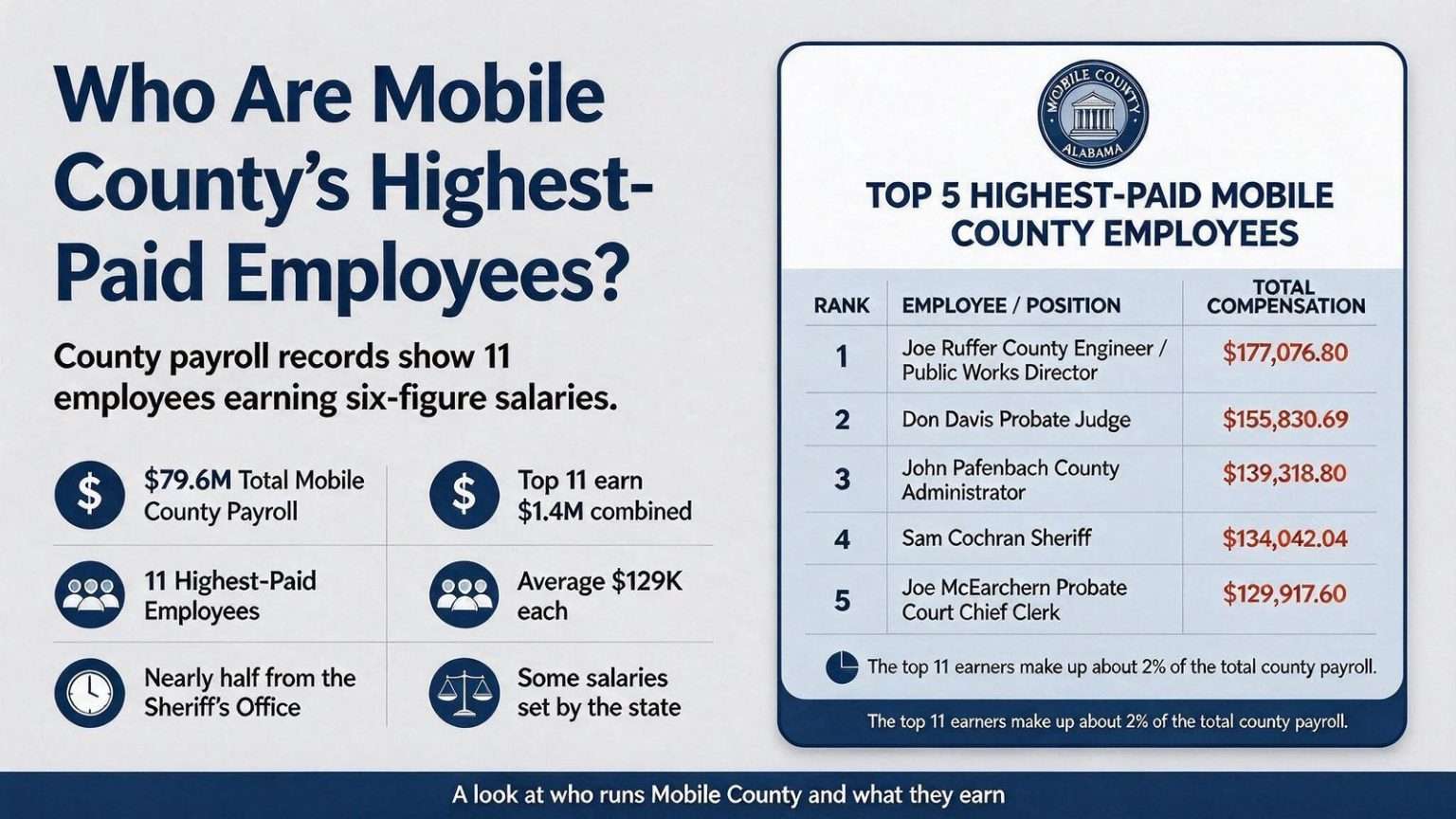
Eleven Mobile County employees earned six-figure salaries last year, according to county payroll records, with the county’s top engineer bringing home the largest paycheck of any local government employee across the county.
Together, the 11 highest-paid county employees collected roughly $1.4 million, averaging about $129,000 each. That edges out the top-paid group at the city of Mobile, whose 11 highest earners collected around $1.2 million, or about $125,000 apiece. Both figures represent a small slice of Mobile County’s overall $79.6 million payroll, which includes medical and retirement contributions.
Topping the list was County Engineer and Public Works Director Joe Ruffer, who earned $177,076.80 — more than the highest-paid employees in either Baldwin County or the city of Mobile.
County Administrator John Pafenbach said Ruffer’s pay, which is set by the state because he is a licensed engineer, reflects nearly four decades of service. “He has been here close to 40 years,” Pafenbach said. “He has simply moved up in his pay scale over the years.”
Mobile County Probate Judge Don Davis ranked second at $155,830.69, with his compensation likewise set by the state. Pafenbach himself ranked third among county employees, earning $139,318.80.
Nearly half of the top-paid list came from the Mobile County Sheriff’s Office, including Sheriff Sam Cochran at $134,042.04 and Mobile County Metro Jail Warden Noah Oliver III at $123,543.60. Rounding out law enforcement’s presence on the list were sheriff’s department deputy chiefs David Wilhelm and Lonnie Parsons, who each earned $103,106.14.
Probate Court chief clerk Joe McEarchern, who ranked fifth at $129,917.60, was the only employee among the group to collect overtime pay, adding $964.08 to his total compensation.
Public Works Superintendent Theodore Lawson ranked sixth at $128,864.67, followed by Deputy Administrator Glenn Hodge at $123,763.60 and Environmental Service Director George Melton, who rounded out the list at $102,303.88.
With the exception of Judge Davis, whose benefits are also set by the state, every employee on the list collected more than $20,000 in additional medical and retirement benefits on top of their base salary.
The 11 positions collectively span the sheriff’s department, probate court, county commission, engineering department and environmental department. County officials note that salary figures for positions tied to state pay scales, such as the engineer and probate judge roles, are largely outside local officials’ control, while administrative and law enforcement leadership pay is set through the county’s own budget process.
Who runs the county, and what they earn
The list reads less like a roster of politicians and more like a directory of the people who keep a county of this size functioning day to day. Roads, bridges, drainage, jail operations, court administration and environmental enforcement are the work of county government, and the salaries at the top of the payroll belong almost entirely to the people who supervise those operations.
Joe Ruffer’s place at the top of the list is a function of both tenure and law. As county engineer, he holds a position whose minimum pay is set through a state schedule tied to his professional engineering license, and his nearly 40 years with the county have carried him up that scale year by year.
The county engineer’s responsibilities are broad and visible. Every road resurfacing project, bridge inspection, drainage improvement and right-of-way acquisition across unincorporated Mobile County passes through the engineering department, and the state’s role in setting the position’s pay reflects how essential the job is considered statewide, in counties large and small alike.
Why the state sets some of these salaries
Two of the largest salaries on the list are not chosen by anyone in Mobile. The county engineer’s minimum compensation is set by the state because of the position’s professional licensing requirement, and Probate Judge Don Davis’s salary is set by state law, as judicial salaries are across Alabama.
Probate judges handle estates, wills, adoptions, guardianships and a range of property matters, and in Mobile County the office’s responsibilities touch thousands of families each year. Because the judge is a constitutional officer, county commissioners cannot adjust the pay up or down; it arrives fixed by statute, just as it does for probate judges in every other Alabama county.
That structure creates the unusual situation reflected in the payroll records: the two highest-paid people in Mobile County government owe their compensation levels to formulas written in Montgomery rather than decisions made locally.
The sheriff’s office presence on the list
Law enforcement accounts for nearly half of the top earners, and the pattern is no accident. The Mobile County Sheriff’s Office patrols a wide stretch of unincorporated county, staffs the Mobile County Metro Jail and runs investigations across the region, making it one of the largest and most demanding operations in county government.
Sheriff Sam Cochran, the county’s chief law enforcement officer, is followed closely on the payroll by Warden Noah Oliver III, whose Metro Jail command is among the largest single responsibilities in county government. The jail operates around the clock, every day of the year, and its warden oversees the staffing, security and legal compliance challenges that come with that scale.
The deputy chief positions held by David Wilhelm and Lonnie Parsons represent the second tier of the department’s command structure. Salaries at that level are set through the county’s budget process, informed by the department’s size, its 24-hour operations and the pay levels needed to retain experienced commanders in a competitive law enforcement market.
Reading the payroll numbers
County officials caution against reading the salary list as a measure of how much local government costs. The $79.6 million payroll includes medical and retirement contributions across the entire county work force, and the 11 top salaries, even combined at roughly $1.4 million, are a small fraction of that total.
The benefits figures attached to the top earners illustrate the point. With the exception of Judge Davis, every member of the list received more than $20,000 beyond salary in medical and retirement contributions, part of the compensation package counties use to attract career professionals rather than short-term hires.
McEarchern’s overtime, a modest $964.08, stands out precisely because it is the only overtime on the list. Salaried leadership positions generally do not collect hourly premium pay, so the chief clerk’s small overtime total reflects the unpredictable workload of the probate court rather than a pattern in how these positions are paid.
Comparisons with neighboring governments carry similar caveats. The county’s top 11 outpace the city of Mobile’s by about $200,000 combined, and the county engineer out-earns his counterparts in Baldwin County and City Hall, but the governments differ in structure, in the positions they employ and in which of their salaries the state fixes.
What the list says about county government
What emerges from the records is a picture of county government as an engineering, public safety and administrative enterprise. There are no elected county commissioners on the list, and the highest earners are instead the appointed and career officials who translate commission decisions into road projects, jail operations and environmental enforcement.
The concentration of long tenure also stands out. Ruffer’s four decades, and the years of service behind other names on the list, reflect a county work force where top officials have risen through the ranks rather than arriving from outside, and where institutional knowledge accumulates in the same offices that hold the largest paychecks.
Payroll records of this kind are public documents, and they surface periodically whenever local governments weigh budgets and pay raises. For residents, they offer a rare concrete look at what running one of Alabama’s largest counties costs, and at the small group of career officials whose salaries reflect that responsibility.
Context behind the numbers
The payroll snapshot arrives at a time when county governments across Alabama are weighing how to pay for competitive services with limited revenue. Mobile County’s major operations are funded through a mix of property taxes, state-shared revenues and fees, and every salary decision competes with road paving, jail costs and other demands on the same budget.
County officials point out that leadership salaries must be understood against what the market demands. Experienced engineers, jail administrators and law enforcement commanders can command substantial pay in the private sector and in other jurisdictions, and counties that pay well below market rates frequently lose veteran officials they spent years training.
The state-set salaries add a wrinkle to local budget debates. Because the engineer’s and judge’s pay arrives fixed by statute, commissioners have no lever to adjust those lines during budget season, and the county simply absorbs the amounts alongside the salaries it does control.
For now, the records show a top-heavy but small group: eleven employees out of a work force spanning every department in county government, whose combined compensation of about $1.4 million represents roughly two percent of one year’s payroll. The rest of the $79.6 million is spread across the deputies, clerks, road crews, maintenance workers and public health staff who make up the bulk of the county’s daily work force.