Mayor Stimpson Pitches $1.9 Million Plan for Mobile City Parks
Mobile Mayor Sandy Stimpson proposed redirecting more than $1 million from a county soccer complex to fund upgrades at parks across the city.
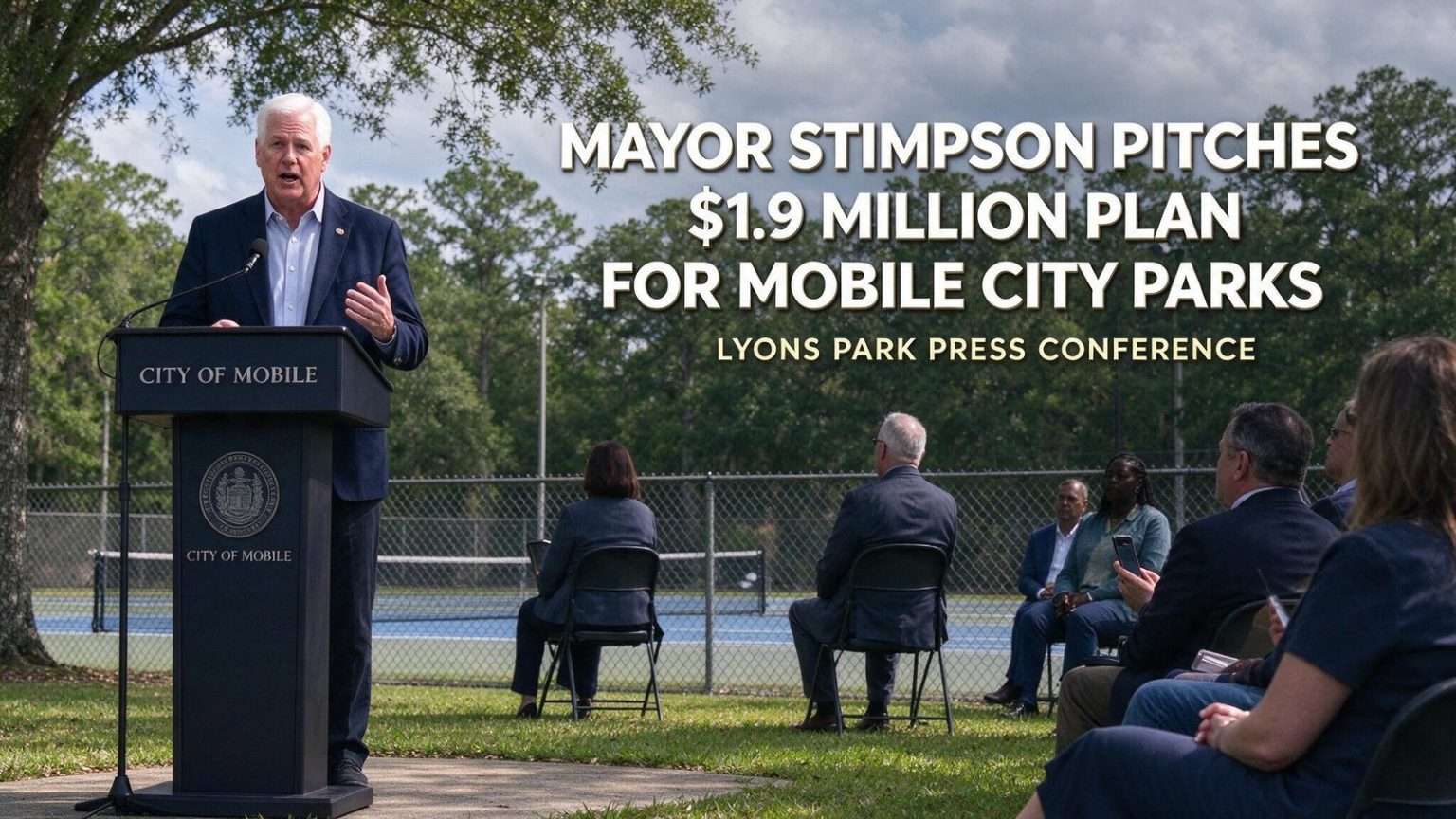
Mobile Mayor Sandy Stimpson unveiled a plan this week to steer roughly $1.9 million toward park improvements across the city, in part by asking the City Council to redirect funding it had previously committed to a regional soccer complex. The council had earlier backed a proposal from Mobile County Commissioner Connie Hudson to help build a soccer complex near the interchange of Interstates 10 and 65, pledging $1.5 million toward the project.
The proposal set up a familiar tug-of-war between city and county priorities. Hudson’s soccer complex concept had been pitched as a regional amenity — a tournament-quality facility that promoters argued could draw travel teams and their families to the area, filling hotels and restaurants on weekends. The city’s earlier $1.5 million pledge represented its share of that vision. Stimpson’s counterproposal argued that the same dollars could do more visible good spread across neighborhood parks in every corner of the city, where maintenance backlogs and aging facilities have accumulated for years.
Stimpson’s new plan would move a large share of that money instead into parks spread across every council district in the city. “I think it’s incumbent upon the City Council to join with us in addressing the needs and the things that currently we have,” Stimpson said at a press conference held at Lyons Park, “and we’ve got to bring up to a standard that’s expected by our citizens.”
The choice of Lyons Park for the announcement was deliberate. The park, one of Mobile’s oldest and most storied public spaces, sits just west of downtown and has served generations of families in the surrounding neighborhoods. Its facilities — like many across the city — have aged, and the mayor’s team wanted the backdrop to illustrate the argument: residents do not need new destinations so much as they need the places they already have brought back to standard.
Among the projects outlined in the proposal: a new dog park at Public Safety Memorial Park, a modular tennis pro shop at Medal of Honor Park, and resurfaced tennis courts at Lyons Park, where Stimpson said declining court conditions had caused play to drop off in what was once a busy tennis destination.
The project list was assembled to touch different kinds of recreation across the city’s geography. Public Safety Memorial Park, which honors fallen officers and firefighters, sits in West Mobile and draws families from surrounding subdivisions; a dog park there adds a low-cost amenity that has proven popular in cities nationwide. Medal of Honor Park on the city’s west side is one of the busiest recreational complexes in the system, hosting leagues and tournaments year-round, and a pro shop facility supports the tennis programming already operating there. The resurfacing work at Lyons Park addresses a facility that once anchored competitive tennis in the city but has watched participation slip as courts deteriorated.
Under the plan, the bulk of the funding — about $1.5 million — would come from reversing the council’s earlier commitment to the county soccer project, while the remaining roughly $400,000 would be drawn from residual capital already sitting in various city accounts.
Redirecting committed capital is never a purely administrative exercise in municipal government. The council’s earlier vote for the soccer complex represented a promise to a county partner, and unwinding it requires a new vote and a renewed relationship with the commission. City officials also must account for where each of the residual balances sits, since money carried over in capital accounts is often already earmarked for specific projects or subject to restrictions tied to its original source. The administration’s decision to spread projects across all seven council districts was clearly designed to build the broadest possible coalition for the redirection vote.
Stimpson framed the initiative as part of a broader push to make Mobile’s neighborhoods more livable for residents of all ages, saying parks serve as connective tissue for the community. City officials acknowledged, however, that the projects included in this round represent only a small slice of a citywide parks backlog that could cost upwards of $10 million to fully address.
That backlog figure has hovered over Mobile’s parks conversation for years. The city operates dozens of parks, playgrounds, community centers, ball fields and courts, many built decades ago when the city’s population and tax base were distributed differently. Deferred maintenance compounds: a roof that goes unrepaired leads to structural damage, a court that goes unresurfaced loses its league play, and a park that loses its league play loses the neighborhood presence that deters vandalism. Officials have warned that a one-time infusion, however welcome, cannot substitute for a sustained capital program that keeps facilities from sliding back.
Not every council member was on board. Councilwoman Bess Rich said the city has not yet finalized a memorandum of understanding with Mobile County on funding for the soccer complex land, and she indicated that pulling the city’s money before the paperwork was settled could create legal and diplomatic complications with the commission.
The Council’s Dilemma
Rich’s objection put her colleagues in an uncomfortable position. Withdrawing the $1.5 million pledge satisfies a mayor pressing for neighborhood investment, but it risks leaving the county’s project short of its funding plan and straining the intergovernmental cooperation that both bodies rely on for drainage, roads and economic development. Council members also had to weigh the optics of redirecting money already promised for a regional project — a decision that youth soccer families in the city would feel directly, since Mobile players would presumably use the complex once built.
The debate also exposed a philosophical split that recurs in municipal budgeting: whether scarce capital dollars should chase new regional amenities or shore up existing assets. Proponents of the soccer complex argued that tournament facilities generate revenue and elevate the city’s profile; the mayor’s camp countered that a city struggling to resurface tennis courts has no business subsidizing facilities outside its borders. Both positions have precedent in Mobile’s history, and the parks plan forced the council to choose between them in a single vote.
What the Plan Would Deliver
If approved, the $1.9 million plan would produce tangible changes within a year at parks across the city. Resurfaced tennis courts at Lyons Park would restore a facility that older residents remember as a hub of the city’s tennis scene, and city officials hoped renewed conditions would bring leagues back. The dog park at Public Safety Memorial Park would give West Mobile dog owners a designated space that few areas of the city currently offer. The modular pro shop at Medal of Honor Park would support one of the system’s busiest complexes, where tournaments and youth programming generate steady traffic.
City engineers and parks staff estimated the projects could move quickly because they involve existing sites, minimal land acquisition and straightforward construction. That speed was part of the mayor’s pitch: unlike a regional complex still in its planning stages, these improvements could begin as soon as contracts were let, delivering visible results in every council district well before the next budget cycle.
The Bigger Picture
Beyond the immediate projects, the Stimpson administration presented the plan as the opening move in a longer-term parks strategy. The $10 million backlog will not disappear with this round of funding, and officials acknowledged that a comprehensive approach — prioritizing facilities, budgeting maintenance annually and deciding what the city can realistically operate — remains unfinished business. Neighborhood associations across Mobile have lobbied for years for attention to their local parks, and the mayor’s decision to distribute projects across all districts signaled an attempt to answer them at scale.
The coming council vote will determine whether the plan moves forward on the mayor’s terms. Whatever the outcome, the debate has already reset the conversation about Mobile’s parks: the question is no longer simply whether the city can afford to invest in its parks, but whether money already on the table should stay committed to a regional project or come home to the neighborhoods that use the city’s facilities every day. For the residents who gathered at Lyons Park to hear the announcement, the answer they hope for is written on the courts behind the podium — cracked, faded and waiting for the resurfacing machine.
The history of the two facilities at the center of the fight illustrates the stakes for each side. Lyons Park dates to the early twentieth century and occupies a place in the city’s recreational memory that few newer parks can match; restoring its tennis courts would revive a tradition as much as a facility. The proposed soccer complex, by contrast, would be an entirely new build on county land near one of the busiest interstate interchanges in the state, designed from the start to compete with tournament facilities in Gulf Shores, Pensacola and elsewhere along the Gulf Coast. Choosing between them meant choosing between restoration and expansion as the city’s parks philosophy.
Parks advocates in Mobile have long argued that the city’s system is one of its most underappreciated assets. The city’s parks host youth baseball and softball leagues that have produced generations of local players, summer programs that serve working families, and green space that supports property values in surrounding neighborhoods. Studies across the country have linked well-maintained parks to reduced crime, improved public health and stronger neighborhood attachment, and Mobile’s neighborhood associations have made the connection repeatedly in their appeals to the council for reinvestment.
The administration’s accounting for the plan was designed to answer the predictable question of whether redirecting the soccer money leaves the county project stranded. City officials noted that the county commission retains its own funding commitment to the complex and that the city’s withdrawal, while unwelcome, would not by itself end the project. Hudson and other county leaders had been working for years to assemble the financing, land and partnerships the complex would require, and the city’s pledge was always one piece of a larger puzzle. Whether that puzzle can still be completed without Mobile’s contribution will be settled in the county’s budget deliberations, not the city’s.