Top 20 Mobile County Employees Collected Nearly $493,000 in Overtime Last Year
Payroll records show Mobile County's highest overtime earners, mostly sheriff's deputies and jail staff, collected close to half a million dollars combined.
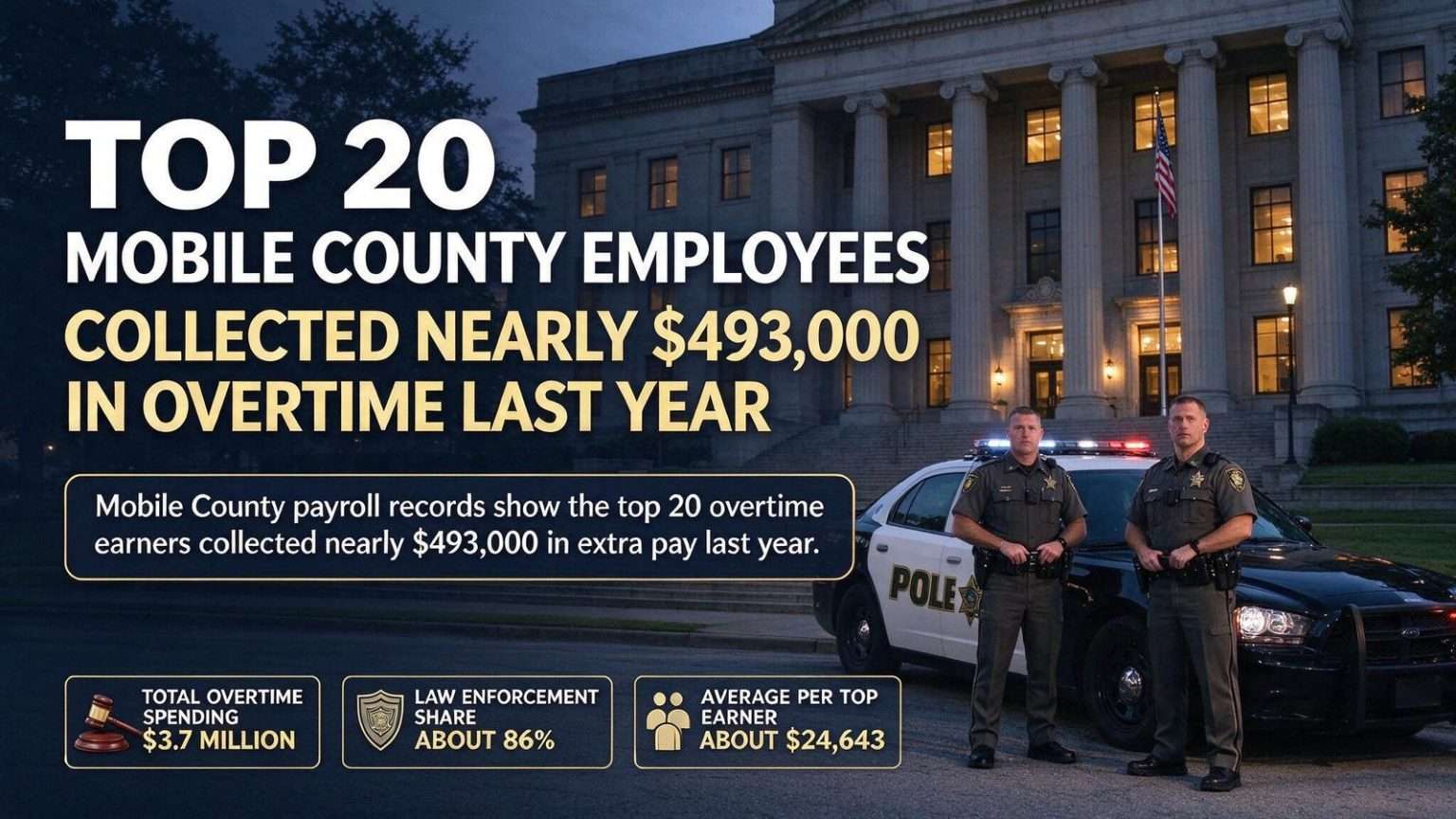
Mobile County payroll records show that the county’s twenty highest-paid overtime earners collected a combined $492,867 in extra pay last year, a figure that sits inside a much larger picture: more than $3.7 million in total overtime spending across county government. The numbers, drawn from the county’s payroll records, offer a detailed look at how one of Alabama’s largest county governments covers the gap between the hours its operations demand and the hours its budgeted workforces can supply.
On average, each of the top twenty overtime earners brought in about $24,643 beyond their base pay over the year. That average is substantial, but it is somewhat lower than the comparable figure next door: the top twenty overtime earners on the City of Mobile’s payroll averaged roughly $33,152 in extra pay over the same period. The contrast between the two payrolls, which together cover most of the public safety and administrative work in Alabama’s second-largest city and its surrounding county, illustrates how differently the two governments absorb the demands of round-the-clock operations.
Where the Overtime Dollars Went
By far the largest share of the county’s overtime spending went to law enforcement. About 86 percent of the total — roughly $3.3 million of the $3.7 million — went to police personnel, including Mobile County Sheriff’s Office deputies and officers of the Thirteenth Judicial Police. That concentration is not accidental. Sheriffs’ offices and judicial police units are among the few county functions that never close, providing patrol coverage, court security, warrant service and jail operations at every hour of the day and every day of the year.
Mobile County Sheriff Sam Cochran said the overtime reflects the practical realities of policing, which often requires odd hours, specialized training and additional staffing that can be cheaper to cover through overtime than through hiring additional full-time employees with benefits. A deputy working a holiday shift or an extended stakeout generates overtime pay for the hours actually worked; a new hire carries a salary, health insurance, retirement contributions and training costs that continue whether or not the position is needed on any given week. For departments facing unpredictable workloads, overtime is often the more flexible — and in many cases the less expensive — tool.
The clearest example of that pressure is the Mobile County Metro Jail. Cochran noted that the jail’s staffing levels have not grown in roughly twenty years, even as the facility’s population has increased by about 60 percent over that span. The jail, which houses inmates for the city, the county and numerous municipal agencies across the region, cannot reduce its coverage without risking safety, and state minimum-staffing standards for correctional facilities leave little room to trim posts. The result has been a steady migration of extra hours onto the schedules of the existing correctional staff, who work the additional shifts needed to keep every housing unit, booking desk and transport detail covered.
The Exception Outside Law Enforcement
Only one of the top twenty overtime earners worked outside law enforcement: Mobile County Revenue Commission Administrator Glen Ford, who collected $21,702 in overtime on top of his $72,588 salary. His presence on the list is a reminder that extended hours are not confined to badge-and-gun work. The Revenue Commission, which administers property tax assessment and collection for the county, has statutory deadlines and caseloads that do not always fit inside ordinary business hours.
Revenue Commissioner Marilyn Wood said Ford, a 28-year county employee, handles bankruptcy, personal property and tax abatement cases that often begin as early as 4 a.m. Bankruptcy filings, in particular, arrive on federal court schedules and can trigger immediate action to protect the county’s position on delinquent accounts. Wood also noted that Ford’s specialized training extends beyond the county’s own operations: he teaches a tax abatement course at Auburn University, making him one of the officials to whom other Alabama taxing jurisdictions look for expertise in a technical corner of property tax law.
Among the Highest Individual Earners
Within the Sheriff’s Office, individual overtime totals reached levels that in some cases approached or exceeded what many employees earn in base salary. Among the highest individual earners were Sheriff’s Sgt. Daniel Holifield, who collected nearly $39,000 in overtime as an on-call employee managing the department’s vehicle fleet and volunteering for weekly highway enforcement shifts. Fleet management is a quiet but essential function for a sheriff’s office that runs hundreds of patrol vehicles around the clock; when a cruiser goes down, the department needs someone who can authorize repairs and put a replacement on the road at any hour.
Also near the top of the list was Deputy John Cassidy, a narcotics investigator who earned around $34,500 through overtime tied to surveillance work and court appearances. Narcotics investigations rarely observe a tidy schedule. Surveillance of suspected drug activity is dictated by the movements of the targets rather than by a shift calendar, and undercover operations that begin in the evening frequently run well past midnight. Then there is the court system itself: when a case built on months of surveillance reaches trial, the investigator must be in the courtroom, often for days, in addition to continuing the caseload that produced the evidence in the first place.
Thirteenth Judicial Police Chief Charles Dube, whose staff earned significant overtime providing security at Government Plaza during roof construction work, said he expects that department’s 2015 overtime costs to drop to roughly a third of the prior year’s total now that the repair work is complete. The roof project at Government Plaza, the downtown Mobile complex that houses courtrooms and county offices, required security personnel to manage entrances, detours and access changes for an extended period, generating hours that no one anticipated when the annual budget was written.
What Overtime Costs — and Saves
The figures complicate any simple conclusion about whether the county’s overtime spending is a problem or a bargain. On one hand, $3.7 million is real money in a county budget that must also fund roads, parks, courts and a jail system serving one of the fastest-growing metropolitan areas on the Gulf Coast. Extended overtime can also strain employees, and studies of public safety agencies across the country have linked chronic long hours to fatigue, turnover and, ultimately, higher costs.
On the other hand, filling the same gap with new hires would cost more in most cases. A full-time deputy position carries not only salary but also benefits, equipment, vehicle costs and academy training that can take many months before the officer works an independent shift. Overtime, by contrast, buys only the hours needed and can be dialed back as circumstances change. For departments such as the Metro Jail, where population surges are hard to forecast, that flexibility has real value even when the annual overtime total looks large.
County officials have not signaled plans to change staffing levels in response to the figures, with Cochran maintaining that overtime remains the more cost-effective option for covering the department’s staffing gaps. That position reflects a calculation shared by many public agencies in Alabama and beyond: as long as overtime totals remain manageable relative to the cost of permanent expansion, the county will continue paying its existing workforce for extra hours rather than growing its fixed payroll.
What It Means for Mobile County Residents
For residents, the payroll figures are more than an accounting exercise. Overtime in the Sheriff’s Office and the Thirteenth Judicial Police translates directly into the services the public sees: deputies responding to calls in unincorporated communities such as Grand Bay, Theodore and Wilmer, bailiffs keeping downtown courtrooms secure, and correctional officers supervising a jail population that has grown far faster than the staff responsible for it. The $3.3 million spent on law enforcement overtime is, in effect, the price of keeping those services operating at current levels without expanding the workforce.
The comparison between the city and county payrolls also gives local taxpayers a framework for evaluating future budget requests. When the sheriff asks for more deputies or the revenue commissioner seeks additional staff, the alternative on the table is not simply hiring — it is continuing to pay for the same coverage through overtime, which shows up year after year in payroll reports. Understanding which option costs less over time requires exactly the kind of disclosure the top-twenty list provides.
The figures also give county residents a benchmark to watch in coming years. If overtime spending continues to climb while staffing remains flat, the pressure that Sheriff’s officials describe — particularly at the Metro Jail — will keep building, and the cost calculation that currently favors overtime may eventually shift. For now, the county’s top overtime earners reflect a government quietly leaning on its most experienced employees to absorb growth that the budget has not yet caught up with.