Spanish Fort Council Rejects $769,000 Artificial Turf Project at Toros Stadium
The Spanish Fort City Council voted down a new artificial turf field at the high school stadium, with the mayor citing lingering tax referendum fallout.
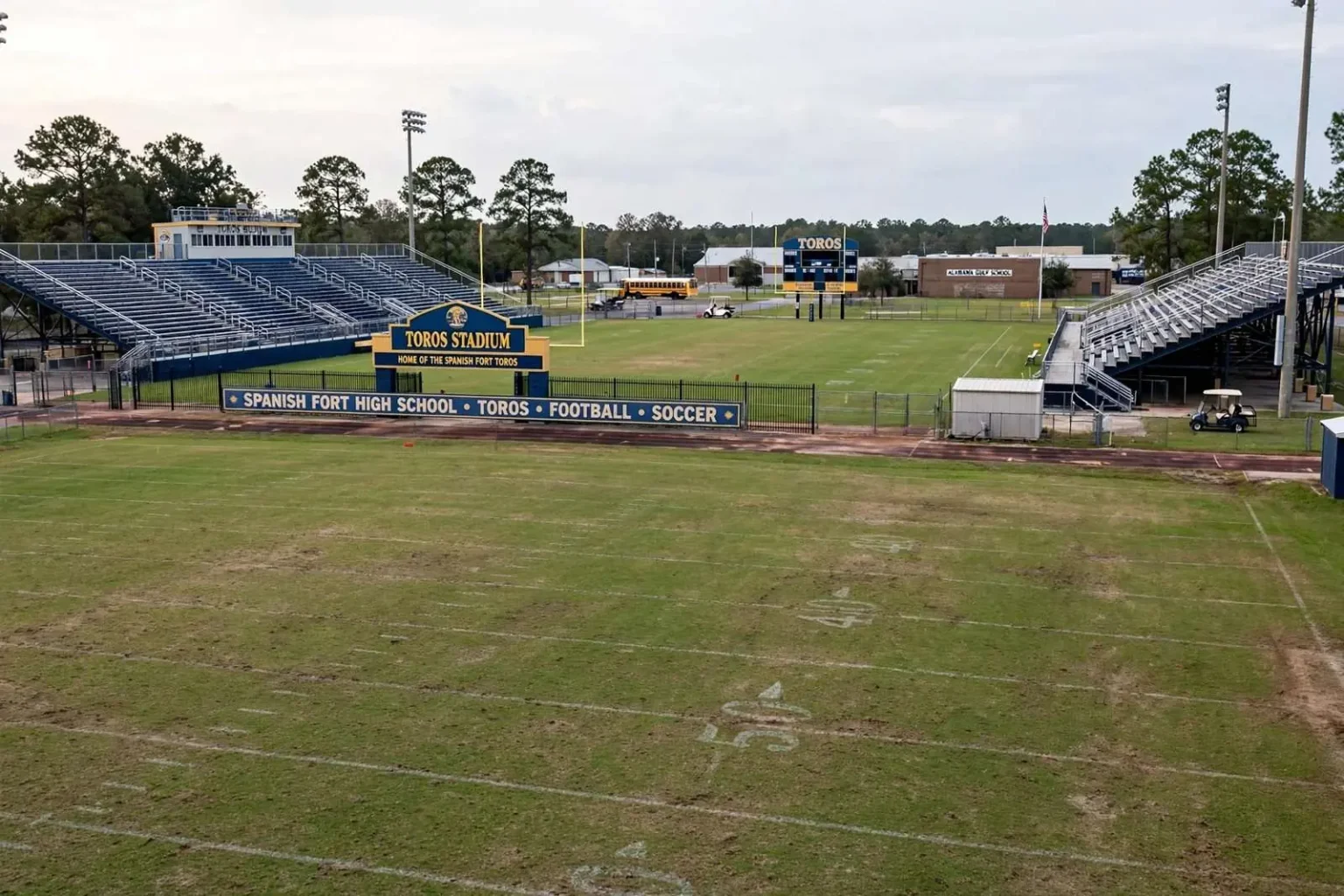
Spanish Fort’s high school football stadium will keep its natural grass field for now after the city council voted down spending roughly $769,000 in city funds on a new artificial turf surface at Toros Stadium. The decision closes, at least for this budget cycle, a debate that pulled in the city’s finances, its relationship with the county school system and the referendum fight that still lingered in the air at city hall.
The council split 3-2 against the project, with one member abstaining. Mayor Mike McMillan and Councilman Bobby Fortenberry supported the turf purchase, while council members Mary Brabner, Clewis “J.R.” Smith Jr. and William “Bill” Menas Sr. voted against it. Councilman R. Curtis Smith abstained because he is employed by the Baldwin County School System, removing himself from a vote that directly involved school property.
The shadow of the March referendum
McMillan said he believed the vote reflected lingering frustration from the county’s March 31 referendum, in which voters rejected an eight-mill property tax increase that would have funded a $350 million, system-wide school building plan. He said he sensed considerable residual opposition to school-related spending carrying over into the turf decision.
The connection was hard to miss. The referendum, the largest school funding proposal in Baldwin County in years, had divided communities across the county, and Spanish Fort voters weighed it alongside their neighbors. Months later, a three-quarter-million-dollar school-related request from the city budget landed before a council whose members had watched that election closely. Whether or not the turf proposal was sound on its own merits, it arrived carrying the political weight of the tax vote that came before it.
Where opponents wanted the money to go
Opponents argued the money would be better spent elsewhere, including on computers, equipment and additional landscaping at the city’s new $7.8 million, 36,000-square-foot community center on U.S. 31. The community center, the largest recreational investment in the city’s history, had just opened its doors, and council members who voted no saw unfinished needs there as the better claim on city dollars than a playing surface.
Brabner also noted the city had already spent $5.4 million on Spanish Fort High School athletic facilities over the past dozen years, including a new field house and previous field renovations. That figure framed the turf request as the latest installment in a long series rather than a one-time ask, and it gave the opponents’ case a concrete anchor: the city has been investing in the high school’s athletics continuously, and the question was whether another three-quarters of a million was the right next step.
The city’s unusual role in school funding
McMillan pointed out that Spanish Fort has historically shouldered more school-related costs than some neighboring communities, contrasting it with the city of Mobile, which does not fund school infrastructure through its municipal budget. The comparison highlights a structural quirk in how Baldwin County’s cities relate to their schools: because the county school system, rather than city districts, runs the schools, any municipal contribution is voluntary — and cities that choose to contribute do so year after year from their own budgets.
He noted the Spanish Fort council had previously approved a $311,168 turf project in 2013 at Ladd-Peebles Stadium, which is used by Mobile County schools. The 2013 decision gave the mayor’s argument its sharpest edge — the city had found the money for a stadium used by students outside its own school system, and rejecting a field its own students play on struck him as inconsistent.
The case from the field
The turf project had the backing of Spanish Fort football coach and athletic director Ben Blackmon, who told the council during a May public hearing that the field sees more than 280 uses a year across multiple sports, including 68 soccer matches between varsity and junior varsity teams over a four-month stretch this year. That usage rate is the standard argument for turf: a natural grass field cannot recover from that kind of wear without extended rest, while an artificial surface plays through it.
He and McMillan also noted that the middle school’s athletic field is in poor condition, and that installing new turf at the high school would have allowed the existing sod there to be reused at the middle school. The plan would have addressed two fields with one purchase — the high school getting a modern surface, the middle school getting grass that, however worn at the stadium, would still represent an upgrade for younger athletes.
For the athletes and coaches who use Toros Stadium, the math in Blackmon’s testimony told the story of a facility stretched to its limits. Football seasons, soccer schedules, band practice and community events all land on the same strip of grass, and by late fall the wear shows. Turf advocates argued the field had simply outgrown its natural surface, and that the 280-plus annual uses would only increase as the city grows.
What happens next
With the vote now behind them, McMillan said the city will regroup and look at its parks and recreation holdings as a whole to find other ways to serve the community’s youth sports needs. That review reframes the question from a single stadium field to the entire inventory of playing surfaces the city maintains, and it leaves open the possibility that turf returns in a future budget — perhaps bundled with other recreation projects, perhaps at the middle school first.
The council’s decision also sets a marker for how Spanish Fort weighs school-related spending going forward. The city’s twelve-year, $5.4 million record of athletic facility investment at the high school remains in place, but the 3-2 vote shows that the council’s appetite for the next installment depends on the fiscal mood — and the referendum shadow — of the moment. Future requests will be measured against both the community center’s unfinished needs and the memory of March’s tax vote.
For now, Toros Stadium keeps its grass, the middle school keeps its worn field, and the city keeps its $769,000. Youth sports across the city will go on as they have, on the surfaces the city already has, while the council’s promised review of parks and recreation holdings determines whether a better-balanced plan for fields and facilities emerges from a debate that, for one season at least, ended in a no vote.
The episode offers a case study for other Baldwin County cities navigating the same dynamics — municipal budgets asked to supplement a countywide school system, residents freshly skeptical after a failed tax referendum, and athletic facilities caught between genuine need and political timing. How Spanish Fort’s regrouping exercise resolves those pressures will be worth watching the next time a turf bid, or anything like it, reaches the council agenda.
The turf-versus-grass question itself has been settled in most fast-growing communities across the Gulf Coast, which is part of why the proposal reached the council at all. Artificial surfaces have become the standard for multi-use high school stadiums because they absorb the kind of schedule Toros Stadium carries — football on Friday nights, soccer on weekdays, band and youth events filling the gaps — without the rest periods grass requires. The maintenance economics also differ: grass demands mowing, watering, fertilizing and re-sodding, while turf’s costs come up front and at replacement time a decade later.
Opponents of the purchase acknowledged the field’s condition but argued that a city’s first obligation is to the facilities it owns outright, and that the community center — built with city money for all residents — still had unfilled needs that predated any stadium upgrade. The 3-2 vote essentially endorsed that ranking, at least for this budget year.
The abstention by R. Curtis Smith illustrated another wrinkle of school-city overlap in Baldwin County: with council members employed by the school system, votes touching school property raise conflict questions that require stepping aside, leaving six members to decide a seven-member question. On this vote the arithmetic still produced a clear outcome, but close school-related decisions in the future could hinge on exactly that kind of recusal.
The city’s larger fiscal picture framed the debate as well. A city that has just opened a $7.8 million community center, that has spent $5.4 million on high school athletics over twelve years, and that approved $311,168 in turf for a Mobile stadium in 2013 has demonstrated neither reluctance to invest nor unlimited capacity to do so. The turf vote landed where those two facts intersect: a willing-spender city reaching the point where each new request competes with the last one’s unfinished business.
Spanish Fort’s growth adds pressure from the other direction. New subdivisions keep feeding students into the city’s schools and athletes onto its fields, and the demand Blackmon described — 280 uses a year on one field — tends to grow rather than shrink as the city fills in. The council’s parks and recreation review will have to measure that rising demand against the facilities on hand, and the middle school’s poor field will remain near the top of whatever list comes out of it.
Whether the next proposal arrives as turf at the high school, sod for the middle school, or a phased plan covering both, it will enter a different political climate than the one that greeted the May hearing: the referendum further behind, the community center further along, and a council majority that has now articulated what it wants city recreation dollars to do first. McMillan’s regrouping exercise is the bridge between this year’s no vote and whatever the city proposes next.