Mobile County’s 2014 Payroll Topped $79 Million, Records Show
Mobile County spent more than $79 million on wages and benefits for 1,764 employees in 2014, with the sheriff's office driving much of the overtime total.
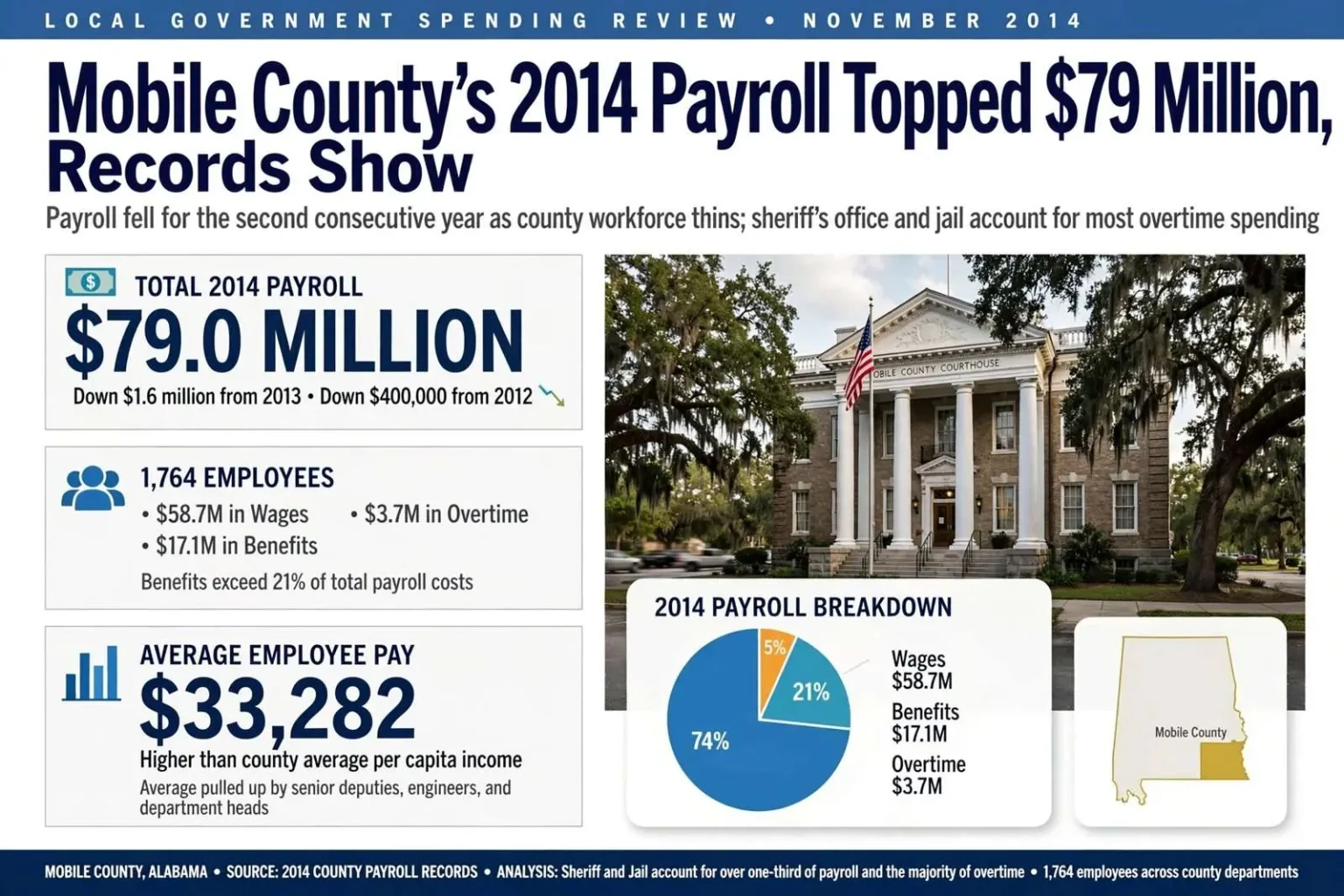
Mobile County government spent more than $79 million on wages, overtime and benefits for its workforce in 2014, according to payroll figures reviewed as part of an ongoing look at local government spending. The numbers offer a detailed portrait of what the county’s workers are paid, who earns the most, and how the cost of running Alabama’s second-largest county has drifted in recent years.
The total covered 1,764 employees and broke down to roughly $58.7 million in wages, $3.7 million in overtime pay and $17.1 million in medical and retirement benefits. Benefits alone accounted for more than a fifth of the overall cost, a reminder that an employee’s true price to taxpayers runs well beyond the paycheck. The figures span the county commission’s operations, the sheriff’s department and the other arms of county government funded through the county’s payroll system.
Perhaps the most notable trend was the direction of the numbers. The overall figure declined slightly compared with prior years, dropping about $1.6 million from 2013 and $400,000 from 2012, suggesting the county has managed payroll growth even as service demands continue. In an era when many local governments have struggled to hold the line on personnel costs — typically the largest single category in any public budget — a two-year decline stands out.
A leaner workforce
A county spokeswoman said staffing has thinned since the recession years, leaving remaining employees covering multiple roles once split among a larger workforce. That pattern has played out in counties across Alabama since the economic downturn: positions eliminated through attrition are rarely refilled, and the duties are absorbed by the workers who remain. It holds costs down in the short run, but it can stretch departments thin and push more of the burden onto the employees left behind.
The scale of Mobile County’s operation reflects its size. With more than 400,000 residents, Mobile County is home to a quarter of Alabama’s population along the Gulf Coast, and its county government provides services ranging from road and bridge maintenance to court support, jail operations, animal control and health services. Every one of those functions depends on the workforce captured in the payroll data.
How the neighbors compare
By comparison, the City of Mobile’s payroll ran closer to $102 million the same year, while Baldwin County’s payroll, not counting its separately funded sheriff’s office, was about $31 million. The contrast illustrates how county and city government costs stack up differently across the region. The city provides police, fire and sanitation services that counties generally do not, which drives its personnel spending higher. Baldwin County, though one of the fastest-growing counties in the state, has historically run a leaner operation and funds its sheriff separately, keeping the headline payroll figure lower.
Comparisons like these carry caveats — different governments fund different functions, and separately elected offices such as sheriffs and license commissioners maintain their own payrolls to varying degrees. But taken together, the three figures sketch a regional picture in which Mobile County sits between a full-service city government and a smaller, faster-growing neighbor to the east.
Sheriff and jail drive the overtime
The Mobile County Sheriff’s Department, which also runs the Mobile County Metro Jail, accounted for well over a third of the county’s total payroll and the vast majority of its overtime spending. The pattern is common in counties where law enforcement and detention staffing drive labor costs. Jails must be staffed around the clock, every day of the year, and shifts have to be covered regardless of vacancies, illnesses or turnover — which is where overtime accumulates fastest.
Detention work is among the most demanding jobs in county government, and staffing the Metro Jail, one of the largest correctional facilities in the state, requires a constant supply of deputies and detention officers. When hiring lags behind need, mandatory overtime fills the gap, showing up in payroll figures long before it shows up in policy debates. Law enforcement overtime also spikes during major public events, emergencies and multi-agency operations along the coast.
The county’s top earners
Individual salary figures showed the county engineer as the highest-paid employee, collecting more than $177,000 in wages plus benefits. The position carries responsibility for one of the largest local road systems in Alabama, along with bridges, drainage and county construction projects, and it typically requires a professional engineering license plus years of public-sector experience. The salary reflects the technical demands of the job and the market competition the county faces from private engineering firms.
Other high earners included the county’s License Commissioner and Deputy License Commissioner, both of whom were separately facing federal charges that same year tied to their handling of public funds. The charges cast a shadow over a constitutional office that handles millions of dollars in tag, title and registration transactions for Mobile County drivers each year, and they made the pair’s presence at the top of the payroll list particularly awkward for county officials.
The Metro Jail’s warden also ranked among the top-paid employees, reflecting the scope of running a facility that houses hundreds of inmates and manages a large correctional staff. Meanwhile, a Revenue Commission administrator posted one of the largest overtime totals outside the sheriff’s office, an outlier in an office better known for property appraisals than round-the-clock operations. Payroll records like these often surface such anomalies, which county administrators can then review.
What the average worker earns
The average Mobile County employee earned about $33,282 in 2014, notably higher than the county’s average per capita income. The comparison cuts two ways. County jobs — with their benefits, retirement systems and relative stability — generally pay better than the typical job in the private economy of the county, and the figures show it. At the same time, the average is pulled upward by long-tenured employees, sworn deputies and highly paid department heads, meaning many rank-and-file workers earn less than the midpoint suggests.
Why the payroll matters to residents
Personnel costs are the single largest expense in nearly every local government budget, which makes payroll data one of the most direct measures of how a county spends taxpayer money. Mobile County’s revenue comes from a mix of property taxes, sales-tax-supported funds, fees and state distributions, and every dollar committed to salaries, overtime and benefits is a dollar not available for roads, equipment or reserves.
The 2014 figures also document the human side of county government. Behind the totals are the deputies patrolling unincorporated Mobile County, the detention officers staffing the Metro Jail, the crews patching county roads after Gulf Coast storms, the clerks processing tags and titles, and the engineers and appraisers whose work touches nearly every property in the county. Tracking what those employees are paid — and how that pay changes over time — gives residents a concrete way to judge whether their government is competing for talent, controlling costs, or some balance of both.
The road ahead for county finances
The two-year decline in payroll costs is unlikely to continue indefinitely. As the national economy recovered from the recession, private-sector wages began climbing, and public employers that hold salaries flat risk losing experienced workers — particularly in fields like engineering, corrections and law enforcement, where trained staff have options elsewhere. Rising health insurance premiums also put steady upward pressure on the benefits line, which already represents more than $17 million a year for Mobile County.
County commissioners will face recurring decisions about where that pressure gets absorbed: whether to let overtime cover gaps in the sheriff’s office and jail, whether to restore positions eliminated during the recession years, and how to fund pay adjustments without cutting services. Each choice shows up in the same ledger that produced the 2014 numbers.
For taxpayers, the review of the payroll figures serves as a standing invitation to look closely at who works for the county, what they are paid and where the overtime goes. The 2014 data shows a government that has held costs down since the recession while concentrating its spending — and its overtime — where the work never stops: on the road, and behind the walls of the Metro Jail. Whether that balance holds will be answered year by year, in the same records anyone can read.
Inside the numbers
Breaking the $79 million down further shows where county dollars concentrate. Wages make up the core of the total, but the $3.7 million overtime figure and the $17.1 million benefits line are where budget officers look for trends. Overtime concentrated in one department signals staffing shortfalls; benefits growing faster than wages signals rising insurance costs. Both dynamics were visible in the 2014 data, and both tend to compound quietly until a budget crisis forces them into the open.
The count of 1,764 employees is itself a data point. Spread across every department, office and facility the county operates, that workforce is smaller than the one that existed before the recession, and the county spokeswoman’s explanation — remaining staff absorbing duties once divided among more workers — is the standard account of how local governments have survived lean budgets. It is also the account most often cited by employee groups when they argue for restoring positions and pay.
Payroll transparency has become an expectation for local governments, with many systems now publishing employee-level data or responding to records requests for salary listings. Mobile County’s figures, reviewed as part of a broader look at local government spending, show why that scrutiny matters: averages hide the outliers, and the outliers — a $177,000 engineer, federal charges against two top license officials, an overtime-heavy Revenue Commission administrator — are where accountability questions live. The 2014 record captures a county workforce doing more with less, and leaves the judgment about whether that is sustainable to the taxpayers footing the $79 million bill.