Candidates From Both Sides of Baldwin Tax Debate Seek State School Board Appointment
Candidates who backed and opposed Baldwin County's failed school tax proposal are both seeking the governor's appointment to a vacant state school board seat.
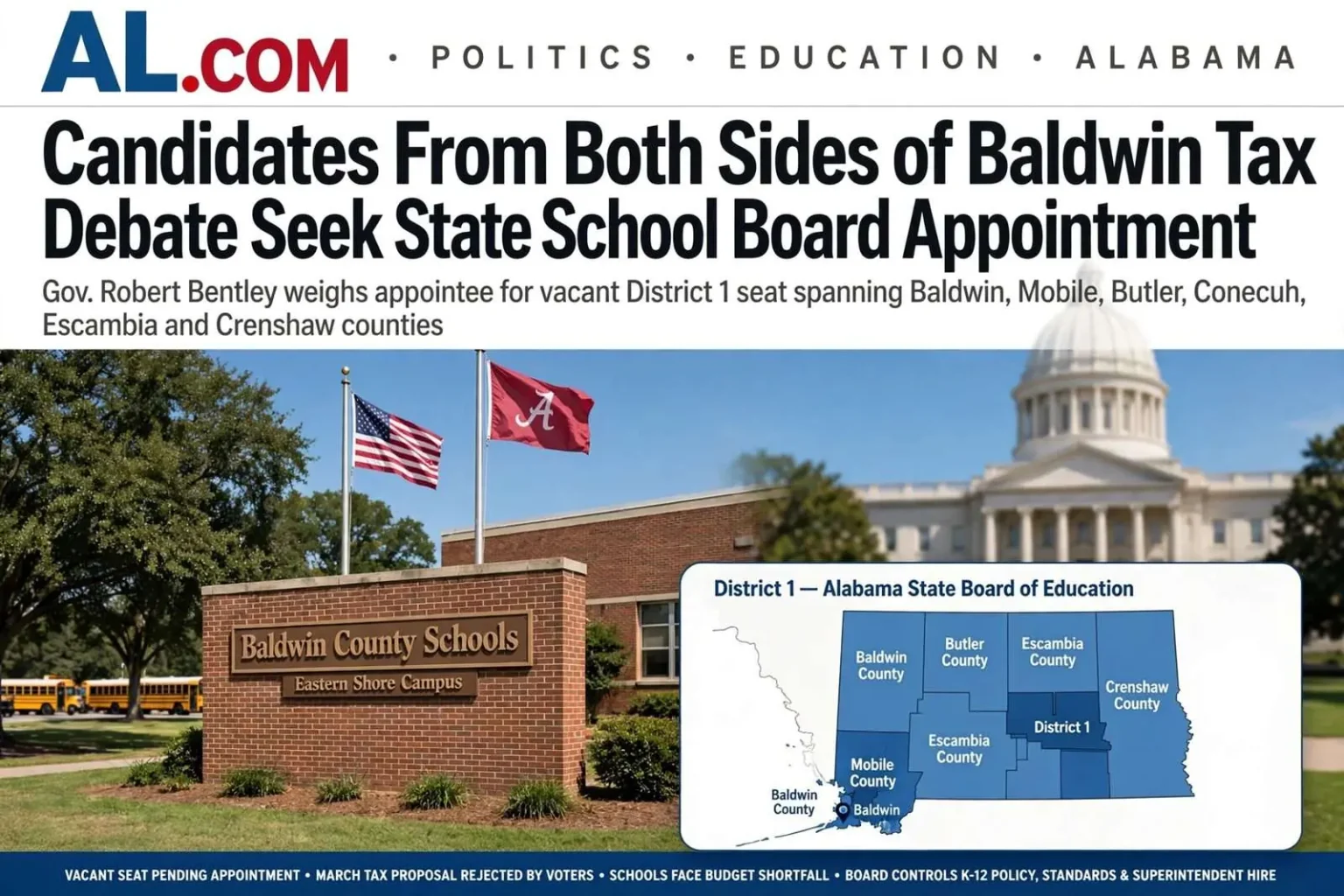
Gov. Robert Bentley has candidates on both sides of Baldwin County’s recent school tax debate to choose from as he considers who to appoint to a vacant seat on the Alabama Board of Education representing District 1, which covers Baldwin County along with parts of Mobile, Butler, Conecuh, Escambia and Crenshaw counties.
Among those who have expressed interest is the executive director of the Baldwin County Education Coalition, who supported the county’s proposed 8-mill property tax increase that voters rejected in March. Also seeking the appointment is a leader of the campaign that helped defeat that same tax proposal, along with a third southwest Alabama resident who previously ran an educational software company before selling it more than a decade ago.
The spread of candidates gives the governor a genuine choice of directions. An appointee from the coalition’s side would arrive as an advocate for increased local school funding, while an appointee from the anti-tax campaign would carry a mandate from the voters who rejected the millage. The third candidate offers a business-and-technology resume detached from the tax fight altogether.
The March vote left Baldwin County’s schools facing a budget shortfall with no new local revenue, and the tax debate has remained the central issue in county education politics since. Whoever wins the appointment steps into a role where that debate, and the policy questions flowing from it, will shape every decision the board makes for the district.
How the Seat Came Open
The District 1 seat has been vacant since the governor appointed its previous occupant to a newly created board overseeing Alabama’s community college system about a month earlier. That move removed from the state school board one of southwest Alabama’s voices at a moment when the board is weighing some of the most consequential education policy questions in the state.
Unlike a previous vacancy the governor filled almost immediately, Bentley’s office has said no timeline has been set for this appointment, with the governor’s office saying only that it is currently accepting recommendations. The slower pace has left the district’s seat empty through the start of the legislative session, and has allowed the field of interested candidates to grow.
Because the seat comes up for election next year, waiting until after the legislative session allows the governor to avoid a confirmation hearing until then. The timing gives Bentley flexibility, letting him weigh the politics of the appointment without committing to a nominee who would face senators before the session’s business is done.
The appointment matters beyond Baldwin County because of what the state board controls. The nine-member board sets policy for Alabama’s public schools, hires the state school superintendent, and decides the standards and accountability systems that every district in the state operates under. District 1’s representative votes on all of it, and the governor’s choice will sit at the table when the board’s most contested issues come to a vote.
For the five counties the district spans, the vacancy also raises the question of geographic voice. Baldwin County’s rapid growth has made it the district’s population center, but the seat’s territory stretches across rural Butler, Conecuh, Escambia and Crenshaw counties, whose residents have their own school systems and their own expectations of representation in Montgomery.
The Field of Candidates
A local tea party organization has also pushed for the appointment of a conservative commentator and former congressional candidate who serves on the board of a Mobile-area preparatory school, citing his experience covering education issues as a journalist. The candidate has said he has not heard back from the governor’s office and believes his chances are slim, but the endorsement gives the field a vocal conservative presence and keeps pressure on the governor’s office from the political right.
The declared candidates include a 28-year-old Fairhope resident who leads the Eastern Shore Metropolitan Planning Organization and chairs the Baldwin County Young Republicans, a longtime education advocate who previously worked with the South Baldwin Chamber of Commerce and South Baldwin Education Foundation, and a Daphne business broker and father of three who serves on his alma mater’s business school board of visitors.
The Fairhope candidate represents the youngest voice in the field, with a public-sector resume built around the transportation planning that has become central to the Eastern Shore’s rapid growth. His dual role in county Republican politics gives him standing in the party structure even at an age when most candidates are years away from seeking such an appointment.
The South Baldwin education advocate brings the deepest background in school issues, with years of work connecting the chamber, the education foundation and the county’s southern schools. Supporters point to that history as evidence of a candidate who understands the classroom consequences of board decisions, whatever the outcome of the tax debate.
The Daphne business broker offers a private-sector profile, with the perspective of a parent of three and a governing role at a university business school. His candidacy speaks to the contingent of Baldwin voters who want board members with management experience rather than education careers, a common theme in state school board races nationwide.
State lawmakers representing the area say they hope the governor selects someone genuinely passionate about K-12 education, regardless of where they stood on the tax vote. That framing, passion over position, reflects the legislature’s awareness that the tax fight split the county’s Republican base, and that a nominee identified too closely with either side arrives in Montgomery with half the district already opposed.
Common Core Looms Over the Choice
One of the central issues facing the state board is the ongoing debate over Common Core academic standards, which has drawn opposition from conservative activists who argue the standards move public education too far toward a national curriculum. Candidates for the seat have offered varying views on the standards, with some expressing support for the flexibility the framework gives local districts and others saying they would need to study the issue further before taking a position.
The Common Core fight has become a defining test for state school board members across Alabama. The standards, adopted by the state board years earlier with broad support from business leaders and education groups, have been challenged repeatedly in the legislature by opponents seeking repeal, and each session brings new attempts to force the issue. Board members who support the standards have defended them as Alabama’s own benchmarks, while critics have pressed the board to abandon them regardless of legislative outcomes.
For District 1’s appointee, the issue will arrive immediately. The board’s calendar does not wait for new members to settle in, and votes on standards, assessments and accountability all carry the weight of the Common Core argument, whichever side the new member takes. Groups on both sides have already begun rating the candidates on the issue, and the appointment will be read across the state as a signal of where the board’s balance stands.
The business community’s support for the standards has been a quiet force in the debate, with employers arguing that consistent, rigorous benchmarks are essential to a workforce that can move across state lines. That position puts Alabama’s business establishment, usually aligned with the governor’s party, on the opposite side from the activists pressing for repeal, a tension the appointee will have to navigate.
What Voters Should Watch
Because the seat appears on next year’s ballot, any appointee serves at the pleasure of an electorate that will judge the choice directly. The governor’s pick will face a Republican primary in a district that has shifted heavily to the party, meaning the appointment functions as much as an audition as an installation, and the candidates who lose out this year can return to the ballot themselves.
The length of the vacancy has also given every interested party time to organize. Community groups have circulated names, local party committees have weighed in privately, and the candidates themselves have solicited letters of support, a level of campaign activity unusual for a non-elected appointment but consistent with a seat that will define the district’s representation on education policy for years.
The appointment also lands in a county that has become the state’s fastest-growing, where school enrollment rises yearly and where the school system is by far the largest single enterprise in local government. Baldwin County’s relationship with the state board has often been defined by growth, funding formulas and the tax debates that growth provokes, and the district’s next board member will carry those fights to Montgomery from the first day.
Until Bentley announces, the field remains open, and the governor’s office continues accepting recommendations from legislators, party officials and community groups across the district. When the choice comes, it will resolve, at least for a year, a question that has divided Baldwin County’s education community since the March tax vote: who speaks for the county’s schools in Montgomery, and with what conviction.