Baldwin County School Board Debates Salary Range for Next Superintendent
As Baldwin County searches for its next school superintendent, board members are weighing how much salary it will take to land the right candidate.
A month after Superintendent Robbie Owen announced he would step down and return to the classroom, the Baldwin County school board is turning its attention to one of the thorniest questions in the search for his replacement: how much the district should be willing to pay. Owen is expected to leave the top post in August and return to Rockwell Elementary, closing out a two-year run as leader of one of Alabama’s largest and fastest-growing school systems and heading back to the campus-level work where he built his career.
The salary question is more than an academic one for a district of Baldwin County’s size, which stretches from the Spanish Fort and Daphne suburbs across the Eastern Shore to the beach communities of Gulf Shores and Orange Beach and the agricultural centers of the county’s interior. The system operates dozens of campuses scattered across some of the largest geographic territory of any district in the state, and its next superintendent will inherit both the growth that has made Baldwin County a magnet for new families and the financial pressures that growth has failed to relieve.
Why the money matters now
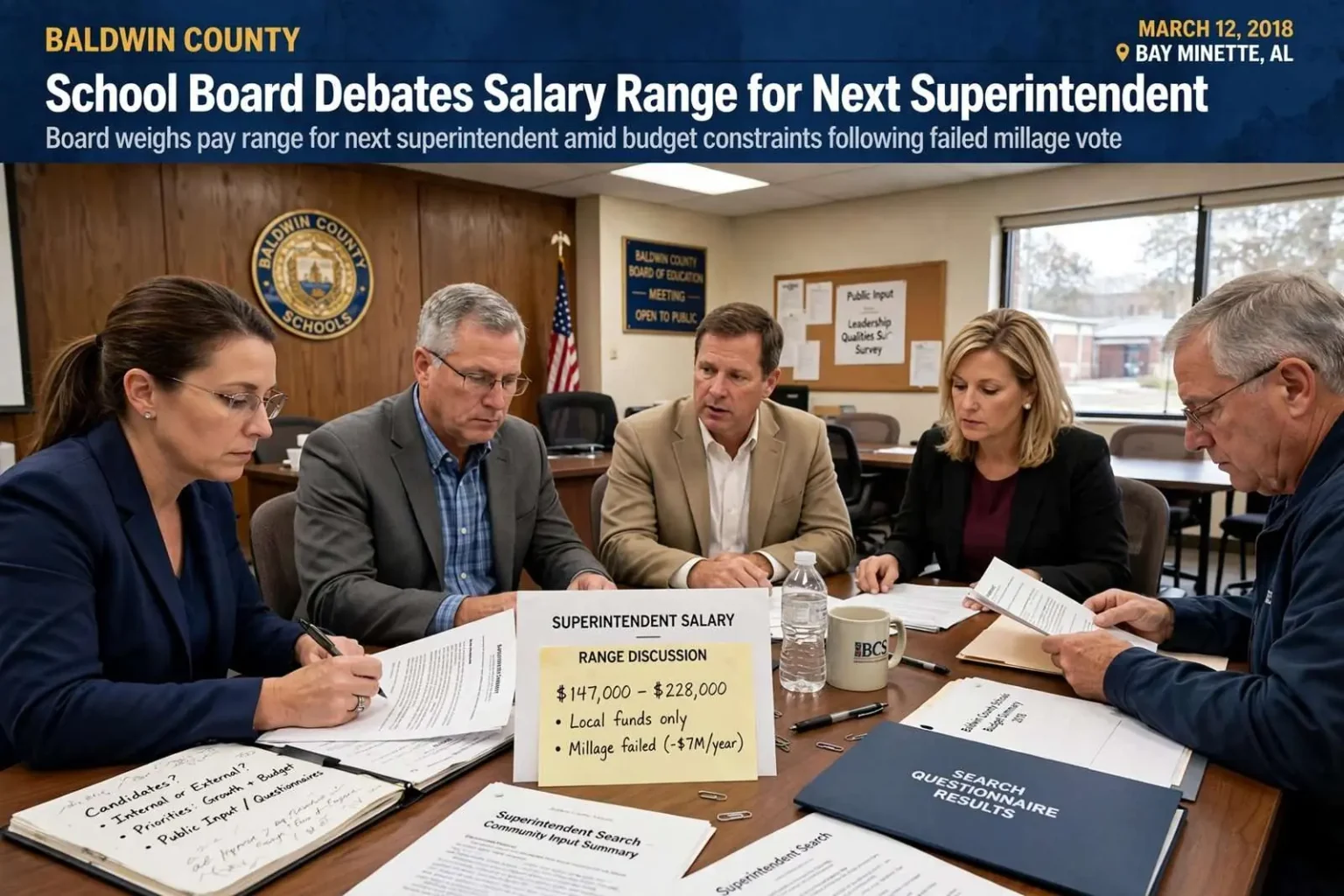
Unlike teacher salaries, which are partly funded by the state, superintendent pay comes entirely from local revenue, a fact made more pressing after voters rejected a new and renewable property tax millage in March, a decision expected to cost the district around $7 million a year once current funding expires in 2018. The failed millage attempt sharpened an already difficult budget picture and handed board members a political reality to weigh alongside any offer they extend: whatever salary the district advertises will be paid from local dollars at a time when local taxpayers have just declined to raise them.
Salary history for the position shows just how much it can vary. Former superintendent Alan Lee earned $175,000 with more than 15 years of experience when he left the post two years ago. When the board hired Owen to succeed him, they agreed to $147,000 for a first-time superintendent, a substantial drop that reflected Owen’s newer profile in the role. By comparison, Jefferson County’s superintendent, the highest paid in the state, earns $228,000 annually, a benchmark that looms over any discussion of what a competitive offer in Baldwin County should look like.
The spread between those figures illustrates the basic tension the board now faces. Pay too little, and the district risks losing serious candidates to systems elsewhere in the state that can offer more; pay too much, and the board risks a public backlash in a county where residents have just voted down a tax increase and where school funding debates are conducted in public view. Somewhere between the $147,000 the board paid for a first-timer and the $228,000 charged by the state’s largest payroll lies the range the board must settle on — or deliberately decline to settle on at all.
A board divided
Board members remain split on whether to set a firm salary range before the search continues. Some worry that leaving pay open-ended risks wasting time on candidates whose expectations don’t match what the district can afford, while others say focusing on qualifications first is more important than settling on a number early. The disagreement mirrors a debate that plays out in superintendent searches across the country, where search professionals often advise boards to advertise a range to pre-qualify applicants, while others argue that an early number can scare off the very candidates a district most wants.
Board Vice President Angie Swiger said finding the most qualified candidate should be the board’s top priority, with salary treated as a secondary consideration. Board member David Cox took a different angle, saying any candidate commanding a salary near what Lee once made “better be an incredibly qualified candidate,” adding that expectations for performance would rise along with the pay. Together the two positions frame the board’s dilemma: whether the district is shopping for the best leader it can find at whatever price the market demands, or whether it is a value-conscious buyer in a market where top-dollar hires come with top-dollar scrutiny.
The board also remains divided over whether the next superintendent should come from within the Baldwin County school system or be recruited from outside the county or state. Internal candidates offer continuity and familiarity with a sprawling district’s unusual geography, its community expectations and its existing staff, and internal promotions tend to come at lower cost. Outside hires bring fresh perspective and experience leading other systems, but they typically command higher salaries, relocation packages and a longer adjustment period in a county where local roots carry considerable weight in public life.
Running the search themselves
Rather than hiring an outside search firm, the board has opted to run the search itself, beginning by inviting employees and the public to fill out questionnaires on what qualities the community wants in its next leader. The do-it-yourself approach saves the district the tens of thousands of dollars a professional search can cost and puts the board in direct control of screening and interviews, but it also means the seven-member panel must manage the logistics — advertising, applicant tracking, background checks — that a firm would normally handle, all while conducting its work under the state’s open meetings law.
The questionnaire effort is aimed at building a leadership profile before any names are considered, asking teachers, support employees, parents and residents what they want in the district’s next chief. Community input processes of this kind have become common in Alabama superintendent searches, where boards are elected rather than appointed and where public sentiment about school leadership runs strong. The results typically shape both the interview questions and the priorities the board announces to applicants.
A consultant who previously led the nationwide search that resulted in Lee’s hiring cautioned that not having a salary range from the outset could complicate recruitment, since it can be difficult to attract serious candidates, especially those not actively job-hunting, without knowing what the position pays. The point carries particular weight for sitting superintendents elsewhere, who generally risk little by staying put and need a clear financial incentive to uproot their families for a new system. Searches that advertise a competitive range, consultants argue, draw applications from those passive candidates; searches that defer the question tend to draw only applicants with something to gain by moving.
Board President Shannon Cauley said a salary limit hadn’t yet been formally discussed among members but could come up as the search moves forward, adding that the district’s tight finances mean it can’t afford to sweeten any offer if doing so creates long-term budget strain. Cauley’s framing — flexibility now, discipline later — captures the middle ground the board appears to be seeking as it weighs the consultant’s warning against the post-millage political arithmetic.
The budget context is unavoidable. The March millage failure means a funding stream worth roughly $7 million a year will disappear when current funding expires in 2018, forcing the district to plan for a leaner operating picture even as Baldwin County’s enrollment keeps climbing with the county’s population boom. Superintendent salaries, while a small slice of a budget that runs primarily through state funding and local ad valorem taxes, are among the most visible line items in the district, and any offer the board extends will be read against the backdrop of the tax vote.
Owen’s departure itself is an unusual wrinkle in the story. Rather than retiring or moving to another district, the superintendent is stepping down to return to the classroom and to Rockwell Elementary, a move that former classroom educators in administration sometimes make to close out their careers at the school level. His departure after roughly two years leaves the board searching for a successor sooner than it might have expected when it hired him, and it hands the incoming superintendent a district in the middle of both demographic growth and budget uncertainty.
What qualities the community asks for in the questionnaires, and whether the board sets a number before applications arrive, will shape the applicant pool in ways that are easy to predict: a published range filters the field, while silence leaves it open. Either way, the board’s members know the hire will be judged against both of the measures they have spent the past month arguing about — the qualifications of the person they choose and the price they agreed to pay. The search is expected to continue through the spring, with the board aiming to have its next superintendent in place before Owen’s planned August departure.
For residents across Baldwin County, from Bay Minette to Gulf Shores, the outcome will determine who leads a school system their communities depend on daily — and how much of the county’s local tax base the board is willing, or able, to commit to securing the leadership it wants. The debate over a single salary range has become a stand-in for bigger questions about growth, funding and what Baldwin County expects from its schools in the years ahead.