Bay Minette Woman Killed in Early Morning Crash on Alabama 225
A Bay Minette woman died and a man was injured after their pickup left Alabama 225 and struck a tree early Sunday morning, state troopers said.
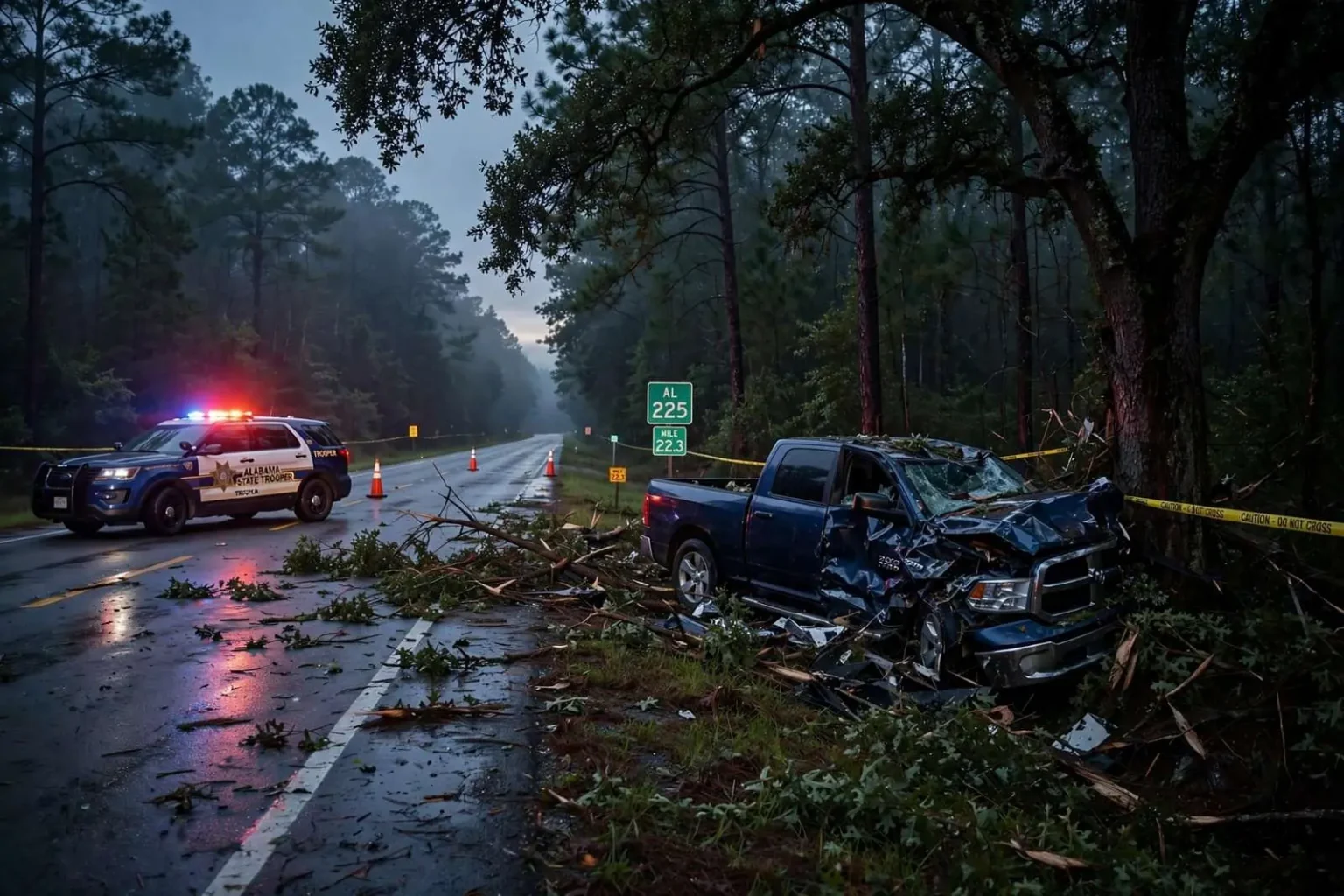
A Bay Minette woman died in a single-vehicle crash early Sunday, June 21, on Alabama 225 northwest of the city, according to Alabama State Troopers. Kimberly Ann Wilson, 49, was a passenger in a 2015 Dodge pickup that left the roadway and struck a tree around 3:57 a.m., troopers said. She was pronounced dead at the scene.
The driver, Harry Leon Wilson Jr., 51, also of Bay Minette, was taken to USA Hospital in Mobile for treatment following the crash, according to Alabama State Troopers spokesperson Kevin Cook. USA Hospital — the University of South Alabama Medical Center — serves as the region’s major trauma center, and patients injured in serious crashes across Mobile and Baldwin counties are routinely transported there for treatment when their injuries exceed what local emergency departments can handle.
The crash occurred at the 22.3 mile marker on Alabama 225, about 10 miles northwest of Bay Minette, a stretch of rural highway in Baldwin County. Troopers said the cause of the crash remained under investigation, and no additional details were immediately available. At that hour of a June morning — before dawn in deep country, with no street lighting along much of the corridor — visibility would have been limited to the pickup’s headlights, and the roadway curves through a mix of timberland and scattered homes where wildlife crossings are common.
The Highway and Its History
Alabama 225 runs roughly 40 miles from downtown Mobile north to Stockton and U.S. 31, crossing Mobile Bay’s upper reaches through some of the least developed terrain in Baldwin County. The section northwest of Bay Minette carries local traffic between the city and the Stockton area, along with through-travelers avoiding the interstate. Two lanes, generous curves and long unlit stretches define the road’s character — the same qualities that make it scenic in daylight make it demanding in the dark.
Single-vehicle crashes on Baldwin County’s rural highways are relatively common, and state troopers routinely urge drivers on roads like Alabama 225 to watch for reduced visibility, wildlife and roadway conditions during early morning hours. Deer strikes spike in the pre-dawn and dusk hours statewide, and drivers who swerve to avoid animals account for a meaningful share of the county’s run-off-road crashes. Edge drop-offs, shoulder softness after rain and curve geometry all contribute in the miles outside town limits.
The Alabama Law Enforcement Agency’s Highway Patrol Division investigates fatal crashes across the county as part of its regular traffic safety enforcement. ALEA, formed in 2015 by consolidating the former state troopers, driver license and other public safety functions, assigns its post troopers to reconstruct serious crashes — documenting skid marks, vehicle damage and roadway evidence — while toxicology testing and witness interviews fill out the record. Findings in fatal cases can take weeks to finalize.
Fatal Crashes in Baldwin County
Baldwin County has seen periodic traffic fatalities on its two-lane rural routes as growth in the region has increased overall traffic volume even on roads that remain largely undeveloped. The county’s population has grown faster than almost any in Alabama for years, and new subdivisions, schools and commercial corridors keep pushing daily traffic onto arterials that were built for a smaller, slower era. Alabama 225’s southern segments, connecting to Spanish Fort and the I-10 corridor, carry that growth most visibly; the northern rural reaches see it too, in commuter traffic between Bay Minette and points south.
State and federal safety data consistently show that rural two-lane roads carry a disproportionate share of serious crashes relative to their traffic volume. Higher speeds, longer emergency response times and the absence of median barriers mean a run-off-road event that would be a fender bender on a city street can be fatal in the country. Baldwin County’s stretch of state routes also serves a large agricultural and timber economy, mixing logging trucks and farm equipment with commuter traffic on the same narrow pavement.
Local and state transportation officials have periodically studied safety improvements for rural corridors like Alabama 225, though any major changes typically take years to fund and construct. The Alabama Department of Transportation’s safety programs fund improvements — enhanced curve signage, rumble strips, shoulder widening and clearing of fixed obstacles near the roadway — through federal Highway Safety Improvement Program dollars allocated by crash history. Trees and other fixed objects close to the travel lane are among the factors engineers weigh when prioritizing projects.
The Investigation
Family members and neighbors in the Bay Minette community were notified of Wilson’s death shortly after the crash, as troopers worked to piece together the sequence of events that led the vehicle to leave the roadway. In cases like this one, investigators examine the pickup for mechanical condition, review whether seat belts were in use, await toxicology results and reconstruct the vehicle’s path from the physical evidence on and beside the highway. Weather records for the early morning of June 21 also form part of the file, since summer rainfall can leave rural pavement slick without warning.
Alabama State Troopers said they would release further findings once the investigation concluded, and encouraged anyone with information about the crash to contact their office. That appeal is standard practice in rural fatal crashes, where the 3:57 a.m. hour means few witnesses and any motorist who passed the scene beforehand — or encountered the pickup earlier on the road — may hold a piece of the timeline investigators lack.
A fatal crash also sets in motion a quieter aftermath for the community. State troopers’ fatality notifications reach next of kin before names are released publicly, volunteer fire departments and first responders who worked the scene return to their stations, and churches and neighbors in the Bay Minette area began organizing support for the families involved — the standard rhythm of grief in a small Baldwin County community where two families now shared a single Sunday morning’s loss.
Staying Safe on Rural Alabama Highways
Troopers’ standing advice for roads like Alabama 225 is built around the conditions that produce crashes at the hours when roads are empty. Slowing below the posted limit in low visibility, scanning the roadside for deer rather than only the lane ahead, keeping headlights and speed matched to conditions, and resting before driving in the pre-dawn hours all address the factors that recur in run-off-road fatality files. Seat belt use remains the single strongest determinant of survival in a single-vehicle collision — unbelted occupants are vastly more likely to be killed when a vehicle leaves the road.
For the counties along the Gulf Coast, the message carries extra weight in summer, when vacation traffic adds unfamiliar drivers to rural routes and late-night returns from beach communities stretch into the early morning. Baldwin County’s roads connect the beaches of the Gulf to the interstate and to the interior of the state, and the volume of that seasonal movement shows up in the crash statistics every year.
A Community’s Loss
For Bay Minette — the seat of Baldwin County, a city of modest size that still functions as the civic heart of the county’s northern half — the loss of a 49-year-old resident resonated through the networks of family, work and church that define daily life there. Kimberly Ann Wilson was pronounced dead at the scene, in the same stretch of highway country where generations of Baldwin County families have driven for work and school. Harry Leon Wilson Jr. remained hospitalized at USA in Mobile as the investigation continued.
The stretch of Alabama 225 at the 22.3 mile marker returned to its usual quiet within hours — the wreckage removed, the evidence marked and measured, the trees standing as they had before 3:57 a.m. What remained was the investigation file, the families’ grief and the recurring reminder, delivered by troopers after every such crash, that the county’s rural roads demand the care their quiet appearance can make easy to forget.
How Rural Fatal Crashes Are Handled
When a crash becomes a fatality, the response differs from an ordinary wreck in nearly every detail. The Highway Patrol’s specialized troopers document the scene with measurements rather than estimates, the roadway may be closed for hours while evidence is collected, and the vehicle itself is often impounded for examination. Prosecutors review the finished file to determine whether any charges are warranted, a process that only begins once toxicology and reconstruction work are complete — typically weeks after the crash itself.
Emergency response in rural Baldwin County relies on a network of volunteer fire departments and county EMS units based in communities like Bay Minette, Stockton and Whitehouse Fork. Response times on remote stretches of Alabama 225 can stretch well past what urban departments expect, which is one more reason run-off-road crashes on the corridor turn serious so quickly. First responders train for exactly the scenario this crash presented: a vehicle off the pavement, patients needing rapid transport and a trauma destination across the bay.
The USA Hospital trauma center in Mobile exists for precisely that reason. Its designation as the region’s Level I trauma resource means helicopter and ground transport decisions across the two-county area route the most seriously injured there, day or night. For the Wilson family, that pathway delivered the driver to the best-equipped facility in the region within the critical early minutes after the crash.
The Road Ahead for Alabama 225
Corridor safety work on roads like Alabama 225 proceeds incrementally. Modern guardrail placement at fixed-object hotspots, reflective pavement markings, clear-zone maintenance that pushes trees back from the travel lane and updated curve warning signs are the typical interventions, funded through state safety programs and matched federal dollars. Residents along the corridor occasionally petition ALDOT for speed limit reviews or passing-zone changes, and the department evaluates each against the crash history at those locations.
As Baldwin County’s growth continues, the pressures on its rural state routes will only intensify. New roofs south of Bay Minette mean more commuters, more school traffic and more miles traveled on pavement built generations ago. Transportation planners say the county’s long-term challenge is pairing that growth with corridor investments before the crash statistics force them — a challenge this June morning on Alabama 225 illustrated in the starkest way a community can experience it.