Robertsdale Woman Dies in Head-On Crash With Semi-Truck in Baldwin County
A 27-year-old Robertsdale woman died when her car collided head-on with a tractor-trailer on a rural Baldwin County road southeast of Bay Minette.
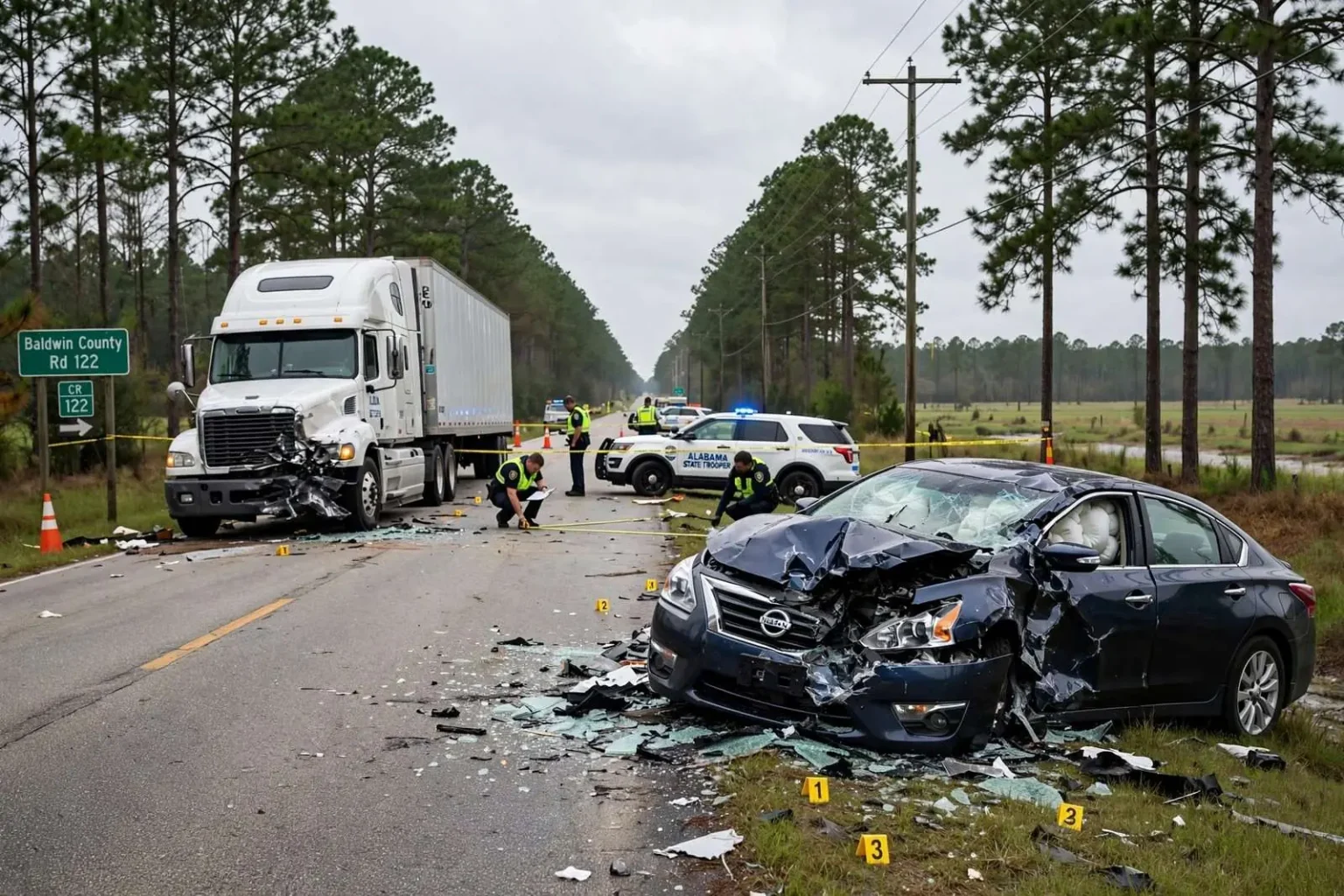
A 27-year-old Robertsdale woman died Thursday morning after her car collided head-on with a tractor-trailer on a rural stretch of Baldwin County highway, according to Alabama State Troopers.
Heather Elyse Propst was pronounced dead at the scene by medics following the crash, which occurred around 10:45 a.m. on Baldwin County Road 122, roughly 22 miles southeast of Bay Minette. Trooper Jamie Maloy said Propst had been driving a 2012 Nissan Altima at the time of the collision.
The driver of the tractor-trailer, identified by troopers as Michael Joseph Vaughan and driving a 2002 Freightliner, was not injured in the crash. State troopers did not release information on what caused the two vehicles to collide, and the investigation into the circumstances of the wreck continued through Thursday afternoon.
Crash reconstruction investigators document such scenes methodically — measuring skid marks and final resting positions of the vehicles, photographing debris fields and examining both vehicles for mechanical evidence — because in a two-vehicle fatal collision the question of lane position, speed and evasive action determines how the report is ultimately written.
The road where it happened
Baldwin County Road 122 runs through a largely rural section of the county, connecting smaller communities southeast of Bay Minette. Like many of the county’s secondary highways, the road carries a mix of local traffic and larger commercial vehicles, including trucks serving the area’s agricultural and timber operations.
Roads of that class are typically two-lane highways without medians or center turn lanes, where a moment of inattention or a failed passing maneuver can put a passenger car directly in the path of oncoming traffic. Commercial traffic compounds the risk: a loaded tractor-trailer cannot stop or maneuver the way a car can, and the physics of a head-on impact between the two are rarely survivable for the occupants of the smaller vehicle.
The stretch southeast of Bay Minette passes through pine timberland and farmland, with long sight lines broken by curves and driveways, the profile of thousands of miles of rural Alabama roadway where traffic volumes have risen steadily with the county’s growth.
The severity of truck-passenger car collisions
Head-on collisions involving passenger vehicles and commercial trucks are among the most severe types of crashes investigated by the Alabama Law Enforcement Agency’s Highway Patrol Division, given the size and weight disparity between the vehicles involved. A loaded semi can weigh twenty times what a sedan weighs, and the energy released in a combined-speed head-on impact is concentrated almost entirely on the smaller vehicle.
Federal crash statistics have long shown that occupants of passenger vehicles bear the overwhelming share of fatalities in car-truck collisions, whatever the configuration — head-on, sideswipe or rear-end. In a head-on crash the disparity is at its worst, because both vehicles’ closing speed adds together in the instant of impact.
Troopers statewide have periodically urged drivers on rural two-lane highways to use caution when passing, particularly on roads without a center turn lane or additional passing lanes. Passing-zone decisions — judging the distance and speed of oncoming traffic across a mile of two-lane road — are among the most dangerous maneuvers in everyday driving, and commercial trucks approaching at highway speed close the distance faster than many drivers estimate.
Baldwin County’s growing rural roads
Fatal crashes on Baldwin County’s rural roadways have drawn continued attention from state and local officials in recent years as the county’s population has grown and traffic volumes have increased on roads originally built to handle far lighter loads. Baldwin has ranked among Alabama’s fastest-growing counties for years, its new subdivisions and businesses spilling commuter traffic onto farm-to-market roads designed for a different era.
Local governments and the Alabama Department of Transportation have periodically studied corridor safety improvements, including turn lanes, rumble strips and widened shoulders — the low-cost countermeasures that safety engineers say deliver the most benefit per dollar on rural two-lane roads.
Rumble strips along the centerline and shoulder, for example, are credited with reducing cross-centerline and run-off-road crashes by alerting drivers who drift from fatigue or distraction — the two leading contributors to head-on crashes on straight rural highways. Turn lanes at intersections with growing traffic, meanwhile, remove the rear-end and sideswipe conflicts that come with left turns onto busy roads.
How fatal crash investigations proceed
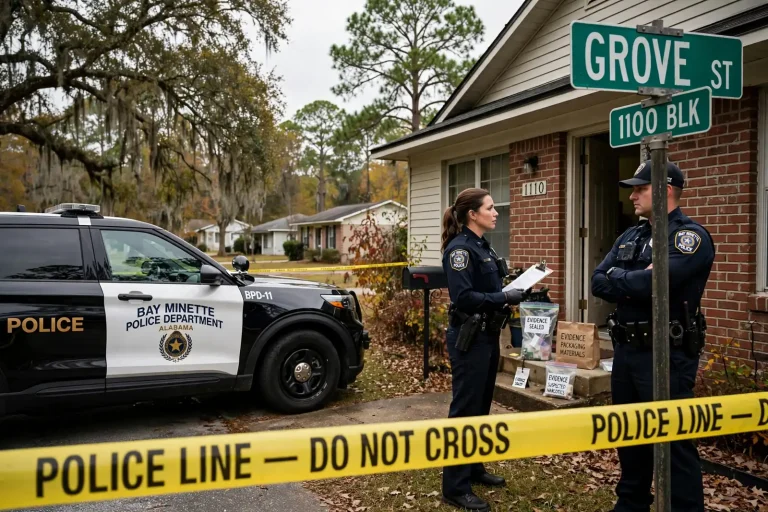
When a crash involves a fatality, Alabama State Troopers take over the scene investigation from local responders, documenting evidence and preparing a reconstruction of the events. The process can take hours on scene and weeks to complete in writing, with the final report determining whether any charges follow.
Investigators will examine the Freightliner’s records as a matter of routine in commercial-vehicle crashes: the driver’s log, the truck’s maintenance file and, in newer trucks, electronic control module data that records speed and braking in the moments before impact. The 2002 Freightliner predates some of the more detailed telematics in modern trucks, but commercial carriers remain subject to federal hours-of-service and inspection rules that generate paper and electronic records either way.
The examination of the Nissan Altima serves the same purpose in reverse — establishing speed, lane position and any mechanical factors that might have contributed. Toxicology testing is standard in fatal crashes, and results arrive weeks after the wreck, often determining the final classification of the cause.
Robertsdale and the county’s road network
Robertsdale, the victim’s hometown, sits in the southern half of Baldwin County along the U.S. Highway 90 corridor, surrounded by the agricultural land and pine forest that still dominate the county’s interior. Its residents commute in every direction — to Foley’s retail corridor, to the county’s industrial employers and north toward Bay Minette and Interstate 65.
County roads like 122 are the connective tissue of that geography, carrying school buses, farm equipment, commuter traffic and the heavy trucks that serve the county’s poultry houses, timber tracts and sand and gravel operations. Traffic engineers describe such roads as mixed-use by necessity, which is why the growth of any one category — commuter cars or commercial trucks — raises the risk profile for all the others.
The Baldwin County Commission, which maintains the county road system, has staggered paving and widening projects across its network as revenue allows, prioritizing corridors by traffic count and crash history. Residents along rural routes have periodically petitioned for safety work at specific intersections and curves, and crash records like Thursday’s feed directly into those priority lists.
After the wreck
Thursday’s investigation continued into the afternoon as troopers worked the scene and interviewed witnesses. The intersection of commuter traffic and heavy trucking on a two-lane rural road — the exact combination present in this crash — remains the pattern safety officials watch most closely as Baldwin County keeps growing into its countryside.
For Propst’s family and the Robertsdale community, the crash was the kind of sudden loss that rural counties know too well: a young resident on a road she had likely traveled many times, killed in seconds by the meeting of two vehicles whose paths should never have crossed. The Highway Patrol’s final report, when it is complete, will determine whether the question of fault ends in a report or in a courtroom.
The human cost in context
Propst was 27, an age at which the state’s crash statistics turn especially grim: drivers in their twenties record some of the highest involvement rates in serious rural crashes in Alabama, a pattern safety officials attribute to a combination of exposure — young adults driving more miles, often at night — and the risk tolerances that fade with age. Each name in the patrol’s fatality log represents a family in a county where word of a wreck travels fast through churches, schools and workplaces.
Medics who pronounce a victim at the scene, as happened Thursday, close the medical part of the response quickly, but the scene itself remains closed for hours. Residents along County Road 122 were rerouted past the wreckage as troopers worked, a familiar disruption in rural communities where a single blocked road can add miles to a school bus route or a commute.
Sharing the road with trucks
Safety campaigns aimed at rural driving return each year to the same instruction set for passenger-car drivers around commercial trucks: stay out of a truck’s blind spots along the sides and directly behind, allow far more following distance than with a car, pass decisively rather than lingering alongside, and never cut back into a truck’s lane immediately after passing — a fully loaded trailer needs a football field’s length or more to stop at highway speed.
For truck drivers, the federal rules impose the mirror image: hours-of-service limits designed to prevent fatigue, mandatory pre-trip inspections and drug and alcohol testing programs. Investigators in crashes like Thursday’s will verify each of those elements before the file is closed.
The meeting of a Nissan Altima and a Freightliner on a two-lane county road encapsulates the reality that Baldwin County’s safety officials have been warning about as growth continues: more residents means more cars on roads built for fewer, and every added vehicle narrows the margin that rural two-lane driving has always required. Until engineering, enforcement and driver behavior close that gap, the county’s secondary roads will keep producing the crashes that the patrol’s rural district knows by heart.