Daphne Partners With High School Students to Broadcast City Council Meetings
Daphne is partnering with Daphne High School students to broadcast city council meetings starting in 2016, funded by a new $10,000 equipment budget.
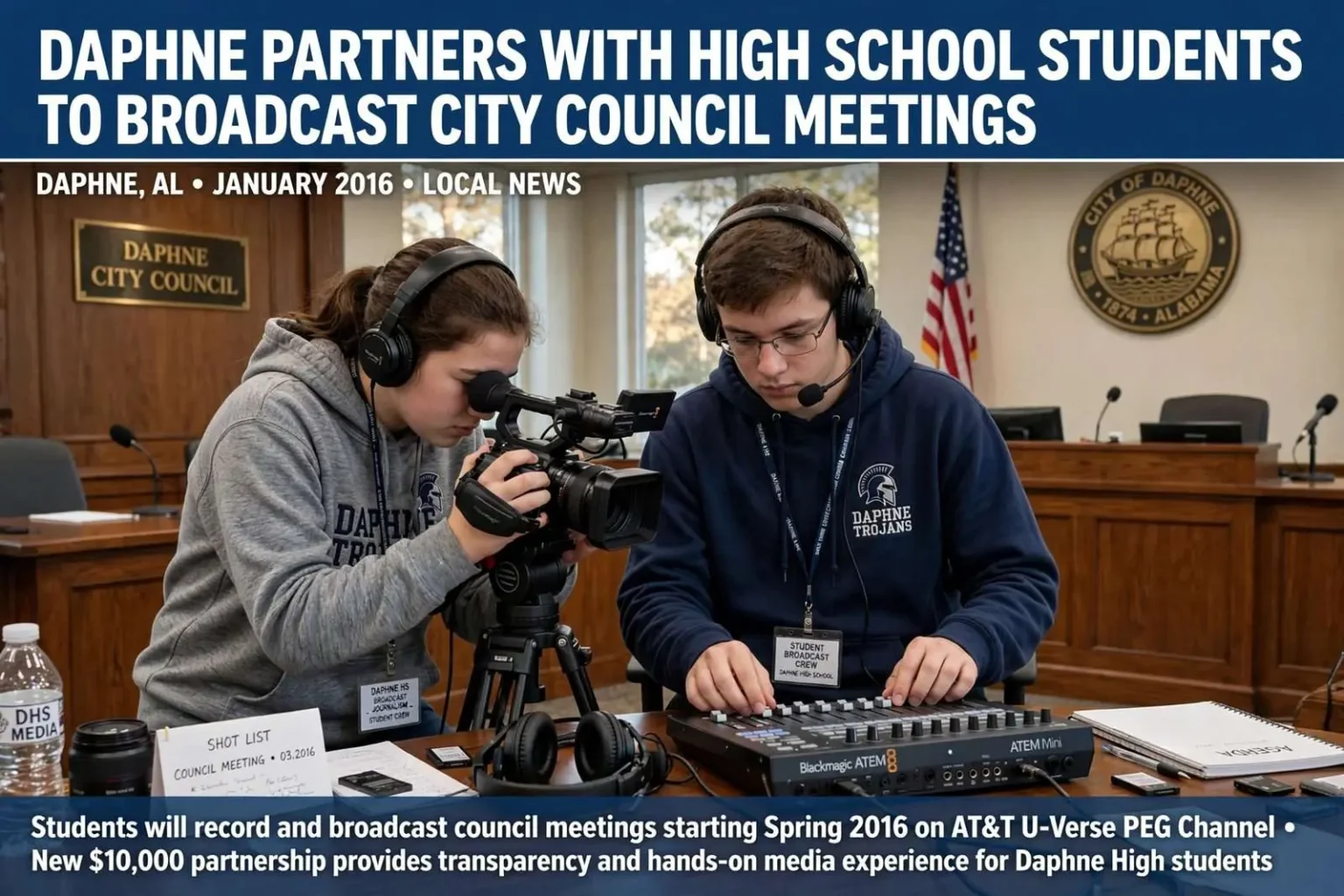
City council meetings in Daphne will soon be beamed into living rooms across Baldwin County’s largest city, thanks to a new partnership between the city and Daphne High School that will put students behind the camera. The arrangement pairs a modest city investment with the talents of teenage broadcasters, and it closes a transparency gap that has left residents who cannot attend meetings in person without a way to watch their local government at work.
The Daphne City Council approved spending $10,000 to acquire video and broadcast equipment that will be operated by Daphne High School students to record council meetings, with broadcasts expected to begin in the spring of 2016 via AT&T U-Verse. The equipment purchase covers cameras and production gear that would otherwise cost the city far more to staff and operate with professionals, an economics that made the partnership attractive to a city watching its budget.
Mayor Dane Haygood said the idea grew out of discussions last year while the city was working on its franchise agreement with AT&T U-Verse, which offers a Public, Education and Government access channel as part of its service. PEG channels, as they are known in the cable industry, are a standard feature of franchise agreements nationwide, set aside for exactly the kind of local government and school programming that Daphne now plans to produce.
While Mediacom offers a similar channel, Haygood said the city had never taken advantage of it because it lacked the broadcasting equipment and couldn’t justify the cost on its own. The result was that Daphne — despite being one of the fastest-growing cities on the Eastern Shore — had no televised record of its council meetings, leaving residents to rely on word of mouth, minutes or newspaper accounts to follow decisions about zoning, budgets and infrastructure that shape their daily lives.
Through the U-Verse negotiations, Haygood said city officials learned about partnerships in other communities between municipalities and local schools that provide broadcasting capabilities while sharing costs. The model has been used across the country, particularly in mid-sized cities where a school system’s media program needs real-world material and a city government needs an affordable production crew.
“Our Young People Are Probably More Tech Savvy Than We Are”
“We came up with the idea that we need to partner with Daphne High School and utilize our young people, who are probably more tech savvy than we are, to broadcast these meetings to each one of you,” Haygood told residents at Monday’s meeting. “So you can watch them on TV, record them if you’d like, watch them at your convenience and see what your council and mayor is doing for you or not doing for you.”
The mayor’s framing made clear that the program is aimed at accountability as much as convenience. A televised council meeting puts votes and debate on the record in a form that any resident can review, and Haygood’s reference to seeing what city leaders are doing — “or not doing for you” — underscored the transparency purpose behind the investment.
Daphne High School is introducing a broadcast journalism class this fall, and the city plans to work closely with the school to identify the equipment students will need for the project. The timing lines up neatly: students entering the new class will train on cameras, audio equipment and production workflows during the school year, then put those skills to work broadcasting actual government meetings when the service launches in the spring.
Educators say the arrangement gives the broadcast journalism program something no classroom simulation can: live, consequential material with a real audience. Students will learn to frame shots, manage audio in a council chamber, run a production switcher and meet deadlines — competencies that translate directly into careers in television, video production and digital media, and that can be practiced only in genuine production environments.
Haygood said the city hopes to eventually offer live streaming capabilities, though early broadcasts will likely rely on a tape-delay format. Getting meetings from the council chamber to the cable channel in real time requires more infrastructure than recording and delivering a finished program, so the city and school will grow into live production as the partnership matures and the student crew gains experience.
Joining the Eastern Shore’s Broadcast Ranks
Once launched, Daphne will join the Baldwin County Commission and the Fairhope City Council among Eastern Shore governments that record their public meetings for residents unable to attend in person. The step brings one of the county’s largest municipalities in line with a practice that has quietly become the norm for neighboring governments.
Fairhope began livestreaming its council meetings on the city website in October 2013, while the county broadcasts its meetings live on its website and through the Baldwin County Governmental and Educational Access Channel. Both have found that recorded meetings draw viewers who never attend in person — parents with young children, shift workers, snowbirds and residents who simply want to review a vote that affects their neighborhood.
Councilman Joe Davis III said he hopes the broadcasting program eventually grows into something resembling Germantown High School’s community television station in Tennessee, which he visited during a chamber of commerce trip. The Memphis-area school station has become a national model for scholastic broadcasting, producing daily news programming with professional-grade facilities and a student staff that functions like a working television newsroom.
“Germantown High School has a phenomenal facility, and I’d like to see what we’re starting here to grow into something like that in the high school,” Davis said, noting that several of the Tennessee program’s graduates now work as television anchors around the country. His vision points toward an eventual pipeline in which Daphne students graduate not just having recorded council meetings but having run a full-scale station that feeds graduates directly into broadcast careers.
The comparison is instructive for what a modest $10,000 start can become. Scholastic broadcast programs that thrive typically begin with a single camera and a single client — often their own school board — and expand as community partners, franchise fees and grants add equipment and hours. Daphne’s council meetings give the program a recurring, guaranteed production schedule that few school stations enjoy.
What Viewers Will See, and When
When broadcasts begin in the spring, Daphne residents will be able to watch council meetings on the AT&T U-Verse PEG channel, with replays allowing viewers to record or watch at their convenience. The council meets on regular evenings each month, and the student crew will record the full proceedings — approvals, public comments, departmental reports and all — rather than producing edited highlights.
City officials said the tape-delay approach will actually help the program in its early going: students can review footage, fix audio problems and deliver a clean product to the cable channel within days of each meeting. As the crew’s skills grow and equipment allows, the city’s stated hope is to move toward live coverage, matching what Fairhope offers online and what the county commission delivers on its channel.
The partnership also carries lessons for other Baldwin County municipalities. Gulf Shores, Foley, Spanish Fort and Orange Beach all face the same transparency calculus Daphne did — franchise channels exist, but producing programming costs money — and the Daphne model offers a template that requires little more than equipment, a willing school and a scheduling agreement. Officials said they have already fielded interest from other cities watching how the Daphne experiment unfolds.
For Daphne High’s students, the work will count as real journalism. Covering a council meeting means preparing by reading agendas, understanding the city budget, identifying stories in zoning cases and framing shots in a room full of moving participants — all under the pressure of a public record that will be broadcast to the entire city. Teachers involved say that combination of stakes and support is what turns a media class into a professional training ground.
For residents, the payoff is straightforward: starting next spring, anyone curious about a rezoning vote, a road project or the city’s budget will be able to watch their city government in action from their own living room — recorded by students learning the craft of television, and carried on a channel the city was already entitled to through its franchise agreement. It is, as the mayor put it, a chance for residents to see what their council and mayor are doing for them, delivered by the youngest and most tech-savvy broadcasters Daphne has.
The $10,000 investment also buys the city a degree of institutional memory it has never had before. Once meetings are routinely recorded, footage becomes a searchable archive — a resource for city staff tracing when a policy changed, for reporters checking what was said about a development, and for students in future government classes studying how their city makes decisions. Officials noted that the recordings will belong to the city and school jointly, ensuring the archive grows with every meeting rather than being lost to the moment as unrecorded proceedings always are.