Jennifer Claire Moore Foundation Rodeo Returns to Foley This Week
The 18th annual Jennifer Claire Moore Foundation Rodeo brings three nights of roping, riding and family fun to the Foley Horse Arena this week.
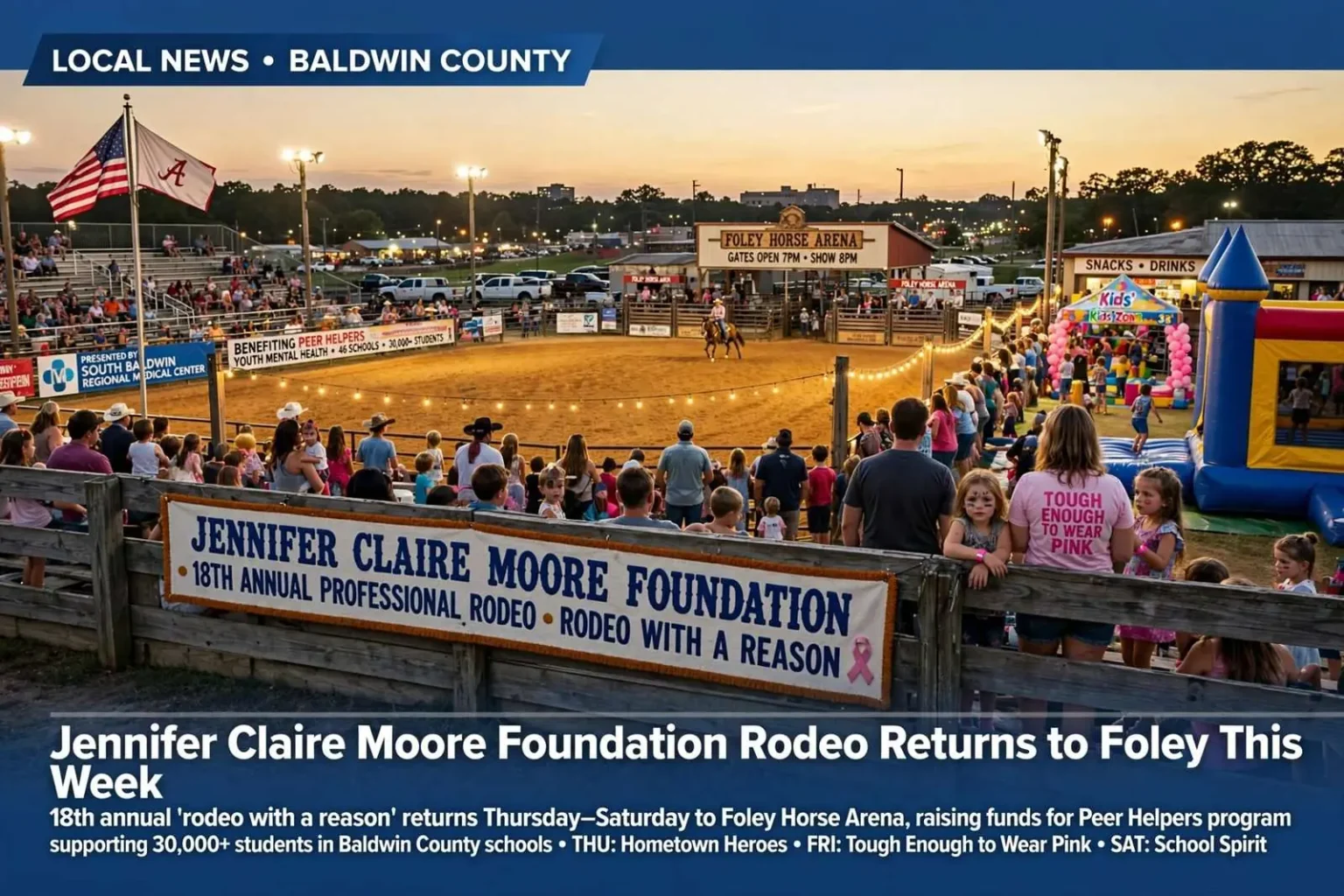
Cowboys and cowgirls are set to return to the Foley Horse Arena this week for the 18th annual Jennifer Claire Moore Foundation Professional Rodeo, a three-day event known locally as the “rodeo with a reason.” The rodeo, presented by South Baldwin Regional Medical Center, runs Thursday through Saturday at the arena off Alabama 59, directly across from the hospital. Organizers expect the event to draw more than 9,000 spectators over the course of the weekend, continuing its status as one of the Eastern Shore’s most anticipated late-summer traditions.
Proceeds benefit the Jennifer Claire Moore Foundation and its Peer Helpers programs, which reach more than 30,000 children and teens across Baldwin County. The nonprofit funds and trains peer-to-peer support programs in 46 schools serving students from pre-kindergarten through 12th grade, making the rodeo a significant fundraiser for youth mental health and support services in the region. Few fundraisers in south Alabama tie a weekend of family entertainment so directly to a cause that touches every school system in the county.
The foundation’s origin story is the reason the rodeo carries the name it does. The organization was founded in memory of Jennifer Claire Moore, a Foley teenager who died by suicide in the late 1990s, and her family built the foundation around a simple conviction: that trained students, trusted by their classmates, can reach troubled peers earlier and more naturally than adults sometimes can. The Peer Helpers program that grew from that conviction has become the foundation’s signature work, and the rodeo is what keeps it funded.
Gates Open at Seven, and the Kids Come First
Gates open at 7 p.m. each night, giving families time to enjoy a lineup of activities before the professional competition begins at 8 p.m. Kids can take advantage of free horseback rides and a dedicated Kids’ Zone featuring face painting, carnival-style games, a bounce house and a 33-foot inflatable obstacle course. The pre-show hour has become part of the event’s identity, turning an evening at the rodeo into a full family outing rather than a spectator sport reserved for rodeo fans.
Once the main event kicks off, spectators can watch calf roping, barrel racing and bull riding from professional competitors. The lineup covers the classic events that define professional rodeo, timed races against the clock and the raw spectacle of bull riding, performed by contestants who compete on the professional circuit. Barrel racing, in particular, has a devoted following among the young riders who fill the arena’s stands, many of whom grow up around horses in Baldwin County’s rural communities.
Each night of the rodeo carries its own theme. Thursday is “Hometown Heroes” night, honoring local military members and emergency services personnel. Friday’s “Tough Enough to Wear Pink” night supports breast cancer awareness, with organizers encouraging attendees to wear pink. Saturday closes out the weekend with “School Spirit” night, inviting fans young and old to show support for Baldwin County schools by wearing their team colors.
Tickets, Logistics and the Arena’s Setting
Tickets are $12 for adults and $6 for children ages 4 to 12, with kids 3 and under admitted free. Advance tickets are available at Summerdale Western Store, giving families a chance to skip the gate line and save a little on the way in. The pricing has stayed deliberately family-friendly, a reflection of the foundation’s aim to make the event accessible to the same school-age population the Peer Helpers programs serve.
The arena’s location on Alabama 59 puts it in the middle of Foley’s busiest corridor, directly across from South Baldwin Regional Medical Center, whose presenting sponsorship ties the county’s hospital to the county’s biggest youth-focused fundraiser. August traffic on 59 can be heavy with beach-bound travelers, and rodeo regulars know to arrive early, but the venue’s long history of hosting the event means parking and crowd flow are well practiced by now.
Eighteen years in, the rodeo has outlasted the typical lifespan of an annual charity event by a wide margin. Organizers credit the formula: professional competition that draws real rodeo fans, family activities that draw everyone else, themed nights that give regulars a reason to come more than once, and a cause that every parent in the county understands.
Peer Helpers: The Program Behind the Rodeo
The money raised this week flows into a program model that has been refined across nearly five decades of use in American schools. Peer Helpers trains selected students to serve as a first line of support for classmates dealing with the ordinary pressures of adolescence and, sometimes, with genuine crises: family upheaval, bullying, academic failure, grief, and thoughts of self-harm. Student helpers are taught to recognize warning signs, to listen without judgment and — most importantly — to know when a situation exceeds their training and must be handed to an adult professional.
Across Baldwin County, that model operates in 46 schools covering every grade level from pre-kindergarten through 12th, touching the lives of more than 30,000 children and teens. The foundation’s role is to fund the training, materials and coordination that keep those programs running, filling a gap that school budgets alone have never fully covered. Counselors and administrators in participating schools have repeatedly credited the program with surfacing problems that would otherwise have stayed hidden until they became emergencies.
The rodeo is the engine that makes that reach possible. A single weekend event supplying the bulk of a year’s program funding is an unusual arrangement for a school-based initiative, and it has forced the foundation to become skilled event producers as well as advocates. Eighteen consecutive years of growth in attendance and sponsorship suggest the two roles have reinforced each other.
Why the Cause Resonates in Baldwin County
Baldwin County is one of the fastest-growing counties in Alabama, and its school system has absorbed that growth in waves of new students moving into communities from Spanish Fort to Gulf Shores. Growth of that kind brings stresses that families and schools feel directly: overcrowded campuses, transplanted teenagers searching for belonging, and the quiet isolation that can accompany any move. Programs built on peer support are designed for exactly that environment, because a trained classmate often sees trouble long before a counselor’s office does.
Youth mental health has also become a more openly discussed subject in the years since the foundation began, and the rodeo has both followed and driven that shift. An event that packs thousands of parents and children into an arena while raising money for student support services sends a message that talking about young people’s struggles is a community value, not a private embarrassment. Organizers have leaned into that role without turning the rodeo itself into a solemn occasion.
The themed nights reinforce the community reach. “Hometown Heroes” night honors the military members and first responders who make up a significant share of the Gulf Coast’s population, from the region’s bases to the volunteer fire departments that cover Baldwin County’s unincorporated communities. “Tough Enough to Wear Pink” connects the rodeo to the national breast cancer awareness movement, and “School Spirit” night turns the final performance into a countywide pep rally.
A Late-Summer Tradition on the 59 Corridor
The timing has always been part of the rodeo’s appeal. August in south Alabama marks the last stretch before school routines resume and the fall sports calendar begins, and the event gives families one more big night out before schedules tighten. The Foley Horse Arena, a fixture of the city’s park and recreation landscape, provides a venue with genuine rodeo credentials in a county where horse ownership and agricultural traditions remain strong.
Alabama 59 itself frames the setting. The highway runs from the interstate down through Foley toward the beaches at Gulf Shores, carrying beach traffic all summer, and the arena sits along it close enough to town that a rodeo night can end with dinner in Foley’s historic downtown. Organizers expect more than 9,000 fans across the three nights, a crowd that rivals anything else the arena hosts all year.
For the foundation, the measure of success will come after the last bull rides Saturday night: the tally of funds raised, the sponsors signed for next year, and the knowledge that when Baldwin County students walk back into classrooms, the Peer Helpers program will be there because a few thousand families spent an evening at the rodeo with a reason.
The Rodeo’s Economic and Community Footprint
An event drawing more than 9,000 visitors over three nights leaves a mark beyond the foundation’s ledger. Hotels, restaurants and shops along the 59 corridor see rodeo traffic, particularly on Thursday and Friday evenings when the summer season is winding down. Local businesses that sell western wear, feed and tack have long supported the event, and the Summerdale Western Store’s role in selling advance tickets reflects the way the region’s agricultural retail community has embraced the rodeo as its own.
Sponsorships anchor the budget. South Baldwin Regional Medical Center’s presenting role is the most visible, but a professional rodeo of this scale depends on dozens of smaller sponsors — feed stores, banks, contractors and family businesses — whose banners ring the arena and whose contributions underwrite everything from stock contractors to the free kids’ activities. Eighteen years of repeat sponsorship says as much about the event’s organization as its cause.
What Spectators Can Expect Night by Night
Thursday’s “Hometown Heroes” opener sets a patriotic tone, with military members and emergency services personnel honored before the first event. Friday brings the pink shirts and the breast cancer awareness message of “Tough Enough to Wear Pink,” a national campaign that rodeos across the country have adopted and that fills the Foley stands with a sea of color unmistakable from the chutes. Saturday’s “School Spirit” finale turns the stands into a countywide gathering of jerseys and colors from Foley, Robertsdale, Fairhope, Gulf Shores and the county’s other schools — a fitting close for an event whose proceeds flow back into those same schools.
The competition itself follows professional rodeo form. Calf roping tests the horsemanship and speed of riders who chase, rope and tie a calf against the clock. Barrel racing sends horse-and-rider combinations around a cloverleaf pattern where hundredths of a second separate winners, and bull riding closes most performances with the event that crowds wait for, 8 seconds of controlled chaos that produces the evening’s loudest moments.
Between events, rodeos of this kind typically weave in comedy acts, announcer routines and crowd games that keep younger spectators engaged, and the Foley event’s family-first programming — free horseback rides, face painting, the bounce house and that 33-foot obstacle course — means the youngest attendees stay as entertained before 8 p.m. as during the competition itself.
Eighteen Years of a Rodeo With a Reason
Longevity is the rarest quality in charity events, and the Jennifer Claire Moore Foundation rodeo has achieved it by staying true to its founding purpose while professionalizing everything around it. The founding family’s story remains the emotional center: a daughter lost too soon, a program built in her name, and thousands of students who have been trained to look out for one another because of her. Parents who attend this week’s rodeo with their own children are, in many cases, supporting a program that already operates in their child’s school.
The event’s 18th year arrives with the foundation’s work more relevant than ever, as schools across the country confront youth mental health challenges with resources that never seem to match the need. Every ticket bought at the gate or the Summerdale Western Store converts directly into training, materials and coordination for the students selected to serve their classmates. That is the reason behind the reason, and the reason the rodeo’s nickname has stuck for nearly two decades.