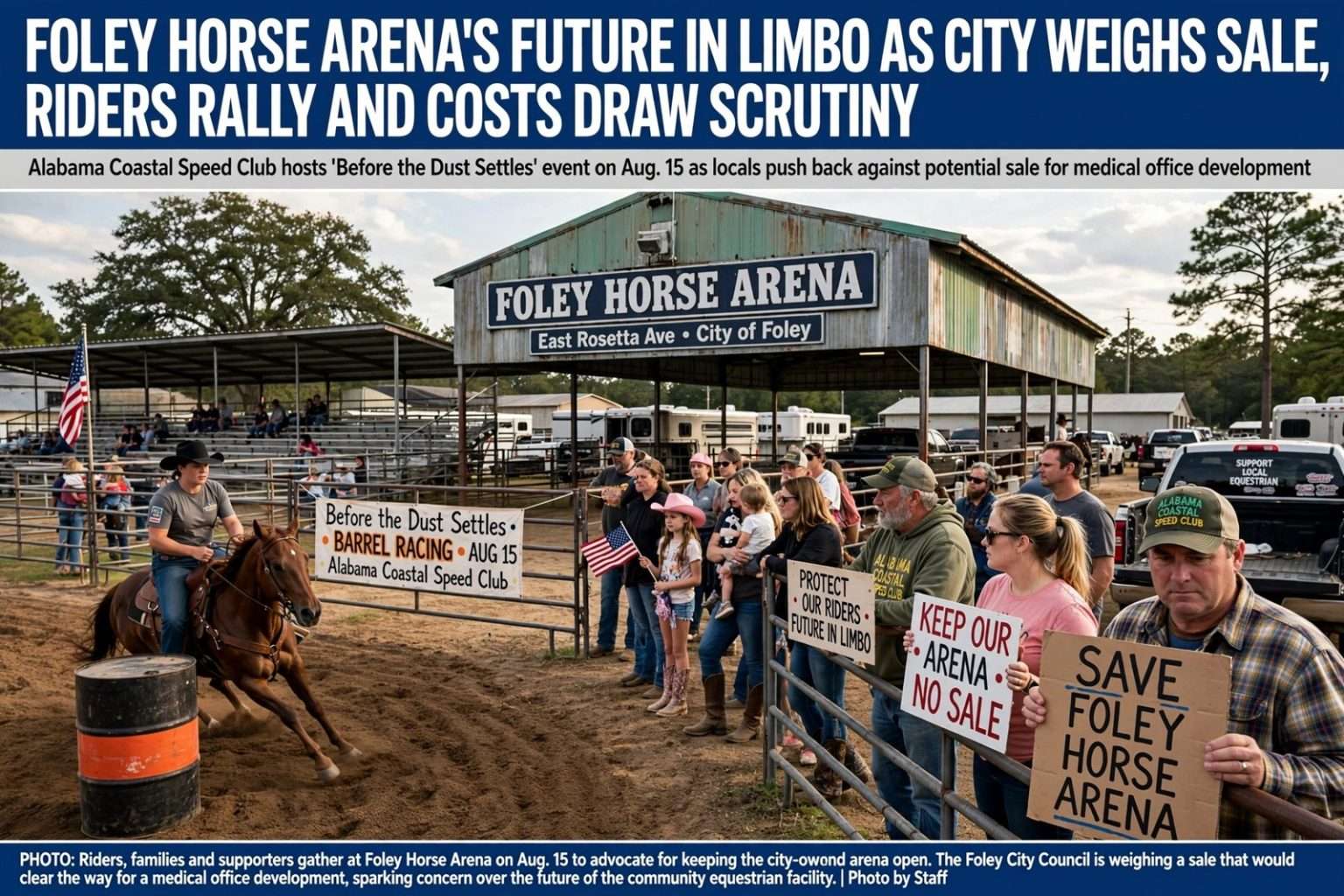
The future of the Foley Horse Arena remains uncertain after the Foley City Council voted last month to begin negotiations to sell the city-owned property on East Rosetta Avenue, a move that could clear the way for a medical office development but has left the local equestrian community scrambling to find out what happens next.
Riders and their families packed the arena over the weekend for a “Before the Dust Settles” barrel racing event, organized by the Alabama Coastal Speed Club, a nonprofit riding club co-founded earlier this year by Keith Hudson and Curt Langford. The Aug. 15 event, which included a 4D barrel race and exhibitions, was billed by organizers as a chance to show the city how much the community values the facility. “(We) are encouraging the community to come out and support the horse community to advocate for a Foley Horse Arena’s future,” organizers said in a news release announcing the event.
Hudson said the club’s goal is to preserve a place for young riders and families to compete and learn. “Our ultimate goal is to be able to continue to provide an area for kids and adults to come out and ride, learn horsemanship, participate in the community and support Foley itself,” he said. Langford said the timing of a potential sale is the biggest concern, since even if the city commits to building a new arena, it could take years to complete. “They sell this September, October, and then it may take two years for them to build another one, even if they’re willing to build us an arena,” Langford said. “It’s the time involved, you know, we’re going to be without one for quite a long time.” Hudson said the club has already scheduled events for the rest of the year and worries sponsors who contributed money to the season won’t get the recognition they were promised if the arena closes early. “We’ve reserved those dates and now they’re telling us that there’s a possibility we may not be able to finish out our season,” he said.
Foley Mayor Ralph Hellmich has said the arena is underused by city residents and primarily benefits riding clubs based elsewhere. “Our arena is used, and we track the use of it. It’s used primarily by groups not from Foley, for club type activities,” Hellmich said. “It is underused, but I’m sure to those people that use it, it is a valuable commodity.” Hellmich said no sale has been finalized, but a decision is expected within three months. If the city does sell the site to a medical provider, he said officials already have an alternative location in mind: a roughly 40-acre unused parcel west of town next to the city’s five-plex sports complex. “We plan on fencing with a horse friendly fence,” Hellmich said, “and also building the facilities inside it for what they currently use it for is training, barrel racing, pole racing, jumping and basically that.”
The debate over cost has intensified in recent weeks after the Mobile County Commission approved construction and design contracts for a new outdoor equestrian arena at the Jon Archer Arena in West Mobile for $949,436 — a fraction of the $5 million to $10 million price tag Foley officials have cited for a replacement facility. The Mobile County project, funded through $500,000 in American Rescue Plan Act money and $449,436 from the county’s Capital Improvement Fund, will add a new outdoor arena, bleacher seating, paved parking, drainage improvements, fencing and a security gate alongside an existing covered arena, with construction expected to take 100 days.
The gap between the two price estimates has fueled frustration among Foley equestrians. “My question is if Mobile County can do that, and Baldwin County is more of an agricultural county, then why can’t we do that?” said Kilmer, a Fairhope resident who owns a horse farm in Foley and has long used the arena. Hellmich said he was unfamiliar with the Mobile County project and that comparing the two would “be hard,” noting Foley’s estimate was developed several years ago and was based on relocating an entire indoor facility, including utilities, parking and amenities — not the outdoor-only arena equestrians are now requesting. Rob Coleman, an associate professor and extension specialist at the University of Kentucky, said an enclosed arena could reasonably run $3 million to $5 million given rising steel and labor costs, but that an uncovered outdoor arena should cost far less. “Even if they put in some of the most high-priced footings, it would take it from $900,000 to the $1.25 million (price range),” Coleman said. “But to get to $5 million without it being covered, that seems to be very high without any kind of justification on what they are doing.”
Langford, who has pushed for a replacement facility, said he remains hopeful the city and equestrian community can reach a compromise, though he acknowledged one option under discussion — new fencing without a replacement arena — has alarmed some horse owners. “I’m optimistic we have some guys on the council who don’t want to leave the equestrian community out in the dark,” Langford said. “I feel like we’ll get another facility built. The timing of it, I don’t know.”
About the ARPA Money in Mobile County’s Project
The American Rescue Plan Act dollars Mobile County is using come from the federal State and Local Fiscal Recovery Funds created by Congress in 2021 to help governments respond to the COVID-19 pandemic and its economic effects. Under U.S. Treasury rules, recipients had to obligate those funds by the end of 2024 and must spend them by the end of 2026, which is one reason local governments have been directing remaining ARPA money toward projects that can be finished quickly.