Daphne Weighs Uber Rules as Ridesharing Debate Spreads Across Baldwin County
Daphne officials are moving to address Uber's presence on the Eastern Shore, following similar debates already playing out in Mobile and Orange Beach.
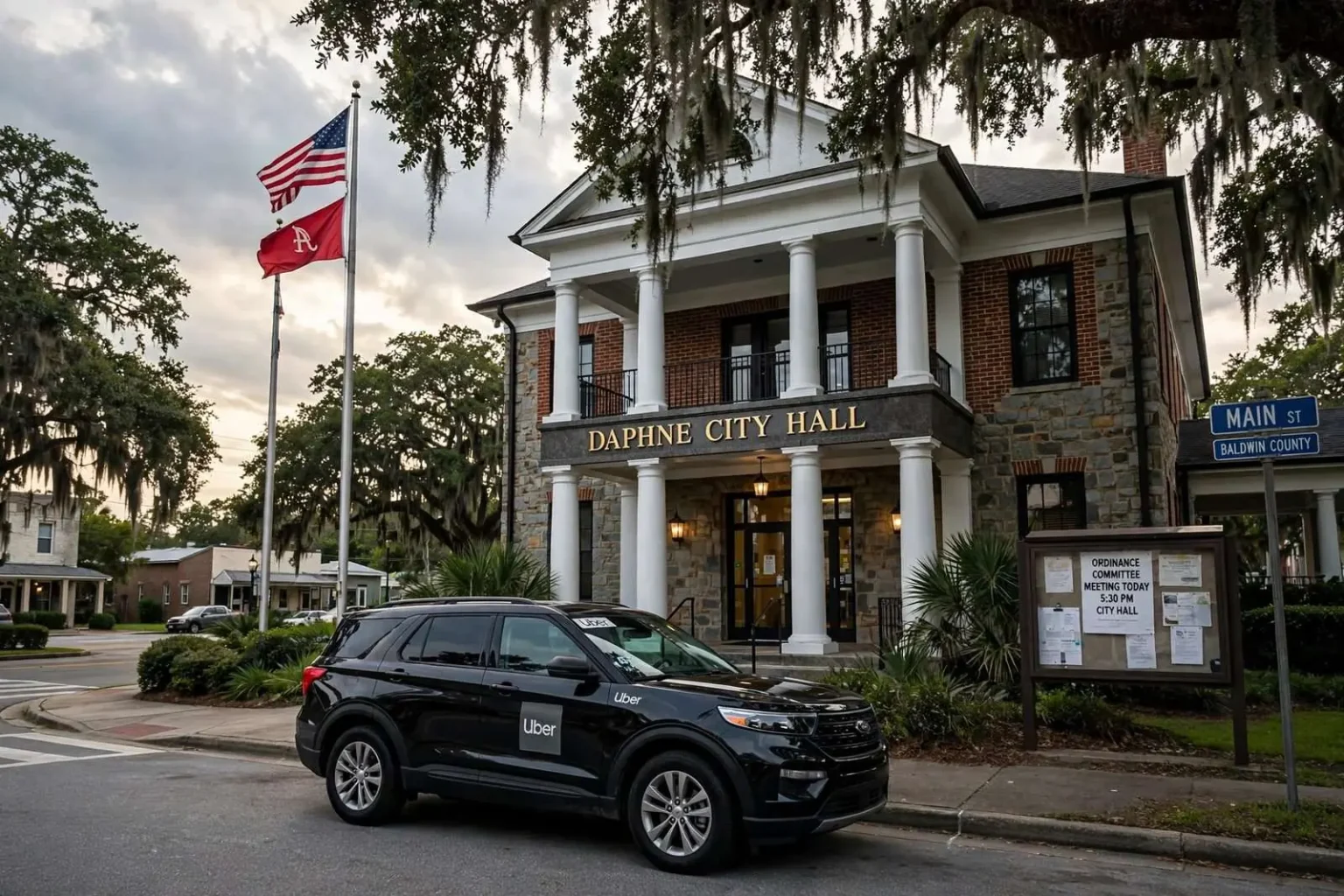
Daphne has become the latest Baldwin County city to grapple with the arrival of Uber, as officials there begin working out how the ridesharing service should be regulated on the Eastern Shore. Mayor Dane Haygood told the City Council he has received reports that Uber drivers are already operating in Daphne, and he encouraged council members to begin addressing the issue through the Ordinance Committee.
From a code enforcement standpoint, Haygood said, the city’s revenue department believes Uber drivers should be treated the same as any other taxi service operating within city limits.
“We’re going to continue to look at that, and the ordinance committee might want to ensure that this new wave of internet-based delivery matches our business license model and accomplishes some uniformity with the competing local businesses,” Haygood said.
The mayor’s framing captures the dilemma facing municipalities across the country as app-based services arrive faster than local codes can absorb them. Cities like Daphne license taxi companies, inspect their vehicles and collect fees on their business activity. Ridesharing drivers, by contrast, operate as independent contractors connected to riders through a smartphone platform, and many of them have no idea which city’s rules apply to a ride that starts in one municipality and ends in another. A single Uber trip can cross three or four municipal boundaries on the Eastern Shore, passing through jurisdictions with entirely different licensing schemes.
How the Debate Reached Baldwin County
The debate over how to regulate Uber first surfaced in Mobile in June, when the app-based service began operating in the city. After weeks of discussion over enforcement rules, Mobile officials ultimately passed an ordinance legalizing the ride-hailing service within city limits.
Mobile’s path made it the regional test case. The city weighed the same questions Daphne now faces: whether drivers needed business licenses, whether vehicles required inspections, how — or whether — to impose taxi-style regulations on a service whose drivers come and go by the hundreds. The ordinance Mobile ultimately adopted gave the company and its drivers a legal framework to operate, ending a period of ambiguity that had left both drivers and city enforcement officers uncertain about the rules.
Uber, founded in 2009, connects riders with drivers who use their own personal vehicles, with background checks and fare payments handled largely through the company’s smartphone app. Riders receive a fare estimate before booking, and the cost is automatically charged once the ride is complete. No cash changes hands, no hailing from a curb is required, and the rider knows the driver’s name, vehicle and rating before getting in.
That model is what disrupted the taxi industry worldwide, and it is why municipal governments have scrambled to respond. Traditional taxi regulation assumes a fleet: a company that owns or leases vehicles, employs or contracts drivers, and maintains a local office. Uber’s platform model breaks every one of those assumptions, spreading the “fleet” across thousands of privately owned cars and leaving cities to decide whether each driver is a business, a contractor, or something local codes never anticipated.
Riders, for their part, have largely embraced the platform’s transparency. The fare is quoted before the trip, the route is tracked on a map, and the receipt arrives by email — a level of disclosure the taxi industry rarely matched. On the Eastern Shore, where taxi service has long been thin and a trip to the Mobile airport or a night out across the bay required planning, an on-demand option filled a genuine gap. Local demand is precisely why drivers began working the Daphne area before any ordinance addressed them, and why city officials expect the pressure for a clear legal framework only to grow.
The company’s marketing campaign for the Alabama Gulf Coast has touted service to “Mobile, Gulf Shores, Orange Beach, or anywhere in between,” but Mobile so far remains the only city in the region with an ordinance specifically addressing the service.
That marketing line highlights the problem Haygood identified. Uber sells riders a seamless regional service, but the legal authority to regulate drivers rests with each individual municipality along the route. A rider can book a trip from downtown Mobile to the Gulf Shores beachfront and cross multiple jurisdictions whose officials have taken sharply different positions on whether the ride is even lawful in their limits.
The Beach Cities Draw a Line
Concerns about drivers operating without local authorization were raised last month by the Orange Beach City Council, and the Gulf Shores Police Department took an especially hard line, stating in a Facebook post that Uber drivers were operating illegally in the city and calling the service “highly dangerous,” though the post was later toned down considerably.
The beach cities’ caution has its own logic. Gulf Shores and Orange Beach economies run on tourism, and the cities maintain strict vehicle-for-hire oversight during the seasons when their populations swell with visitors. Officials there worry about unregulated drivers picking up passengers who have no local recourse if something goes wrong, and about insurance coverage that may not apply when a personal vehicle is used commercially. The softened Facebook post suggested the cities recognized the message had landed harder than intended, even as their enforcement concerns remained.
The insurance question sits at the center of most ridesharing debates. A personal auto policy typically excludes commercial use of a vehicle, which means a driver’s coverage could theoretically lapse the moment a ride request is accepted. Uber carries contingent coverage for its drivers during trips, but the gaps between personal and commercial policies — and between periods when a driver is waiting for a fare versus carrying one — have been the subject of legislation and litigation in state after state. Cities lack the authority to resolve those questions themselves, which is part of why their responses have been inconsistent and why the subject keeps returning to statehouses.
The disagreement between the beach cities and Mobile illustrates a broader national argument over ridesharing. Supporters point to convenience, lower fares, flexible income for drivers and safety features like GPS-tracked trips and cashless payment. Skeptics raise questions about background check standards, commercial insurance requirements and the effect on licensed taxi operators who carry regulatory costs ridesharing drivers avoid. Cities have landed on every point of the spectrum, from outright bans to full embrace, often with neighboring municipalities in direct conflict.
Fairhope Leans Toward Welcome
Not every Baldwin County city has taken a skeptical stance. Fairhope officials recently signaled a more welcoming approach toward Uber and are expected to use Mobile’s ordinance as a template for crafting their own rules for the service.
Fairhope’s decision to borrow from Mobile’s ordinance reflects practical reality on the Eastern Shore, where the cities sit close enough together that riders and drivers cross municipal lines constantly. A patchwork of incompatible rules would be nearly impossible to enforce, and drivers could find themselves legal in one city and violating the law a mile down the road. Adopting a neighboring city’s framework, with adjustments, offers the best chance of regional consistency short of action by the state Legislature.
That is where Daphne’s deliberations matter most. As the largest city on the Eastern Shore, Daphne’s choice will influence whether the corridor from the Causeway to Spanish Fort to Fairhope converges on a common approach or fragments further. Haygood’s emphasis on matching the business license model suggests Daphne is inclined toward accommodation — bringing drivers into the city’s existing revenue system rather than shutting the service out.
With Daphne now weighing in, Baldwin County cities appear split between cautious regulation and open acceptance of ridesharing, leaving riders and drivers across the Eastern Shore navigating a patchwork of local rules as each city works out its own approach.
What It Means for Riders and Drivers
For riders in Daphne and the surrounding communities, the practical effect of the current ambiguity is uncertainty about whether their next ride is sanctioned by local law. In cities that have legalized the service, riders can book with confidence; where rules remain unsettled, enforcement activity against drivers — however unlikely in day-to-day practice — remains a theoretical possibility that both drivers and riders have to consider.
For drivers, the stakes are livelihood. Many Uber drivers in the region are part-timers earning supplemental income, and few can navigate multiple municipal licensing regimes as a condition of driving. Most simply follow the app and let the legal questions sort themselves out, which is precisely what makes ordinance adoption urgent for cities that want some measure of oversight rather than none at all.
The state level may ultimately settle the question. Legislatures across the country have stepped in where cities fractured, passing statewide ridesharing laws that preempt local ordinances and set uniform insurance and background check requirements. Until Alabama does the same, the task falls to city councils like Daphne’s — one municipality at a time, working through the Ordinance Committee to fit a global technology platform into a local codebook written for a different era.