University of South Alabama Orange Beach
Extreme Heat Triggers Widespread Fish Kills in Orange Beach Backwaters
A brutal summer heat wave left back-bay waters near Orange Beach starved of oxygen, killing schools of small fish from Cotton Bayou to Bear Point.
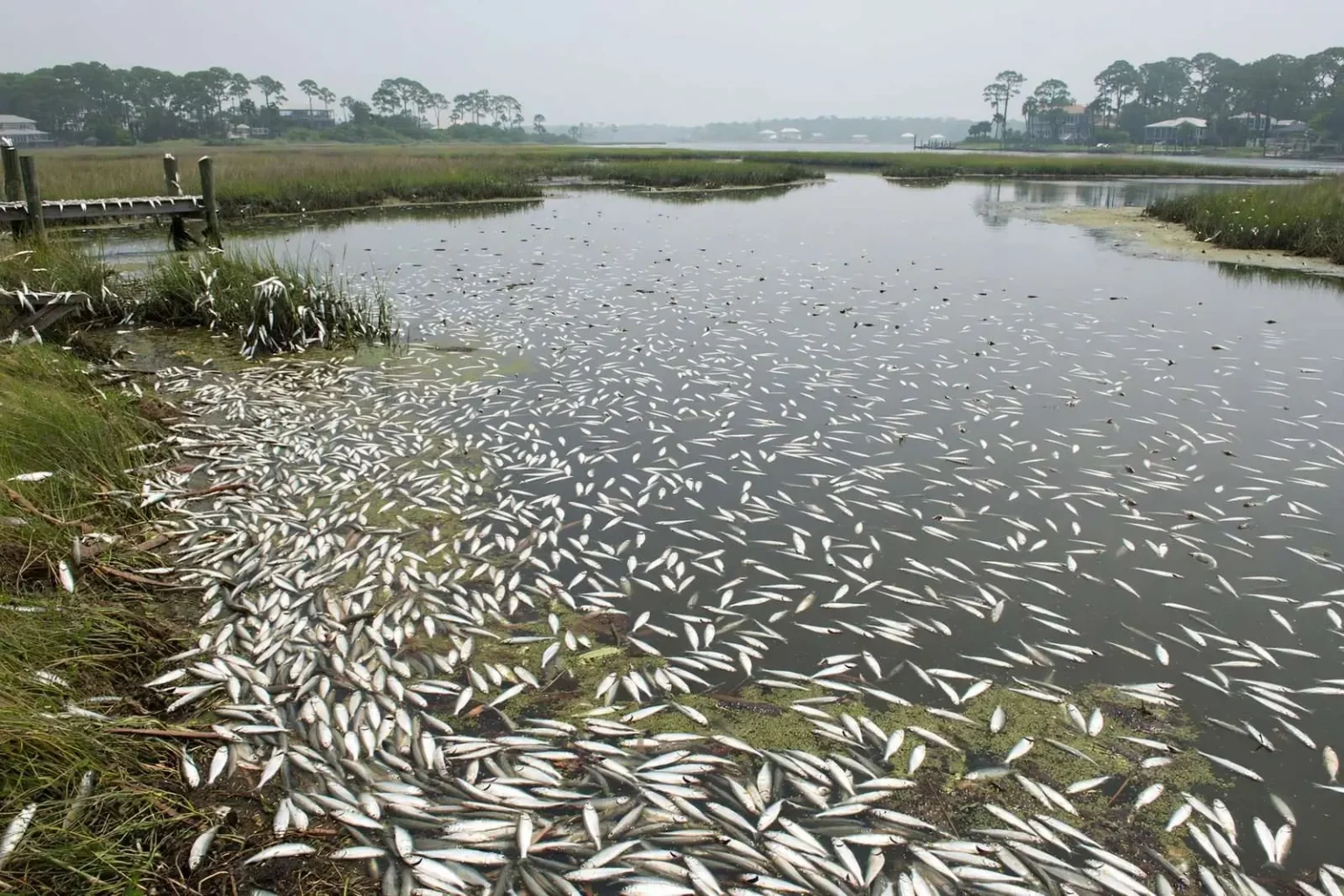
ORANGE BEACH, Ala. — A stretch of scorching, windless weather in early August 2015 set off a wave of fish kills in the sheltered back-bay waters around Orange Beach, with city officials pointing to low oxygen levels rather than pollution or disease as the cause.
Orange Beach Coastal Resources Manager Phillip West said the combination of relentless heat and weak northerly winds had stopped the natural mixing that normally keeps bay water oxygenated. Without that mixing, the water in shallow, poorly flushed pockets grew stagnant just as large schools of small baitfish, likely alewife or menhaden, crowded into the same stressed waters.
“These are species that show up in huge numbers in water that’s already struggling for dissolved oxygen, and that combination is a recipe for a fish kill,” West explained.
The mechanics are straightforward summer physics. Warm water holds less dissolved oxygen than cold water to begin with, and sheltered back-bay pockets — fenced in by islands, impoundments and residential canals — depend on wind to churn oxygen from the surface down through the water column. When the wind dies and the heat peaks, the mixing stops, the oxygen budget shrinks, and whatever is using the oxygen keeps using it: fish, crabs, and above all the decaying organic matter that Gulf Coast backwaters accumulate.
Into that stressed water come the baitfish schools. Menhaden and their relatives travel in enormous, dense pods through the summer estuaries, and each mouthful of water they pass over gills draws down the oxygen around them. A school of thousands in a pocket that is already oxygen-poor can tip the balance in an afternoon, killing the school and further depleting the water as the dead fish decompose.
Where the Kills Showed Up
The first major kill was spotted in Cotton Bayou, and sightings continued through the following days across a wide stretch of the coastline, from Robinson Island near Perdido Pass north to Bayou St. John, between Ono Island and Bear Point. Most of the dead fish recovered were small, in the four-to-seven-inch range, with the heaviest concentration found in Cotton Bayou itself.
West drew on research from longtime University of South Alabama marine sciences authority Bob Shipp, whose writing on Gulf of Mexico fish species describes how menhaden often gather in shallow, poorly circulated estuaries during summer months. Because the species cannot tolerate low-oxygen conditions, large die-offs can cascade once conditions turn stagnant. As dead fish decompose, they consume even more of the water’s remaining oxygen, feeding a cycle that produces still more kills.
Shipp, a retired professor and department chair at South Alabama whose guides to Gulf fishes are standard references for anglers and biologists along the coast, had spent decades documenting how the region’s estuarine fish respond to exactly the conditions Orange Beach was experiencing. His descriptions of menhaden behavior — schooling tightly in warm, poorly flushed shallows where food is abundant and predators are visible — explain why the species dominates summer kill events rather than the gamefish that chase them, which are generally better able to sense and escape deteriorating water.
“It’s kind of a textbook phenomenon based on the conditions we’re dealing with right now,” West said.
Residents who spent time on the water described the scale of the die-off as unusual. West recounted that one longtime resident walking along Cotton Bayou said he had not witnessed a kill of this size since a severe heat wave years earlier, a comparison that placed the 2015 event among the worst the backwaters had seen in recent memory.
Natural Event, Real Consequences
City officials emphasized that low oxygen — not pollution, runoff or disease — was the culprit, an important distinction for a coastal town whose economy leans on clean water. Summer fish kills of this type are natural events with long precedent in Gulf Coast estuaries, and they typically end when the weather pattern breaks: a front, a sustained breeze or rain-cooled water restores mixing, oxygen levels rebound, and the surviving fish move back into the pockets they abandoned.
But “natural” does not mean consequence-free. Back-bay property owners awoke to bobbing mats of dead baitfish and a stench that made waterfront evenings unbearable until cleanup crews arrived. Municipal teams from the Coastal Resources office and public works gathered what they could from canals and shorelines, since decomposing fish left in place prolong the oxygen sag and can touch off secondary kills in the same water.
The geography of the die-off told the story on its own. Robinson Island and the shallows near Perdido Pass, Bayou St. John, and the waters between Ono Island and Bear Point are precisely the sheltered, poorly flushed pockets where West’s explanation predicted trouble — tidal exchange reaches them weakly, and their residence time is long enough for a week of still air to drain the oxygen.
For anglers, the event was a mixed signal. Kills concentrated on small menhaden and alewife-type baitfish, not the speckled trout, redfish and flounder that draw fishing traffic to the back bays, and adult gamefish generally survived by moving to deeper, better-oxygenated channels. But a sustained baitfish die-off thins the forage base the gamefish depend on, and guides working the back bays in the following weeks watched for disruption in the usual feeding patterns.
Watching the Weather
Coastal Resources staff spent the days after the first kill monitoring dissolved oxygen and tracking reports from residents, mapping the extent of the event as it spread from Cotton Bayou across the backwater system. The city asked the public to report kills and to leave cleanup to the crews working the sites, both to keep decomposing fish out of the water and to keep the data flowing that helps officials understand how widespread an event has become.
The episode also fed a longer conversation about the health of the back bays. Orange Beach’s Coastal Resources program — one of the more active municipal environmental offices on the Alabama coast — has spent years working on habitat restoration, water quality monitoring and living shorelines across the city’s estuarine holdings, from the islands at Perdido Pass to the bayous behind Ono Island. Events like the 2015 kill illustrate why that work matters: the same sheltered pockets that suffered through the stagnant week are the areas where restored marsh edge, better tidal circulation and healthy submerged grass beds give the water more oxygen capacity and the fish more refuge when conditions turn.
West’s team communicated the same practical message to residents that coastal scientists have repeated for years: summer fish kills in shallow Gulf Coast bays are almost always weather-driven, and the appropriate response is cleanup and patience rather than a search for a polluter. Reports of oily sheen, unusual discoloration or dead adult gamefish in numbers get referred to state agencies, but a tide of small menhaden after a windless heat wave is a known pattern.
The 2015 event joined a regional record of similar kills. Nearly every summer brings at least scattered reports along the northern Gulf coast, from Mobile Bay’s western shore to the Perdido system, whenever heat, calm and abundant baitfish converge. What made the Orange Beach episode notable was the breadth — kills reported across the full sweep of the backwater system at once — and the density of dead fish in Cotton Bayou, where the concentration was heaviest.
By the time the weather pattern broke, the backwaters began the recovery that always follows: oxygen levels rebuilt with the returning breeze and tides, scavengers and cleanup crews cleared the carcasses, and the baitfish schools that survived regrouped in the deeper channels. The gamefishery that draws anglers to the Orange Beach back bays came through an event that, by the city’s account, was a textbook summer phenomenon — unwelcome on the waterfront, deadly to the baitfish, and entirely a creature of the weather.
What Residents Can Do
City guidance during the kill events covered the practical questions waterfront residents actually face. Dead fish on private docks and canal banks could be buried in a yard, bagged for household trash after checking local disposal instructions, or left for the municipal cleanup crews working public areas. Residents were cautioned against hauling fish to other locations or dumping them back into the water, since either move just relocates the oxygen demand that caused the problem. Pets kept away from rotting fish on the shoreline avoid more than a foul smell — decomposing marine carcasses can carry bacteria that sicken animals that scavenge them.
Boaters navigating the affected pockets were asked to run slowly and avoid churning shallows, both because prop wash in an oxygen-starved basin stirs low-oxygen water upward and because disturbed sediment releases nutrients that feed the cycle. The same guidance applies during any summer stagnation on the back bays: the water column is in a fragile balance, and every bit of unnecessary disturbance pushes it further from recovery.
The city also used the event to point residents toward the monitoring resources that already exist for the back bays, where dissolved oxygen readings, bacteria reports and habitat data are collected and published through the Coastal Resources program and its state partners. Anglers and waterfront property owners who understand the oxygen cycle — warm, still, nutrient-rich water in poorly flushed pockets — are better equipped to interpret what they see from their docks, to report accurately when something falls outside the normal pattern, and to support the restoration work that gives the back bays more resilience the next time a week of heat and still air settles over Perdido Pass.