State Warns Hurricane Sally Victims About Repair and Tree-Removal Scams
Alabama officials warned Hurricane Sally victims about repair scams and price gouging during a Baldwin County consumer-protection briefing.
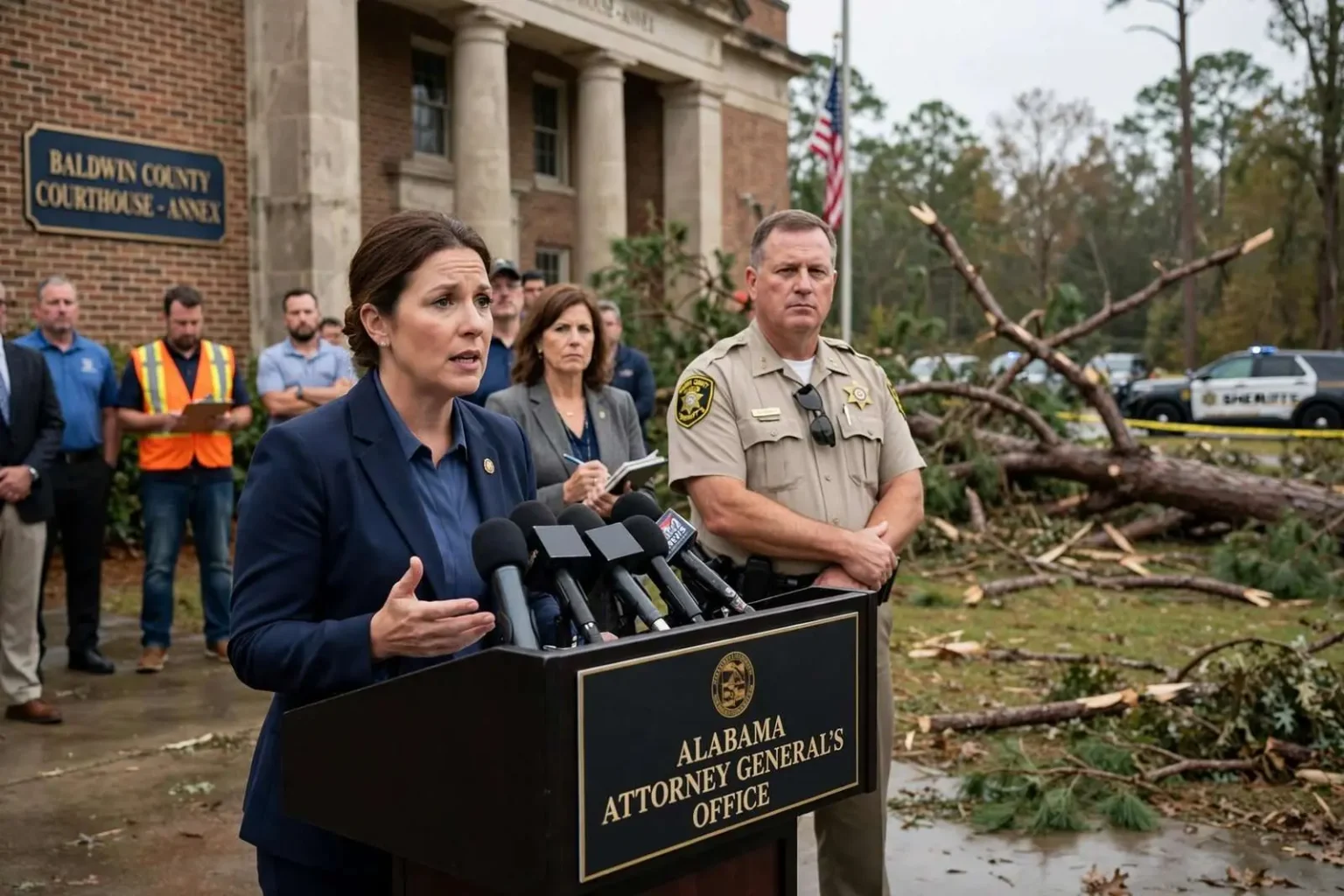
BAY MINETTE, Ala. — State leaders gathered at the Baldwin County Courthouse annex Monday to warn residents recovering from Hurricane Sally about consumer scams that tend to follow major storms, delivering a message aimed at a county still digging out from one of the most damaging hurricanes in Alabama history. With cleanup underway from Orange Beach north through Bay Minette, contractors from across the country have poured into Baldwin County, and officials want homeowners to separate the legitimate professionals from the con artists who trail every disaster.
Among the biggest concerns officials cited is being cheated by tree-removal companies — a hazard particular to Sally, which toppled thousands of oaks and pines across the county’s residential streets. With trees on roofs, across driveways and tangled in power lines, homeowners desperate to clear their properties can be easy marks for crews demanding cash up front for work they never finish, or never intend to start.
Their advice: compare prices with neighbors, look for online reviews, and avoid rushing into a deal. In a county where nearly every block has a downed tree and nearly every homeowner needs the same services, information travels fast — and officials urged residents to use it before signing anything.
‘People will be victimized’
“Try to use your common sense and not get in a hurry. What we are expecting over the next month and six weeks, people will be victimized,” said Assistant Attorney General Tina Hammonds of the Alabama Attorney General’s Office. Hammonds’ warning reflects a pattern documented after every major Gulf Coast hurricane: in the weeks following landfall, complaints about contractor fraud, price gouging and abandoned jobs spike as out-of-state operators arrive alongside the legitimate disaster-recovery workforce.
The math of a storm like Sally explains why. Baldwin County is Alabama’s largest county by land area, and Sally’s debris field stretched from the beaches at Orange Beach and Gulf Shores all the way north to Bay Minette — a distance of roughly 50 miles. Demand for tree work, roofing and repairs vastly exceeds the supply of local licensed contractors, creating the opening that fly-by-night crews exploit: a homeowner who has called every company in the phone book will often take the first crew that answers, vetted or not.
How to screen a contractor
The guidance offered at the courthouse annex follows the standard playbook for disaster-recovery consumers. Compare prices with neighbors, since several households on the same street often receive quotes for similar work and wide discrepancies are a red flag. Look for online reviews, and check with the Alabama Licensing Board for General Contractors and the Better Business Bureau before hiring. Avoid rushing into a deal, particularly with any contractor who demands full payment up front, offers a special “storm price” good only for today, or arrives uninvited at the door.
Residents should ask for proof of insurance and verify licenses in writing, get estimates and contracts on paper, and never pay the full cost of a job before the work is completed. A down payment for materials is customary in legitimate contracts; a demand for cash for the entire job is not. Officials also cautioned homeowners to be skeptical of crews that lack local addresses or vehicle registrations, since scammers typically move on to the next storm market within weeks.
Price gouging on the watch list
The briefing outlined how storm victims can guard against home-repair fraud and price gouging, and how to report suspected fraud to law enforcement. Price gouging — the practice of dramatically raising prices on essential goods and services during a declared emergency — covers fuel, lodging, building materials, generators and repair services in Alabama, which declared a state of emergency ahead of Sally’s landfall. While supply shortages can legitimately raise prices, state law limits unconscionable increases during a declared emergency, and complaints are investigated by the Attorney General’s Office.
Charity scams round out the familiar post-storm playbook. Officials urged residents to donate to established, verifiable organizations rather than responding to unsolicited calls, emails or social media appeals soliciting storm relief money, which commonly surge after major hurricanes and often divert funds from the communities they claim to help.
Home-repair fraud takes other forms as well: crews that collect payment for materials and vanish; subcontractors performing work the homeowner never agreed to, then demanding payment; “inspectors” who charge fees to assess damage that municipal or federal programs will evaluate free of charge; and filing schemes in which a contractor offers to handle an insurance claim and pockets the proceeds. Each thrives on the same condition — a homeowner in a hurry — which is why officials returned repeatedly to the same two words: slow down.
How to report suspected fraud
Residents who believe they have been victimized, or who spot a suspicious operator working their neighborhood, have several avenues for reporting. The Alabama Attorney General’s Office handles consumer complaints, including contractor fraud and price gouging, and can be reached through its consumer protection channels. Local law enforcement — from the Baldwin County Sheriff’s Office to municipal police departments — handles reports of theft and fraud committed in their jurisdictions, and district attorneys prosecute criminal cases arising from complaint investigations.
Documentation matters in every case. Homeowners should keep copies of contracts, estimates, text messages, receipts and photographs of the work performed or not performed, along with the names and any identifying details of the crews involved — including vehicle license plate numbers, which become critical when a contractor leaves the area. Even residents who paid and feel the work was substandard should file a complaint; complaint patterns help regulators identify repeat offenders operating across multiple counties.
Why Baldwin County is a target
Sally created nearly ideal conditions for predatory contractors. The storm damaged tens of thousands of properties across a county of roughly 220,000 residents, knocking out power for a week or more in many communities and leaving a debris field that will take months to clear. Insurance payouts and federal assistance are flowing into homeowners’ accounts, putting cash in circulation precisely when the market for repairs is most desperate — and when the difference between a legitimate roofer and a fraudulent one can be thousands of dollars.
Baldwin County’s geography compounds the problem. Its population is spread across more than a dozen municipalities and a wide swath of unincorporated territory, from Daphne, Fairhope and Spanish Fort on the eastern shore to Foley, Robertsdale, Summerdale and Loxley in the center, and Bay Minette in the north. In the county’s rural stretches, homes sit far from neighbors who might compare notes, and sheriff’s deputies cover long distances — conditions that predatory crews have historically exploited in past storms.
The county has seen this before. Hurricanes Frederic in 1979, Ivan in 2004, Katrina in 2005 and a series of smaller storms each brought a wave of contractor complaints to Baldwin County, and each recovery produced the same lessons: the crews that show up uninvited, quote a suspiciously low price or demand full payment in cash are the ones that most often disappear before the work is done.
The weeks ahead
Officials expect the risk window to remain open well past the immediate cleanup. Hammonds’ projection — that victims will be made over “the next month and six weeks” — covers the period when the initial emergency response fades and the long repair phase begins, when homeowners are signing the biggest contracts of the recovery for roofs, structural repairs and major tree work.
By then, the crews that poured into the county from Orange Beach north through Bay Minette will have sorted themselves out: legitimate contractors with local references and insurance paperwork will still be working, while the fraudulent ones will be chasing the next storm. Homeowners who took the time to verify licenses, compare prices and get everything in writing will have complaints to make if something goes wrong; those who did not will often have nothing but a receipt — if that.
The message from the courthouse annex was consistent from start to finish: the recovery from Sally will take months, and no repair job is so urgent that a homeowner should skip the basic checks that separate legitimate contractors from criminals. Common sense, neighbors’ advice and a little patience, officials said, remain the best protection the county’s residents have.
State leaders said the courthouse annex briefing was organized precisely because the county’s residents need the warnings before the contracts get signed, not after the money is gone. The session covered the consumer-protection basics that apply in every disaster: the difference between civil fraud and criminal theft, the role of the district attorney’s office, and the complaint process that turns individual reports into enforcement action.
FEMA and insurance scams to watch for
Disaster-assistance fraud deserves its own caution, officials noted, because it exploits the programs designed to help. Federal disaster assistance is free — applicants never pay a fee to file with FEMA or to be considered for aid — so any “representative” charging for FEMA applications is running a scam. The same goes for insurance-related schemes: policyholders should deal directly with their carriers or licensed local agents, beware of “public adjusters” demanding large upfront percentages, and be suspicious of anyone who offers to inflate a claim, since claim fraud exposes the policyholder to prosecution, not the person who proposed it.
Homeowners with questions about a contractor’s license, a suspicious price or a suspected scam do not need to wait until they have lost money to act. A quick call to the Attorney General’s consumer protection line or the local sheriff’s office can verify a company’s standing or flag a crew that other victims have already reported. In disaster recovery, as officials stressed Monday, the cheapest time to detect a scam is always before the check is written — and in Baldwin County’s long recovery from Sally, the residents who ask questions first will be the ones who keep both their trees and their money.