Thomas Hospital Proposes South Alabama’s First Free-Standing ER in Daphne
Thomas Hospital has applied to build south Alabama's first free-standing emergency department in Daphne, backed by a unanimous city council endorsement.
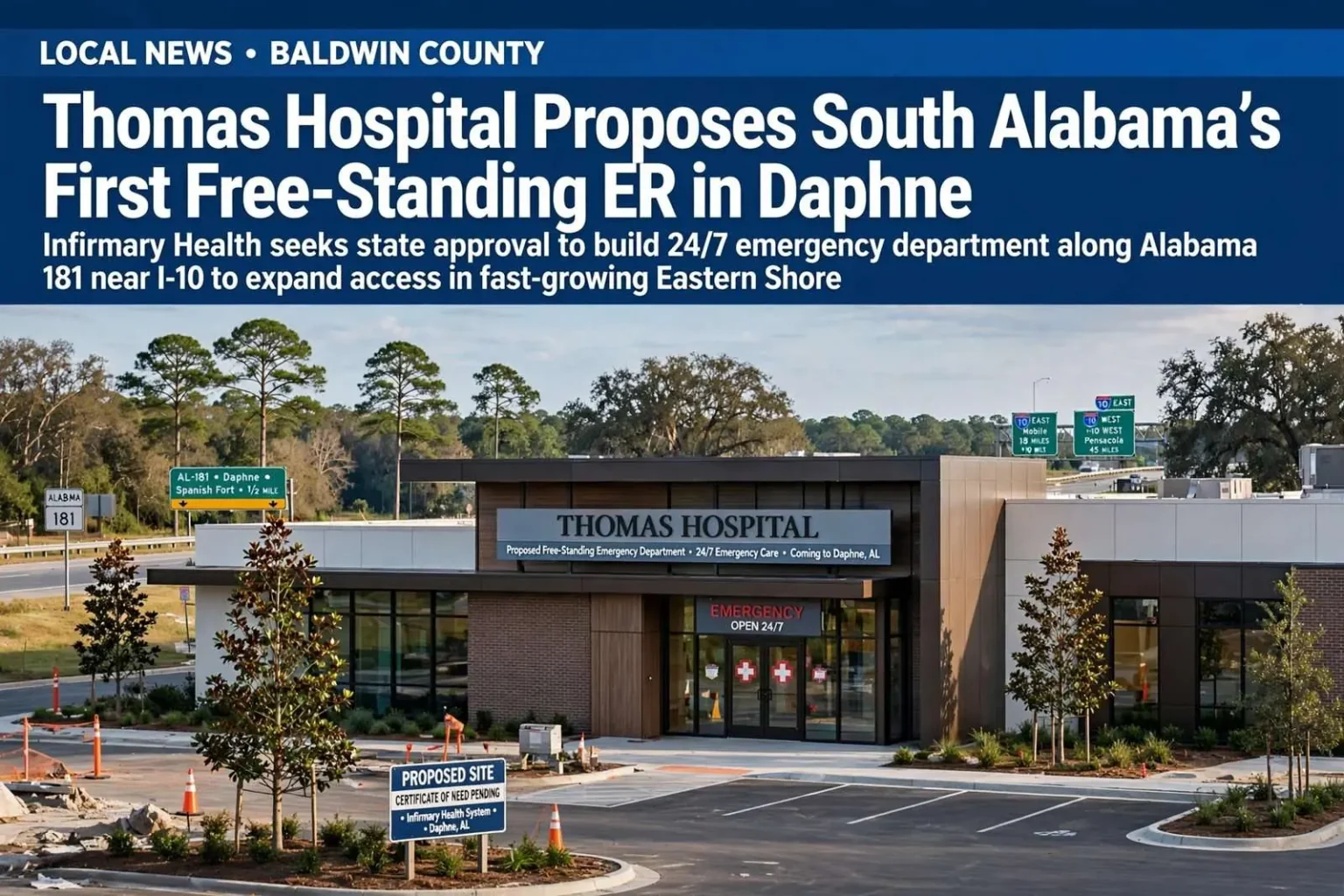
Thomas Hospital, an Infirmary Health System facility based in Fairhope, is seeking state approval to build south Alabama’s first free-standing emergency department in Daphne, a move hospital leaders say would dramatically improve access to round-the-clock emergency care in fast-growing Baldwin County. The hospital has filed a certificate-of-need application with the State Health Planning and Development Agency, the state body that reviews major health care construction and service expansion proposals before they can move forward in Alabama. If approved and construction moves forward, the Daphne facility would become just the third free-standing emergency room in the state, following planned projects in the Birmingham area.
The certificate-of-need process is a familiar hurdle for Alabama hospitals and one that can shape health care access across a region for decades. Under state law, providers must demonstrate to the State Health Planning and Development Agency that a proposed facility or service is genuinely needed before they are permitted to build it. The review is intended to prevent unnecessary duplication of expensive medical services and to steer investment toward communities that lack options, but it also means projects like the one proposed in Daphne can spend months moving through application, public comment and review stages before any site work begins. No timeline for a final regulatory decision was announced, and hospital officials said additional details on design and site selection would follow as the approval process moves forward.
Unlike an urgent care clinic, a free-standing emergency department operates around the clock and functions identically to a hospital-based emergency room, just without inpatient beds on site. Patients who arrive by private vehicle or by ambulance are evaluated by emergency physicians and nursing staff, and the department can provide imaging, laboratory testing and stabilization for serious illness and injury. Those who require admission are transferred to a full-service hospital, which in this case would mean Thomas Hospital in Fairhope or another facility in the Infirmary Health system. Supporters of the model say it fits best in fast-growing suburban corridors that are close enough to a hospital campus to coordinate transfers but far enough away that minutes can matter in a stroke, heart attack or trauma case.
City Council Backs the Project
Earlier this week, the Daphne City Council voted unanimously to send a letter of support for the project to state regulators. The letter describes the proposed facility as greatly needed and says it would improve access to health services throughout the county while serving as an asset to the broader community. In certificate-of-need proceedings, where competing providers sometimes argue that a proposed service is unnecessary or would dilute existing operations, endorsements from municipal governments can carry real weight, and the council’s unified stance signaled that Daphne’s leadership views the project as answering a long-standing gap in Eastern Shore health care coverage.
The council’s action also reflects how central emergency medical access has become to quality-of-life debates in Baldwin County. The county is among the fastest-growing in Alabama, and its population is spread across a wide geographic area that stretches from the Mobile Bay shoreline east toward the Florida line. For residents of Daphne, Spanish Fort and the surrounding communities, the closest hospital-based emergency departments have historically required a drive to Fairhope, to hospitals along the Interstate 10 corridor, or across Mobile Bay, a trip that can be complicated by bridge and tunnel traffic at peak hours.
What the Facility Would Offer
Thomas Hospital Administrator and Vice President Ormand Thompson said the new facility would essentially extend the hospital’s emergency capabilities directly into the Daphne area. He said the department would operate 24 hours a day, seven days a week, with full-service physician staffing, radiology and lab services, and coordination with local EMS crews for patients who need ambulance transport to a full hospital. That last element matters for response planning across the Eastern Shore, because ambulance crews that today must decide between long transport runs would be able to deliver patients to a fully equipped emergency setting much closer to where the call originated.
Thompson said an exact site has not been finalized, but the hospital is eyeing property along Alabama 181 near Interstate 10. That corridor has become one of the busiest commercial and residential arteries on the Eastern Shore, lined with new subdivisions, schools and retail centers, and its junction with Interstate 10 puts the proposed facility within practical reach of Daphne, Spanish Fort and parts of unincorporated Baldwin County. Plans also call for attached physician office space to house additional outpatient services, an arrangement that would let patients follow up with specialists near where they received emergency treatment rather than making separate trips across the bay or down the bayway to Fairhope.
Keeping Pace With Growth
Thompson emphasized that the Eastern Shore, which includes Daphne, Spanish Fort and Fairhope, remains one of the fastest-growing regions in the country, and hospital officials believe the expanded emergency access is overdue given that growth. Decades of residential development have transformed the once-quaint communities along Mobile Bay’s eastern shore into a suburban belt that serves thousands of commuters who cross the bay daily for work in Mobile. Population growth of that scale brings added traffic, added demand on public services and a corresponding increase in emergency medical calls, yet the area’s dedicated round-the-clock emergency infrastructure has lagged behind the rooftops, remaining concentrated outside Fairhope proper.
Hospital systems across the Gulf Coast region have been wrestling with the same equation, weighing where to place expensive emergency capacity as suburbs sprawl outward from traditional city cores. Free-standing emergency departments have become an increasingly common answer nationwide because they can be built faster and at lower cost than a full hospital while still delivering around-the-clock physician care. For Infirmary Health, which operates multiple facilities across the region and has long treated Thomas Hospital as its flagship in Baldwin County, the Daphne project represents a bet that emergency demand on the Eastern Shore will only intensify as the population continues to climb.
A Mayor’s Personal Story
Daphne Mayor Dane Haygood spoke in support of the project, recounting a personal experience from the previous year that he said illustrated the gap the free-standing ER would fill. One of his daughters was injured during a community Relay for Life event, and because the local urgent care clinic on Alabama 181 in Malbis had already closed for the evening, Haygood said he had to drive roughly 12 miles to Fairhope for treatment. The incident, he noted, happened on an ordinary evening in a developed part of the county, not in a remote corner of it.
Haygood said that even a short distance can feel like an eternity during a medical emergency, and he praised Thomas Hospital for continuing to invest in expanded services for the community. His anecdote underscored the distinction hospital leaders have drawn between urgent care and true emergency capacity: walk-in clinics typically keep daytime and early evening hours and are not equipped for the most serious cases, which leaves late-night injuries and illnesses dependent on whichever emergency department is farthest down the road. For families along the Alabama 181 corridor, that has meant long drives at the worst possible moments.
What Happens Next
If the certificate-of-need application is approved, the free-standing ER would mark a significant expansion of emergency medical infrastructure along the Eastern Shore, an area that has seen rapid residential growth in recent years but has lagged in dedicated round-the-clock emergency facilities outside of Fairhope proper. Approval would set in motion the next round of decisions, including final site selection along the Alabama 181 corridor near Interstate 10, architectural design, and construction scheduling, though hospital officials have not projected when the doors might open even in the best case.
Regulators with the State Health Planning and Development Agency will review the application against the state’s criteria for emergency service expansion, a process that typically includes scrutiny of projected patient volumes, the impact on existing providers and the demonstrable need of the community to be served. The unanimous backing of the Daphne City Council and the documented growth of the Eastern Shore give the application a foundation of local evidence that officials hope will carry the day. Competing providers will also have the opportunity to weigh in during the review period, as they often do in contested certificate-of-need cases.
For residents of Daphne and neighboring communities, the practical stakes are straightforward. A free-standing emergency department on Alabama 181 would put 24-hour physician-staffed emergency care, including radiology and laboratory services, minutes from thousands of homes that today are a dozen miles or more from the nearest hospital ER after dark. It would also give EMS crews a closer destination for ambulance runs, potentially shortening out-of-service time for crews who serve the whole Eastern Shore.
Hospital officials said additional details on design and site selection would follow as the approval process moves forward, and no date was given for when regulators might rule. In the meantime, city leaders have made their position clear, and the letter from the council now sits with the state as part of the record. Whether the project becomes south Alabama’s first free-standing emergency department will be decided in the months ahead, but the proposal itself has already succeeded in focusing attention on how far Eastern Shore residents must travel when the unexpected happens.