Daphne Names Volkert to Lead Long-Awaited Parks and Recreation Overhaul
Daphne city council picked Volkert to lead a mixed parks and recreation overhaul, though funding and the full project scope remain undecided.
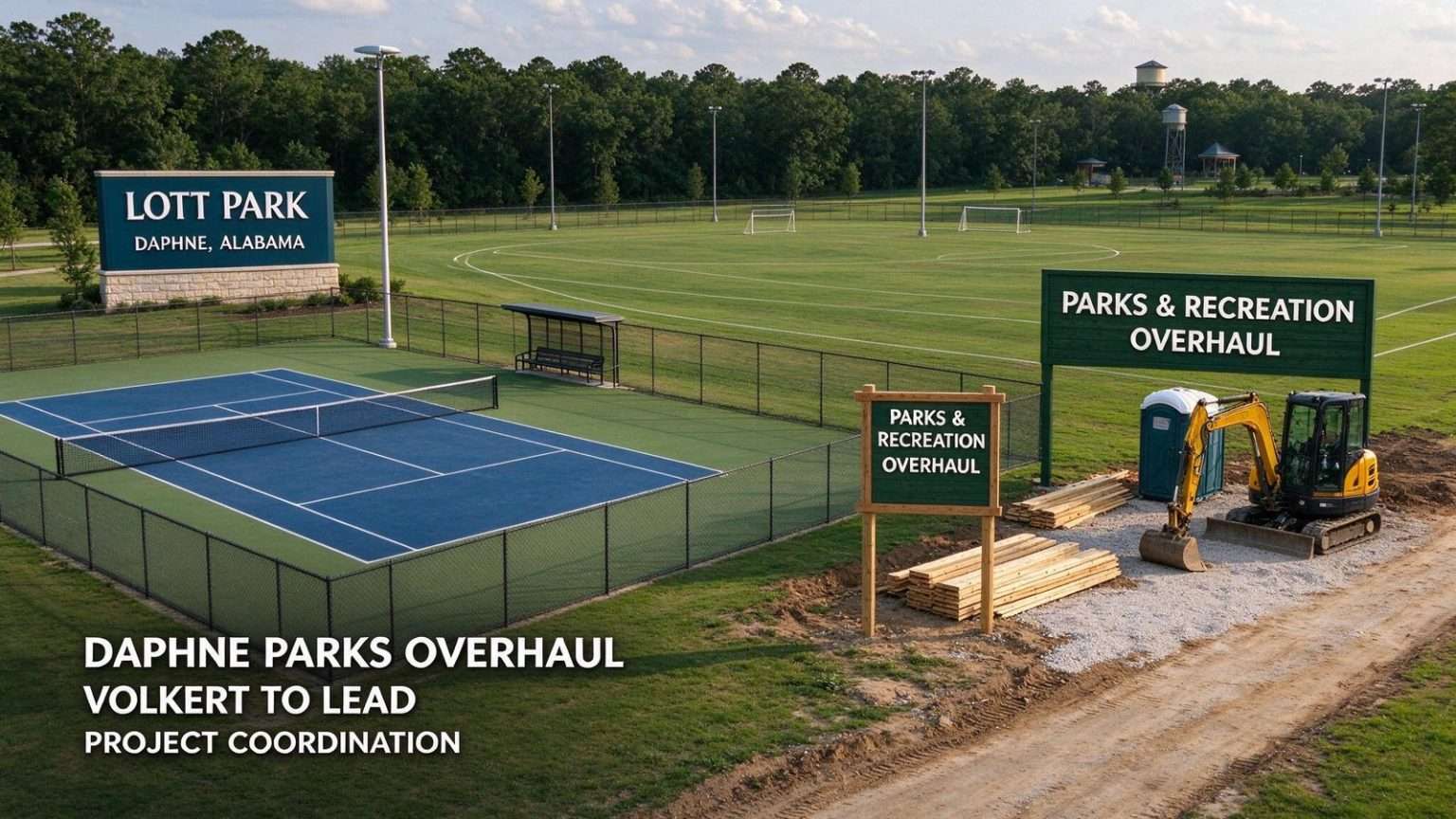
Daphne’s city council has taken its first firm step toward a long-discussed overhaul of the city’s parks and athletic facilities, voting this week to bring on a project manager even though the full scope and cost of the work remains undecided. The vote moves the project from the wish-list stage into procurement — the phase where plans get drawn, budgets get tested and, eventually, dirt gets moved. For a city that has talked about upgrading its recreational offerings for years, hiring professional management is the clearest signal yet that the overhaul is actually proceeding.
The city solicited proposals in January from five planning and engineering firms interested in expanding and upgrading Daphne’s recreational offerings. Submissions came from Goodwyn Mills and Cawood, Volkert, Hatch Mott MacDonald, Preble-Rish, and a partnership between Lose and Associates and Hutchinson, Moore and Rauch. The field itself said something about the project’s ambition: it drew regional heavyweights with statewide practices, national firms with local offices, and specialist designers who work almost exclusively on parks and athletic facilities.
Rather than pick a single master plan wholesale, the council opted to mix elements from multiple proposals, which variously called for new tennis courts at Lott Park on Main Street, upgraded fields and amenities at the Al Trione Sports Complex on Whispering Pines Road, and improvements at a 123-acre city property on Park Drive. The pick-and-choose approach lets the city assemble the best features of each submission — and assign each firm to the work it pitched best — rather than binding itself to one firm’s overall vision. It also keeps the city’s options open at a moment when the budget for the work has not been settled.
The Vote and the Firms
Mobile-based Volkert was chosen to serve as overall project administrator after securing four of seven council votes, with council members Robin LeJeune, Pat Rudicell, Randy Fry and Joe Davis III in support. The role makes Volkert the quarterback of the entire program — coordinating the other firms, managing schedules and keeping the various projects moving in a coherent order. The split vote showed the council took the choice seriously, with a majority persuaded that Volkert’s size and experience managing multi-site public projects made it the right steward.
Public project management has become the standard first hire for municipal building programs of this kind, and for good reason. A city managing several parks projects across multiple sites — each with its own designer, contractor and funding source — needs a single administrator watching schedules, change orders and budgets across all of them. Without that coordination, costs drift and timelines slip independently, and the council learns of overruns only when invoices arrive. Volkert’s role is to be the city’s technical agent, answerable to the council, for every moving piece of the program.
The Lose and Associates and Hutchinson, Moore and Rauch partnership will consult on athletic field design, while Hatch Mott MacDonald, which keeps an office in Daphne, was picked unanimously to design the tennis court upgrades at Lott Park. Dividing the work this way matches each firm to its strongest specialty. Athletic fields are a discipline of their own — grading, drainage, turf selection and lighting all determine whether a complex holds up under years of league play — while tennis court design is a narrower craft where a specialist’s detail work shows. The unanimous vote for the tennis piece suggested the council saw little controversy in that assignment.
Volkert, headquartered in Mobile, has spent decades as one of the Gulf Coast’s flagship engineering firms, with a project history that includes transportation, municipal and site work across the region. Goodwyn Mills and Cawood, also deeply rooted in the region, and Preble-Rish, a firm with a strong municipal portfolio, remain in the picture as the city’s procurement proceeds, since contract awards for construction and design packages can go to any of the firms involved. For the firms that did not win the administrator role, the mixed-scoping approach leaves room to compete for the actual project work.
Money Is the Next Question
LeJeune, who said he began pushing for the recreation overhaul back in 2013, called the vote a milestone. He said the council’s next task is figuring out how much money is actually available, since funding will ultimately dictate what gets built and in what order. The distinction matters for a project of this shape: a master plan can be drawn generously, but the construction schedule will follow the money, and LeJeune has been clear that the council will sequence the work rather than commit to everything at once.
The city currently has roughly $8.5 million in bonding capacity tied to lodging tax revenue earmarked for recreation, though LeJeune estimated upgrades at Lott Park and Trione Park alone could cost closer to $10 million, meaning the council will likely need to identify additional funding sources before finalizing any contracts. Lodging taxes — levied on hotel and short-term rental stays — are a common financing tool for cities with visitor economies, and Daphne’s position along the Eastern Shore corridor gives it steady hotel traffic from business and event travelers. Dedicating a slice of that revenue to recreation lets the city borrow against a growth-funded stream rather than raising property taxes, but bonding capacity is not cash: it is borrowing power, and every dollar borrowed must be repaid from future collections.
The gap between the $8.5 million available and the $10 million the two flagship parks could consume forces a sequencing decision. The council could phase the work — building Lott Park’s tennis complex first, then returning to Trione as funding allows — or seek grants, which Alabama cities routinely chase through state recreation funds and federal programs for parks and trails. Each path has trade-offs between speed, debt and scope, and LeJeune said the council intends to weigh them before signing contracts that lock in costs.
The 123-acre Park Drive property represents the wildcard in the planning. A tract that size dwarfs the city’s existing developed parks, and the proposals’ suggestions for it ranged from trail systems to athletic fields — a scale of development that would take years and significant money. With the funding picture still unresolved, the property’s future will be shaped by whatever the city can afford to begin, and by how ambitious the council decides to be about leveraging it.
What Happens Next
The January solicitation drew proposals that treated the city’s needs from different angles. Some firms emphasized bold master-planned visions for the Park Drive acreage; others focused on near-term fixes at the existing parks, where leagues are playing on aging fields today. Reading the submissions side by side gave the council a catalog of options at every price point, which is partly why the mixed approach appealed to a body that has not yet settled how much it can spend — the proposals collectively gave the city a menu it can order from as funding allows.
Contract terms with Volkert and the other firms still need to be worked out, and no construction timeline has been set. The contracts will define each firm’s scope, fee and deliverables — documents the council will review before any ground is disturbed, and the first real test of the project’s fiscal discipline. Until they are signed, the city has a project team, a loose set of priorities and a funding gap, which is exactly the stage at which well-run public projects either find their footing or stall.
For Daphne residents, the overhaul touches facilities they use weekly. Lott Park sits along Main Street near the heart of the city, close enough to neighborhoods that families walk to its fields and courts, and the Trione complex on Whispering Pines Road carries much of the load for youth league play across the city. Demand on both has grown with Daphne’s population, which has expanded steadily along the Eastern Shore as families move in for the schools and the commute to Mobile’s employers. Worn fields and undersized amenities are the visible symptoms of that growth, and the council’s recreation push is the response.
The Eastern Shore’s growth has also raised the competitive stakes among neighboring cities. Fairhope, Spanish Fort and Baldwin County’s beach cities have all invested heavily in parks and sports complexes in recent years, both for their own residents and for the tournament traffic that well-built complexes attract. Youth sports tournaments bring weekend visitors who fill hotels and restaurants, which is one reason lodging tax revenue has become the natural funding stream for recreation projects — the visitors who generate the tax are the same families the facilities serve. Daphne’s council is weighing its park upgrades against that regional backdrop, aware that facilities determine which cities capture that traffic.
LeJeune’s decade of pushing for the overhaul gives the project an unusual reserve of political patience — and a warning about timing. Projects that spend years in the discussion stage often lose their funding windows or their public support before the first contract is signed. This week’s vote, with a project manager hired and the design assignments made, is meant to break that pattern by putting the overhaul on a procurement calendar the public can track, even as the hardest question — how much the city can afford, and when — remains to be answered.