Baldwin County Weighs Merging Eastern Shore Transportation Planning Group Into Regional Commission
Baldwin County officials are considering folding the Eastern Shore's transportation planning organization into a Mobile-based regional commission.
Local officials on the Eastern Shore are weighing whether to fold their regional transportation planning organization into a Mobile-based commission, a move that could reshape how road and infrastructure projects are funded and prioritized across Daphne, Spanish Fort, Fairhope, Loxley and parts of unincorporated Baldwin County. The question under review touches every major road project on Alabama’s fastest-growing county’s most congested corridors — and it arrives wrapped in local politics.
A proposal under discussion would shift oversight of the Eastern Shore Metropolitan Planning Organization to the South Alabama Regional Planning Commission, moving it away from direct funding through the Baldwin County Commission’s budget. The idea was expected to come up at a policy board meeting held at Daphne City Hall, as the group’s annual funding contract with the county approaches its expiration — a deadline that gives the discussion practical urgency beyond the organizational question.
What an MPO Actually Does
Metropolitan planning organizations exist because federal law requires them: any urbanized area that spends federal transportation dollars must plan those expenditures through an MPO, a board of local elected officials that prioritizes which projects move forward. The Eastern Shore MPO performs that function for the densely growing corridor along Mobile Bay’s eastern shore, where population growth has outpaced road capacity for years.
Practically, the organization’s influence runs through the long-range transportation plan and the transportation improvement program — the documents that determine which road, intersection and transit projects are positioned for federal funding. Where an MPO sits, who staffs it and who answers to which county commission can determine whether a corridor’s priorities rise or stall.
The Political Undercurrent
The conversation carries an undercurrent of local politics. The MPO’s current coordinator led an organization opposing a school property tax increase during a contentious campaign that concluded when Baldwin County voters rejected both a proposed 8-mill increase and the renewal of an existing 4-mill tax in a late March referendum, a result expected to cost the county school system millions of dollars in funding in the coming years.
Several members of the MPO’s policy board — made up of elected mayors and county commissioners — had publicly supported the tax increase, putting them on the opposite side of a hard-fought campaign from the coordinator whose organization they now help oversee. The coordinator declined to discuss any connection between the tax campaign and the proposed restructuring.
One Eastern Shore mayor who sits on the policy board defended the coordinator’s work, saying politics should have no bearing on decisions about the organization’s future. The comment framed the fork in the road the board faces: judge the current structure on its transportation results, or judge it in light of the campaign its leader just ran.
What the Mobile Commission Is Offering
The head of the regional planning commission said his organization has both the capacity and interest to take on oversight of the Eastern Shore group, arguing it would give the area better access to existing relationships with state and federal transportation officials. The South Alabama Regional Planning Commission already serves the Mobile area, and its director noted the commission already oversees a similar planning organization on the Mobile side of the bay.
The pitch, in effect, is consolidation: one regional planning body with standing relationships in Montgomery and Washington, speaking for both sides of Mobile Bay. Supporters of the idea argue that unified representation carries weight when state and federal officials decide which regional projects receive funding, and that a larger organization can offer the Eastern Shore staff depth and technical capacity it cannot maintain alone.
Skeptics hear a different implication — that Baldwin County’s transportation priorities would be filtered through a Mobile-based institution, with the Eastern Shore’s specific corridor needs competing for attention inside someone else’s agenda. Which framing wins will depend on the policy board’s reading of what the last several years have delivered.
The Money Behind the Question
Funding has emerged as a central concern driving the discussion. The Eastern Shore MPO currently receives roughly $1.2 million annually for transportation projects, along with a smaller annual allocation from Baldwin County — a stream that pays for planning work and positions local projects to compete for federal dollars.
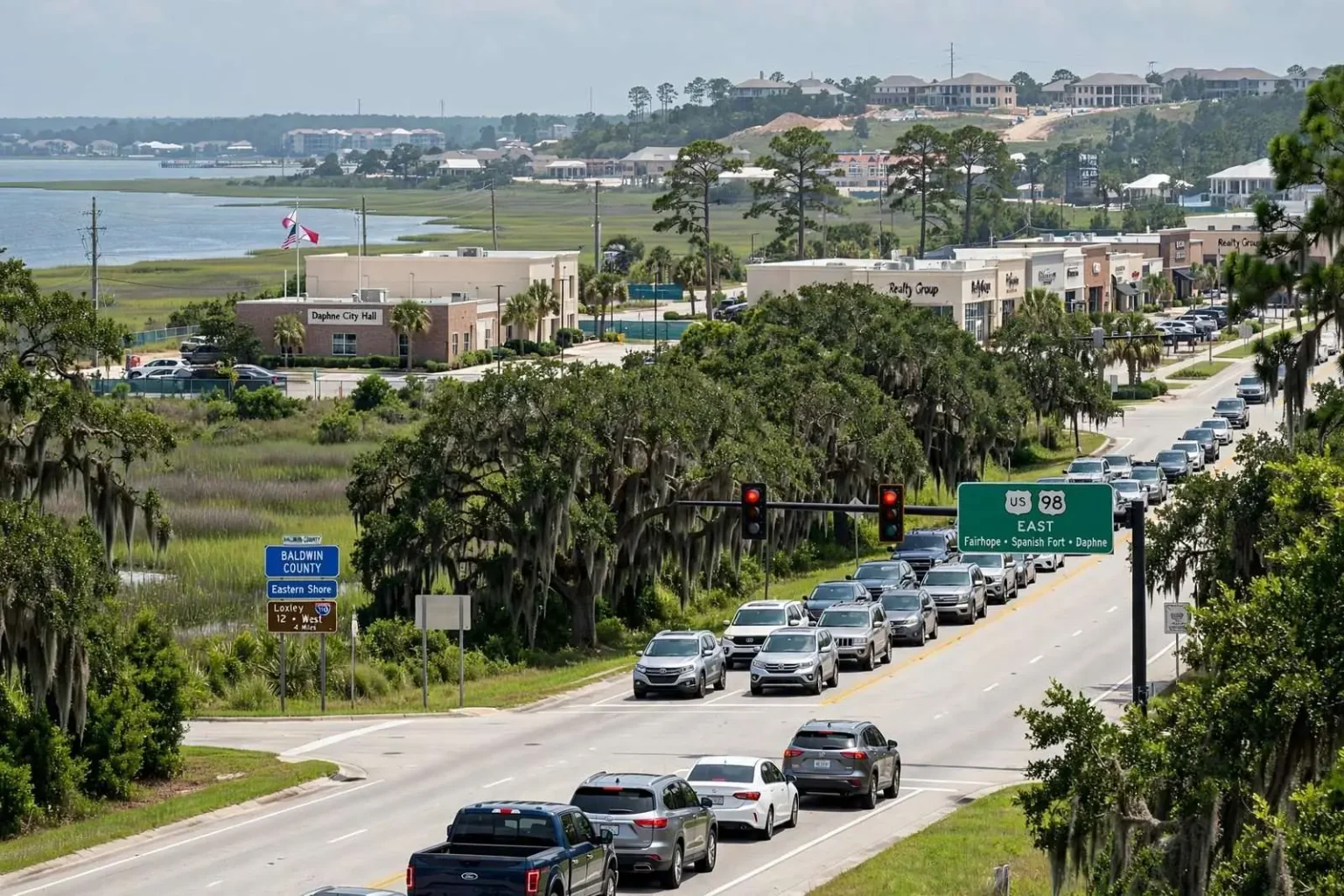
Its coordinator said state officials have signaled reduced matching funds may be available for larger projects, potentially forcing the group to redirect money toward smaller efforts such as road resurfacing rather than long-planned upgrades, including a proposed synchronized traffic signal system for some of the Eastern Shore’s busiest corridors. The signal project — aimed at the corridors where growth has turned commute routes into stop-and-go gauntlets — is exactly the kind of improvement that depends on predictable matching funds.
That squeeze sits behind the merger debate: if the money for big projects is drying up, the question becomes whether the current standalone structure can still deliver, or whether the Eastern Shore’s interests are better served inside a larger organization with more reach.
The Case for Staying Independent
Not everyone is convinced a merger would improve outcomes. One Baldwin County commissioner who sits on the board questioned the value of maintaining a large multi-jurisdictional group if state matching funds remain limited, saying he would support continuing the current structure only if meaningful project support materializes.
His position captures the pragmatic middle of the debate: the question is not organizational pride but project delivery. If the standalone MPO can still move the Eastern Shore’s priorities into funded projects, the case for independence holds; if the money and the attention flow elsewhere regardless, the structure becomes an expensive formality.
The Corridors at Stake
The roads at the center of the discussion are the ones Eastern Shore residents drive every day. U.S. 98 threads through Daphne and Spanish Fort, U.S. 31 runs the length of the older corridor through Spanish Fort, Fairhope and Point Clear, and the interchanges around Interstate 10 absorb both local growth and the beach traffic that funnels toward the coast on every summer weekend. Loxley’s explosive growth around its own I-10 interchange has added another pressure point at the county’s center of gravity.
Synchronized signal systems, widened intersections and improved arterial connections are the bread-and-butter projects an MPO positions for funding, and each year of delay compounds the congestion that growth delivers. For the elected officials on the policy board, the merger question is ultimately about whether those projects arrive faster under one structure or the other — a calculation made against traffic counts that rise every year.
What Happens to the Money if the MPO Moves
A shift to the South Alabama Regional Planning Commission would not change federal planning requirements, but it would change the administrative home of the Eastern Shore’s planning work, the staff who prepare its documents and the budget line the county currently funds directly. The annual funding contract with the Baldwin County Commission — the one approaching expiration — is the mechanism that would need to be renegotiated or replaced under any reorganization.
Transitions of this kind also raise practical questions the board will have to resolve: whether existing staff stay with the work, how the Eastern Shore’s voting representation is preserved within a larger organization, and how the group’s project list survives the move intact. Boards that have made similar moves elsewhere typically negotiate those details before the contract lapses, which is why the Daphne meeting and the ones that follow carry real weight.
Options on the Table
The policy board’s realistic choices amount to three: continue the current standalone structure with the county’s direct funding, fold the organization into the Mobile-based regional commission, or find a middle arrangement that preserves local control while adding the larger body’s reach. Each carries a different answer to the political question beneath the process — and none can be resolved without the funding picture becoming clearer.
The policy board is expected to continue weighing its options in the coming weeks as officials sort out funding uncertainty and the organization’s long-term structure. For the drivers of Daphne, Spanish Fort, Fairhope and Loxley, the stakes will show up eventually in the condition of the roads: whether the corridors that carry the Eastern Shore’s growth get their long-planned upgrades, and who — and where — the people are who decide.
Whatever the board chooses, the decision will be watched from both sides of the bay. The Eastern Shore’s experiment in how to organize transportation planning has become a test case for a county whose growth shows no sign of slowing, and whose next decade of road projects depends on getting the answer right.
Baldwin County’s Growth Engine
Context for the debate comes from the census numbers that have made Baldwin County one of the fastest-growing counties in Alabama and, by some measures, in the Southeast. The county’s population has climbed steadily for decades as retirees, families and remote workers choose the Eastern Shore’s schools, waterways and small-town downtowns over denser metros — growth that arrives on the same roads the MPO is trying to fund improvements for.
Each subdivision and commercial development along the U.S. 98 and Alabama 181 corridors adds cars to intersections designed decades ago, and the traffic signal synchronization project the coordinator cites is a direct response to that arithmetic. Transportation planners describe the pattern as a race between capacity and growth; on the Eastern Shore, the gap between the two widens each year that major projects wait in queue.
How Neighboring Regions Are Organized
The Eastern Shore’s deliberations fit a broader pattern across Alabama, where MPO structures have evolved differently in each urbanized area. Mobile’s planning work flows through the South Alabama Regional Planning Commission, Huntsville’s through its own regional body, and Birmingham’s through a large multi-jurisdictional organization covering multiple counties — each model with its own trade-offs between local control and regional reach.
Those examples give the Baldwin County board real-world comparisons as it weighs the merger. The question officials will ask is which structure has better served similar fast-growing suburban corridors: standalone organizations answering directly to the counties they serve, or regional bodies with larger staffs, broader relationships and longer agendas. The answer, in most regions, has been contested — which is precisely the position the Eastern Shore finds itself in now.