Eight Mile Family Struggles to Recover After Arson Guts Gas Station
A burglary-turned-arson destroyed a family-owned Eight Mile gas station, causing an estimated $200,000 in uninsured damage.
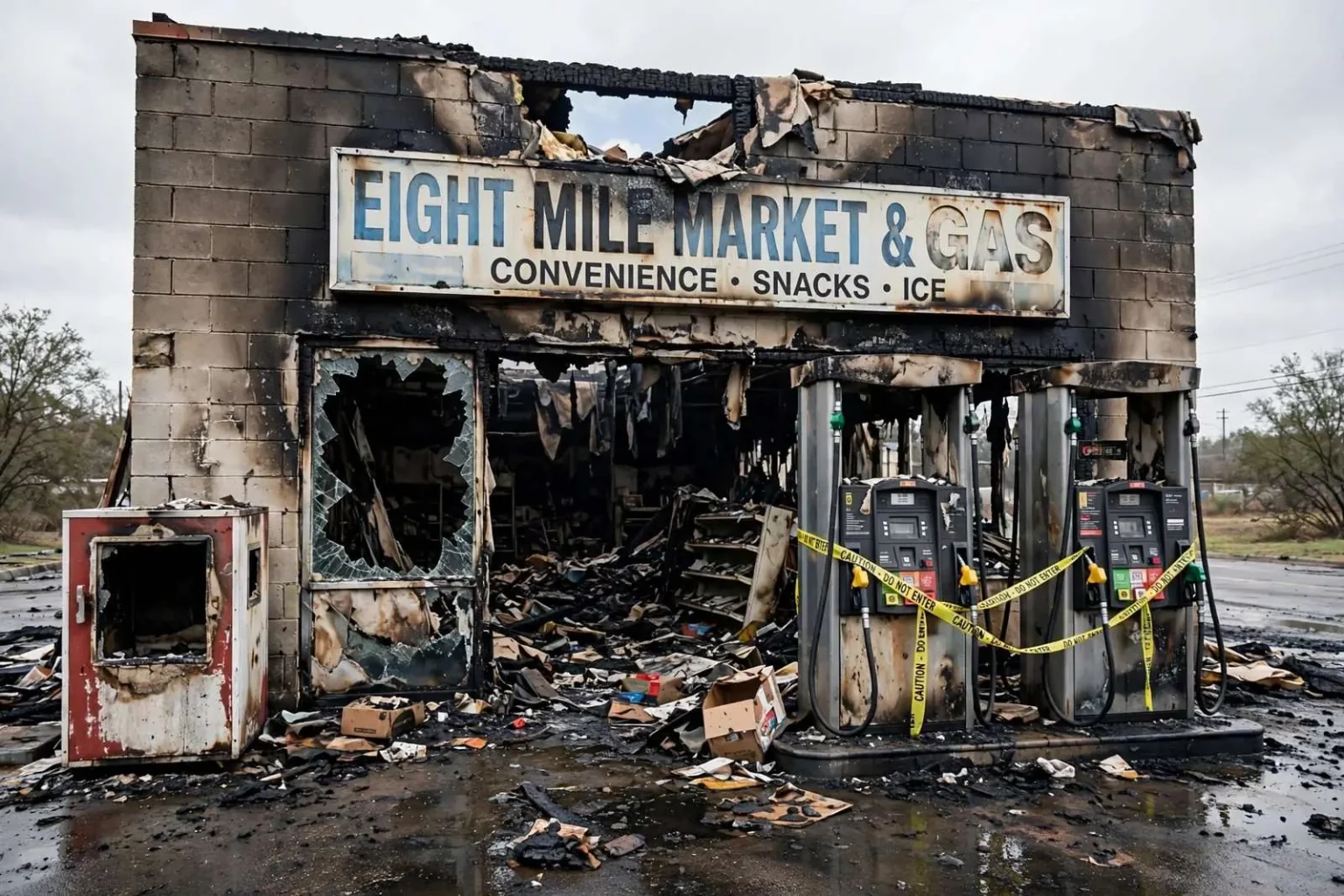
Two weeks after fire tore through their Eight Mile gas station, the smell of smoke still hung inside the gutted building. Glass had cracked from the heat, and water had seeped through holes punched into the walls and roof, leaving little of the store intact. The scene inside told the story the family had been living since that April morning: a business built over 15 years, destroyed in a single night by someone who broke in, stole what he could carry and set the rest alight.
“I don’t know what we do now,” said owner Lilian Maatouk Faragalla. “I feel very bad and very sad.” Faragalla and her husband, George, opened the shop 15 years ago and had built it into their family’s sole source of income. For a family business of that kind, the store was never just a building — it was the payroll, the college fund and the retirement plan all at once, and it vanished in the hours between one day’s close and the next day’s opening.
In the early morning hours of April 7, the couple learned their business had apparently been targeted in a burglary that ended in arson. Investigators with the Prichard Fire Department, working under Mayor Troy Ephriam’s administration, continued examining the scene in the days that followed, combing through the burned shell for the physical evidence that could identify and convict whoever was responsible.
What the Cameras Caught
According to the Faragallas, the break-in began late the night before. Store surveillance cameras captured a masked intruder forcing entry, stealing jewelry, cigarettes and cash, then attempting unsuccessfully to crack open a safe behind the counter. When that failed, the intruder appeared to douse scattered papers with an accelerant, set them ablaze and flee. The recording preserves the sequence in chilling order: burglary first, arson as an apparent afterthought, and a fire left burning inside a building where the family’s livelihood was stored.
Investigators had not said publicly how the attacker cut through the building’s cinder block walls and roof to get inside, a question that remains part of the case’s unanswered details. Entry through block construction is no small undertaking, and the effort involved has struck the family and investigators alike as deliberate — not a crime of opportunity but a planned attack on a specific store.
The fire consumed nearly everything in the store. George Faragalla pointed to bare spots where a computer, television and cash register once sat. Wiring beneath the counter used to run the station’s fuel pumps was charred beyond repair, leaving the pumps inoperable. The store has stayed closed ever since, its parking lot empty beside a road where it had served the Eight Mile community for a decade and a half.
“It damaged everything,” George Faragalla said.
A Family’s Loss, Measured
The family estimated total losses at roughly $200,000. They had no insurance on the business — a gap that transforms a devastating fire into an open-ended financial catastrophe, since every dollar of rebuilding must now come from savings, borrowing or charity rather than a claim. For a family store in Eight Mile, $200,000 represents years of profit that never got the chance to accumulate.
With three children between the ages of 13 and 17 depending on the store’s income, the Faragallas said the loss threatened more than just a building. “This is our only income,” Lilian Maatouk Faragalla said. “If you want to steal stuff, destroy stuff, fine. But why set it on fire?” Her question hangs over the case: the stolen merchandise and cash were recoverable losses in a way the burned building is not, and the arson converted a burglary the family might have survived into an economic disaster.
The damage reaches beyond the family to the neighborhood the store served. Independent gas stations and convenience stores anchor communities like Eight Mile — unincorporated Mobile County territory where the nearest alternative may be a drive away, and where a family-run store doubles as an informal community institution. Its closure leaves customers, and the store’s former routines, without a home.
How Arson Investigations Proceed
The Prichard Fire Department’s investigation will follow the standard path for a suspicious fire: a scene examination to determine the origin and cause, collection of debris samples for accelerant testing at a laboratory, a review of the surveillance footage the family preserved, and coordination with law enforcement on the burglary evidence. Arson prosecutions rise or fall on that physical evidence, because the person who set the fire left it designed to destroy its own traces.
Fires set during burglaries occupy a grim category for investigators, combining two felonies into a single event and often leaving behind accelerant patterns, pour trails and burn signatures that trained fire investigators can read even in a gutted structure. The holes cut through the walls and roof — both the intruder’s apparent entry and the fire’s own ventilation — will be mapped as part of reconstructing the night.
Prichard’s fire investigators work cases like this amid the demands of a busy department, and the Faragallas’ case now sits where so many property crimes do: in the slow work of evidence analysis and canvassing, waiting for the tip or the match that moves it forward. For the family, each day of the investigation is also a day the store stays dark.
The Uninsured Small Business
The family’s lack of insurance places them among a sobering statistic. A large share of America’s smallest businesses — particularly family-run stores operated on thin margins — carry no commercial property coverage, whether because premiums strain the budget or because owners underestimate the risk. When disaster strikes an uninsured store, there is no claims adjuster and no rebuilding fund; there is only the family’s own resources and whatever help the community organizes.
Insurance would not have returned the stolen keepsakes or eased the violation the family felt, but it would have changed the arithmetic of recovery: funds to clear the site, repair the block walls, rewire the fuel pumps and restock the shelves. Without it, the Faragallas face the full cost of reconstruction — or the possibility that the store that anchored their family for 15 years never reopens.
Fire officials and small-business advocates use cases like this one to make the argument that coverage is as fundamental to a store as its inventory. A single uninsured fire can erase a family’s entire business equity overnight, and the April 7 fire at the Faragallas’ station is a local illustration of how quickly that can happen — through no fault of the owners, in a crime they could not have prevented.
A Community Watches
For now, the Eight Mile community has watched the story unfold with the mixture of sympathy and unease that accompanies any violent attack on a neighborhood institution. Residents who bought fuel, cold drinks and everyday necessities at the station for 15 years now drive past a burned shell and a family weighing its future. The surveillance images of a masked figure torching a family’s livelihood have done more than any leaflet to remind neighbors that property crime and arson are not abstractions.
The Faragallas’ questions — why burn what could simply be stolen, and what does a family do when its only income burns with the store — remain the human center of the case while the investigation works toward answers. Investigators have not announced an arrest, and the family has not said whether it can afford to rebuild. What is certain is what the April 7 fire took: a 15-year-old family business, roughly $200,000 in property, three children’s household stability, and a community’s sense that its corner store would always be there in the morning.
Anyone with information about the fire or the burglary seen on the store’s cameras is urged to contact investigators, as tips from the public remain the most common path to resolution in arson cases like this one.
Rebuilding Without a Safety Net
The options ahead for the family are the ones uninsured business owners confront after a total loss: rebuild with borrowed money, seek help from the community, or close permanently. Each carries weight for a couple in their store’s 16th year. Rebuilding a gutted cinder block structure — new walls, roof, wiring, pumps, counters and equipment — is a months-long project even with financing in hand, and lenders are reluctant to fund a store whose income stream stopped the night of the fire.
Community support has emerged as the likeliest bridge. Neighbors and local residents sympathetic to the family’s story have discussed ways to help, and Gulf Coast communities have rallied behind burned family businesses before, through fundraisers, benefit drives and donations of labor. Whether that support materializes at the scale a $200,000 loss demands will shape the store’s future as much as any arrest in the case.
The family, meanwhile, has kept the store’s records, its surveillance files and its story intact while the investigation proceeds. Lilian Faragalla’s grief and George Faragalla’s inventory of what the fire destroyed tell the same account from two angles: a family that did everything right for 15 years, undone by one night and one decision by someone they have never met.
The case also serves as a reminder of the stakes carried by the small businesses that line the corridors of Mobile County’s unincorporated communities. A gas station is a mundane thing until it is gone — then it is a family’s income, a neighborhood’s convenience and a decade and a half of work measured in ash. How the Faragallas’ story ends depends now on investigators, on the community and on the family’s own endurance, in that order.