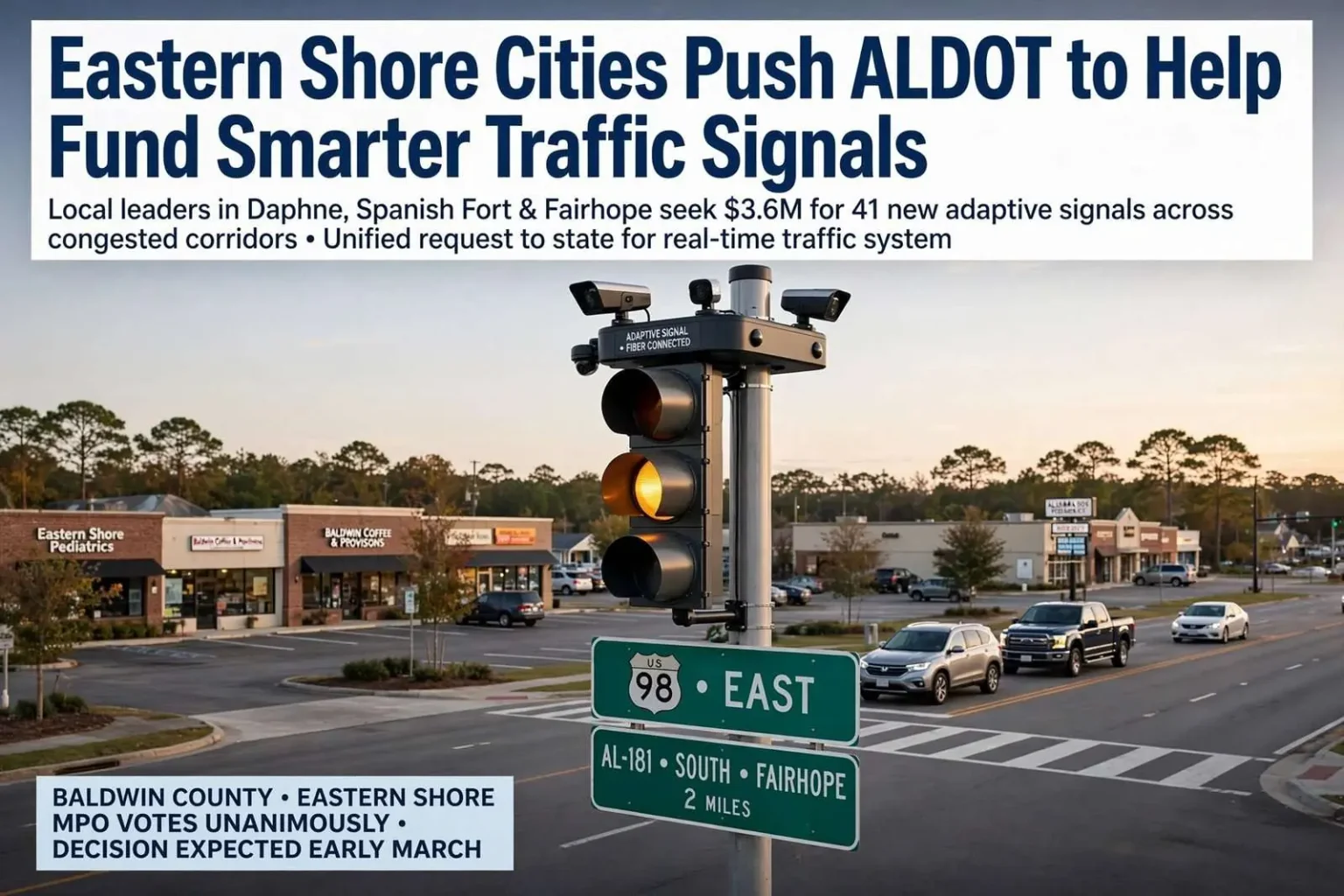
Eastern Shore Cities Push ALDOT to Help Fund Smarter Traffic Signals
Baldwin County leaders asked state transportation officials to split the cost of adaptive traffic signals aimed at easing congestion on U.S. 98 and Ala. 181.
Local leaders across Baldwin County’s Eastern Shore are pressing the Alabama Department of Transportation to help pay for a modern traffic signal system designed to move cars more efficiently through some of the region’s most congested corridors. The effort represents one of the most coordinated transportation asks the rapidly growing area has made to the state, uniting cities that often compete for resources around a single, data-backed project.
The Eastern Shore Metropolitan Planning Organization’s policy committee, made up of mayors, city council members and Baldwin County commissioners, voted unanimously to back a consulting report recommending “adaptive traffic signal” technology at dozens of intersections in Daphne, Spanish Fort and Fairhope. Instead of running on fixed timers, the new signals would adjust in real time based on actual traffic volume and would be linked together over a fiber optic network.
The technology marks a fundamental shift from the way most signals in the area operate today. Conventional signals cycle through pre-programmed patterns whether cars are present or not, which means drivers routinely sit at a red light at an empty intersection in the middle of the night or wait through a long cycle while cross traffic barely exists. Adaptive systems, by contrast, read the road continuously and reallocate green time second by second, smoothing platoons of cars along a corridor instead of stopping and starting them.
The first phase of the plan targets 41 intersections considered among the busiest in the county: 19 along U.S. 98 in the Daphne and Spanish Fort area, 12 on Alabama 181 in those same cities, and 10 more along U.S. 98 in Fairhope. Those corridors carry the daily load of commuters headed to jobs in Mobile, shoppers moving between the Eastern Shore’s commercial centers, and the steady growth traffic generated by some of the fastest population gains in Alabama.
Engineers estimate the total cost at roughly $3.6 million, and local officials want the state to cover half. The split reflects the reality that ALDOT controls the rights of way and signal infrastructure along the U.S. highways involved, while the cities and county have shouldered much of the study and design work that produced the recommendation in the first place.
“Bang for your buck” on Baldwin’s busiest roads
“This is about as good of a bang as you can get for your buck,” Baldwin County Commissioner Chris Elliott said, pointing out that similar technology is already used in Gulf Shores and along heavily traveled stretches of road in the Birmingham area. “We’ve pulled it along this far and we got it here. If this is not way high up on their funding list, we have a big problem.”
Elliott’s argument leans on precedent close to home. Gulf Shores has operated adaptive signals along its tourist corridors, where seasonal traffic swings from quiet winter mornings to summertime surges that can multiply volumes many times over, and the Birmingham area has deployed the technology on some of its most congested suburban arterials. For Eastern Shore officials, those working examples answer the question of whether the systems deliver in Alabama conditions — the technology is not experimental, it is already running down the road.
A second phase would extend the upgrades to nine more intersections along Alabama 181 in unincorporated parts of the county near Fairhope, but that piece of the project is on hold because no fiber optic network currently reaches that stretch of road. The fiber backbone is the unglamorous prerequisite that makes adaptive signals possible: without a high-capacity connection linking each intersection to the system’s central brain, individual signals cannot coordinate or share traffic data in real time.
State transportation officials said the request would be reviewed alongside other Baldwin County transportation priorities, with a decision expected by early March. The timeline puts the Eastern Shore’s ask in direct competition with a lengthy list of needs across a county that has been adding residents faster than its road network has been expanding, from bridge work on the Eastern Shore to capacity projects in the county’s southern communities.
Even if the state agrees to help fund the work, planners estimated it could take up to six months just to design the system, plus additional time for procurement and installation before the first adaptive signals go live. The sequencing means that a favorable funding decision in March would still leave drivers waiting more than a year for relief at the worst intersections, a reality officials have been careful to communicate.
Why the Eastern Shore corridors are the problem
U.S. 98 through Daphne and Spanish Fort functions as the commercial spine of the Eastern Shore, lined with shopping centers, restaurants, schools and medical offices, while Alabama 181 has evolved from a rural connector into a parallel arterial lined with new subdivisions. Fairhope’s stretch of U.S. 98 carries traffic into the heart of one of Alabama’s most desirable small cities, where growth has tested a street grid designed for a much smaller town.
The Metropolitan Planning Organization process gives the region a formal channel for federal and state transportation planning, and the policy committee’s unanimous vote matters in that structure. When Daphne, Spanish Fort, Fairhope and the Baldwin County Commission speak with one voice through the MPO, the request carries the weight of a unified regional priority rather than a set of competing municipal wishes — a posture that officials calculated would strengthen their hand with ALDOT.
Congestion on the Eastern Shore is not simply a quality-of-life issue; it has measurable economic costs. Commuters crossing Mobile Bay on the Blakeley and Daphne utilities routes face signal after signal on their way to work, businesses along the corridors contend with customers who time their trips around traffic, and emergency responders must thread the same bottlenecks. Adaptive signal technology addresses a specific slice of that problem — the delay and unpredictability introduced by fixed signal timing — at a fraction of the cost of widening a road.
Officials have framed the roughly $3.6 million price against those alternatives. Adding lanes through the commercial sections of U.S. 98 would cost far more per mile, require extensive rights-of-way acquisition through developed property, and take years of environmental review and design. Upgrading signals, by contrast, works within the existing pavement, and the fiber network it requires could support future Intelligent Transportation System applications such as connected-vehicle infrastructure and real-time traffic monitoring.
What local drivers can expect
If funding is approved and design proceeds on schedule, the rollout would likely be staged corridor by corridor, with the U.S. 98 intersections in Daphne and Spanish Fort — the largest single block of the phase-one plan — anchoring the system. Drivers would notice the change gradually: fewer unnecessary stops, better progression through long strings of lights, and signals that recover quickly after a train crossing or an emergency vehicle interrupts the pattern.
The fiber network installed for the project would also become a durable regional asset, giving the cities and ALDOT a communications backbone on which cameras, sensors and future signal expansions can ride. Planners view that infrastructure as the foundation for a smarter transportation system on the Eastern Shore generally, not just a one-time signal upgrade.
For now, the region’s leaders are watching the calendar toward the state’s expected decision in early March. Having completed the study, secured unanimous local backing and identified the funding split, the Eastern Shore has done everything within its control to move the project forward. Whether the state meets the effort with half of $3.6 million will determine when Baldwin County’s busiest intersections start thinking for themselves — and how long commuters and residents keep waiting at lights that cannot see them coming.
The consulting report behind the recommendation analyzed traffic patterns across the three cities before settling on adaptive signals as the highest-value intervention, and its findings have been circulated among the member governments for months. Local engineers have pointed out that the report’s intersection-by-intersection ranking gives ALDOT a ready-made design starting point, potentially shortening the state’s own review cycle and lowering the cost of any project that moves forward.
Officials have also noted the timing pressure created by continued growth. Residential development along the Alabama 181 corridor and the commercial build-out around Spanish Fort’s shopping district keep adding vehicles to intersections that were already near capacity during peak hours, and each year of delay effectively erodes the benefit the upgraded system would deliver. Acting while the design is fresh and the local consensus intact, backers argue, is the cheapest moment to act.
The regional cooperation itself has been pointed to as a model. Baldwin County’s Eastern Shore municipalities have historically pursued transportation improvements through separate requests, but the shared congestion of U.S. 98 and Alabama 181 has produced an unusual alignment of interests, with the county commission speaking for unincorporated areas and the mayors for their cities through the same committee vote. ALDOT’s decision in March will show whether that unified approach translates into a different result than the piecemeal requests of the past.