Airbus Mobile Assembly Line On Track as First European Components Set to Arrive
Airbus says its Mobile A320 assembly plant remains on time and on budget, with major aircraft components expected to arrive by ship as early as June.
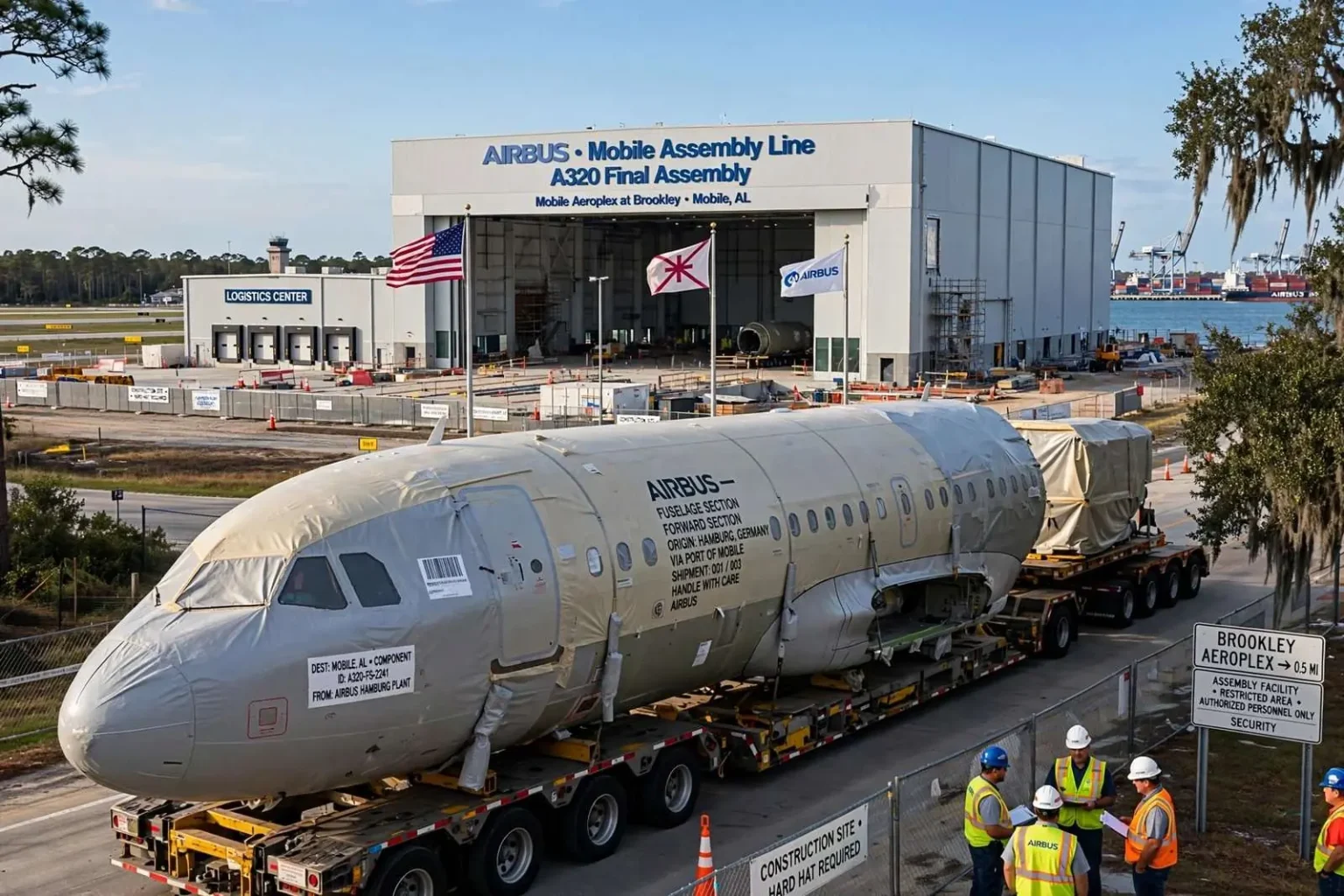
Construction of Airbus’ A320 final assembly line at the Mobile Aeroplex is progressing on schedule and within budget, with company officials saying the plant could receive its first shipment of major aircraft components from Europe through the Port of Mobile as early as June. The update offered the clearest picture yet of a project that stands as the largest industrial recruitment win in Alabama history and one of the most closely watched manufacturing arrivals in the United States.
The vice president overseeing the Mobile facility told reporters this week that the project remains on track to begin incremental production this summer, with the first Mobile-assembled aircraft slated for delivery to a major U.S. airline carrier in 2016. He described construction of the plant’s three primary structures — its hangar, logistics center and service center — as nearing substantial completion, with crews now installing the heavy jigs and tooling systems needed for final assembly work.
The installation of tooling marks the transition from a construction site to a manufacturing facility. Final assembly of a commercial jet depends on precision fixtures that hold fuselage sections, wings and other components in exact alignment while they are joined, and the jigs now being set into place inside the hangar represent the physical heart of the operation. Their arrival signals that the buildings themselves are far enough along to support equipment that must sit on precisely level foundations.
The roughly $600 million facility represents Airbus’ first A320 assembly line built on U.S. soil, part of the company’s strategy to work through a substantial backlog of orders for its popular single-aisle aircraft. The A320 family has become the workhorse of short- and medium-haul aviation worldwide, competing directly with Boeing’s 737, and demand from American carriers has grown to the point that building aircraft closer to customers has become commercially attractive for the European manufacturer.
Once fully operational, the plant is expected to employ about 1,000 workers and produce 40 to 50 aircraft annually by 2018. Those hiring projections have made the project a centerpiece of Alabama’s economic development story, adding to a portfolio that already includes the Mercedes-Benz plant in Vance and a growing supplier network spread across the state.
Components from Europe, assembly on the Gulf
Major components including fuselage sections and wings will arrive in pieces from manufacturing sites in France, Germany and Spain, shipped by vessel into the Port of Mobile before being transported to the assembly site for final construction. The logistics chain is among the most distinctive elements of the Mobile operation, echoing the ocean-delivery system Airbus uses at its other final assembly lines, and it leverages the Port of Mobile’s deepwater access just a short distance from the Aeroplex at Brookley.
The plant’s location at the former Brookley Air Force Base places it minutes from the port facilities where the massive components will be unloaded. Fuselage sections and wings travel aboard specialized roll-on, roll-off and heavy-lift vessels, and their short overland trip from dock to hangar reduces the handling risks that come with moving aircraft structures worth millions of dollars apiece. Airport access at Brookley also means completed aircraft can be fueled, tested and flown out directly, an arrangement few assembly sites anywhere can match.
A construction executive overseeing the project on behalf of a Birmingham-based program management firm said all of the facility’s major structures are now vertical, meaning most remaining visible work will shift to site improvements such as taxiways, aprons and fencing. With the hangar, logistics center and service center enclosed, the project’s silhouette on the Brookley skyline is essentially complete, and attention turns to airfield infrastructure that will connect the plant to the runways.
The airfield work carries its own complexities. Taxiway and apron construction at an active airfield requires coordination with the FAA and careful sequencing so that existing operations at Brookley are not disrupted, and the paving must meet commercial aviation standards for the heavy loads that assembled aircraft represent. Site fencing and security systems likewise follow the stringent requirements that govern final assembly plants for commercial aircraft.
Airbus officials highlighted the project’s local economic impact, noting that a majority of spending on construction and equipment to date has gone to Alabama- and Mobile-based suppliers, with the vast majority of overall spending staying within the United States. That localization extends beyond construction contracts to the workforce pipeline, where partnerships with two-year colleges and universities across the region are feeding the skilled labor the plant will need as production ramps up.
Company data also showed that most of the roughly 150 employees hired for the assembly workforce so far have come from the Gulf Coast region, reinforcing what officials describe as the project’s deep local roots. Early hires have included experienced aviation technicians along with workers drawn from other manufacturing sectors in the region, and training programs developed with Alabama’s community college system, including the Alabama Industrial Development Training Institute model that helped launch earlier automotive projects in the state, have been part of the recruitment strategy.
A milestone years in the making
Airbus’ decision to build in Mobile capped a recruitment effort that spanned multiple governors and followed the state’s earlier successes in landing automotive manufacturing. State and local incentives, the availability of the Brookley site with its airfield and port proximity, and Alabama’s track record of workforce training all featured in the company’s calculations, and the announcement transformed the Aeroplex — already home to aerospace suppliers and maintenance operations — into one of the Southeast’s fastest-growing aviation campuses.
The arrival schedule for the first European components will be a public event of sorts for the city. Residents will be able to see the distinctive shipments move through the Port of Mobile and down the corridor to Brookley, a visible demonstration of the transatlantic supply chain that will feed the plant for decades. Company planners have compared the cadence to that of Airbus’ existing lines in Toulouse, Hamburg and Tianjin, China, each of which receives its major structures by sea or specialized transport before final assembly.
The incremental production schedule set to begin this summer reflects a deliberate ramp-up strategy. Rather than starting at full rate, the plant will assemble its first aircraft at a measured pace, allowing the workforce to build proficiency and the supply chain to stabilize before output climbs toward the 40 to 50 aircraft per year target by 2018. First delivery to a major U.S. carrier in 2016 gives the airline a Mobile-built A320 family aircraft at the front of the queue.
For Mobile’s economy, the significance extends well beyond the direct jobs. Aerospace analysts have estimated that each final assembly position supports multiple additional jobs among suppliers and service providers, and the presence of an OEM anchor tenant makes the region more attractive to parts suppliers weighing where to locate U.S. operations. The Port of Mobile stands to gain recurring cargo volume from component shipments, and the city’s broader effort to brand itself as an aerospace hub gains its most powerful emblem.
Local officials have also pointed to the project’s effect on commercial real estate and infrastructure planning around Brookley, where roads, utilities and port facilities are being evaluated against the needs of a plant that will operate for decades. The construction spending already reported — with the majority flowing to Alabama firms — has circulated through the regional economy during the build-out period, and the operational phase will bring recurring payroll that ripples through restaurants, housing and services in Mobile.
As the first component shipments approach, attention will shift from construction milestones to production ones: the arrival of the first fuselage sections and wings, the start of join-up work inside the hangar, and the rollout of the first Alabama-built A320 family aircraft. Company officials’ consistent message — on schedule, within budget, hiring locally — suggests the project is tracking toward each of those moments as planned, keeping Mobile on course to become a permanent fixture in the global map of commercial aircraft manufacturing.
Behind the headline numbers, the plant’s progress has also become a case study in how large industrial projects are executed on the Gulf Coast. The coordination among Airbus’ project office, the Birmingham-based program management firm and the general contractors on site has kept three major buildings and an airfield package moving in parallel, a schedule that could easily have slipped had weather or logistics gone badly. Instead, officials report both the timeline and the budget holding, an outcome that industry observers note is rarer than it should be for projects of this scale.
The workforce numbers will continue to grow through the ramp-up period. Between the roughly 150 already hired and the 1,000-worker target by full rate production, the plant will conduct rolling hiring waves in the years ahead, and local officials expect the applicant pool to draw from across the central Gulf Coast, including Baldwin County and the Florida Panhandle. The assembly line’s labor needs span aircraft structures, avionics, cabin installation, quality inspection and test, giving workers with varied technical backgrounds a path into aviation manufacturing without leaving the region.
Educational institutions across the area have been building aviation-focused curricula to feed that pipeline, adding programs in composites, avionics and aircraft assembly that align with the skills the Aeroplex employers need. City and county leaders have described the Airbus project as a generational inflection point for Mobile’s economy — one that converts a closing of the old Brookley Air Force Base decades ago into the opening of one of the most advanced manufacturing operations in the American South.