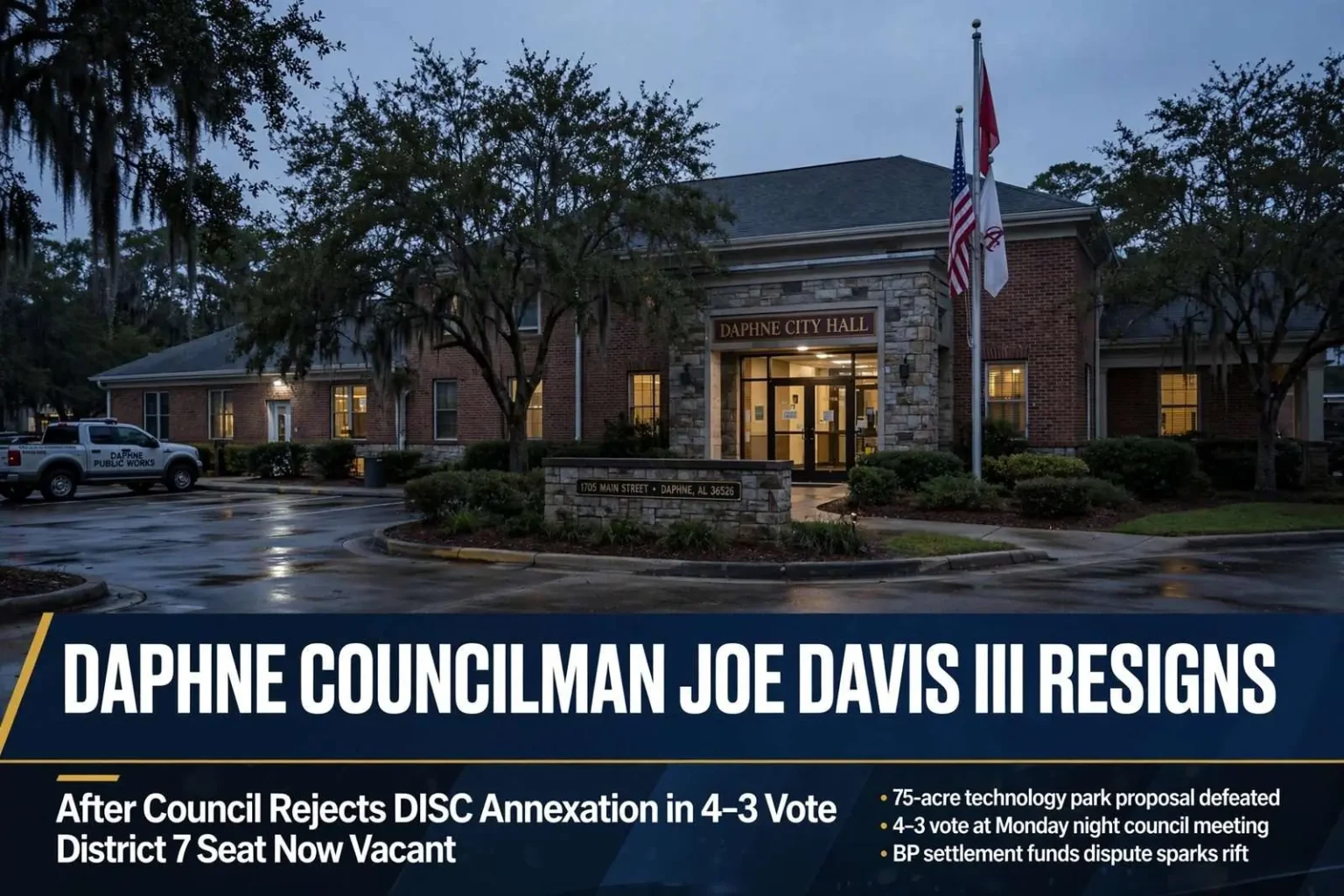
A Daphne city councilman has stepped down just hours after his colleagues voted down a land deal tied to a proposed technology and office park, capping months of tension over the future of one of the city’s most closely watched economic development proposals. Councilman Joe Davis III announced his resignation from the District 7 seat following the City Council’s regular meeting Monday, in which members voted 4-3 against the pre-zoning and annexation of a 75-acre parcel at the southwest corner of Champions Way and State Highway 181. Approval would have paved the way for the first phase of the proposed Daphne Innovation and Science Complex, known locally as DISC.
The vote was the climax of a fight that had been building at City Hall for months. Council President Tommie Conaway and council members Randy Fry, Pat Rudicell and John Lake voted against the measure, while Davis joined council members Ron Scott and Robin LeJeune in supporting it. The council had delayed the vote once before, at a previous meeting, before taking it up again Monday night — a postponement that gave both sides time to lobby but, in the end, changed no minds.
The money at stake was modest by the standards of economic development deals, but its source made it politically charged. The proposal called for the city’s Industrial Development Board to draw on $426,768.26 in previously unused BP settlement funds toward an initial 30-acre purchase, with the IDB covering the remaining $325,231.74 of the $725,000 acquisition from its own account. Infrastructure improvements tied to the project were projected to cost nearly $1.7 million. The BP money — funds flowing to Gulf Coast governments in the years after the 2010 Deepwater Horizon oil spill — carried its own expectations: Baldwin County communities that received settlement dollars have faced constant public scrutiny over whether the money is being spent on recovery-related economic development or simply absorbed into general budgets. Using it to buy land for a technology park was, to supporters, exactly the kind of lasting investment the settlement was meant to enable; to critics, the accounting still had to be airtight before the city committed a dollar.
Daphne’s setting explains why the proposal drew such attention. The city of roughly 25,000 sits on the Eastern Shore of Mobile Bay, a corridor whose population and retail growth have surged along the Highway 181 and Highway 98 spines while its employment base has remained largely residential — thousands of Daphne residents commuting across the bay to Mobile each day. A park promising Class A office space and science-based employers near the Highway 181 corridor was pitched as a way to grow jobs on the Eastern Shore’s side of the causeway rather than watch its tax base work elsewhere.
The vote and the rift it exposed
Davis, who served as the council’s liaison to the Industrial Development Board, had been one of the project’s most outspoken supporters, arguing that DISC would bring Class A office space and higher-paying, white-collar jobs to the city. “This was the most pivotal vote the city has had in a long time and I think the vote of some council members was very short sighted,” Davis said. “I think some people on the council had only their re-election in mind when they cast a vote.”
Davis said disagreements over how the project would be funded, along with pointed criticism from some council members who characterized the arrangement as “corporate welfare,” had created rifts on the council that he did not believe could be mended. “After that I don’t have any credibility with them, and they don’t have any credibility with me,” he said. “I wish the city very well, but this was very disappointing. It is time for me to move on.”
The corporate welfare label captured the ideological divide that had hardened around DISC. To its supporters, an IDB land purchase was routine industrial development practice — the board exists, in every Alabama municipality, to do precisely this kind of front-end work that private developers won’t do on speculation. To its critics, the city was being asked to buy land and install infrastructure on behalf of tenants who had not been named, for buildings that had not been designed, at public risk and private benefit.
Davis was appointed to the council in 2013 to fill the District 7 seat vacated by Dane Haygood, who moved into the mayor’s office following the death of former Mayor Bailey Yelding. The circumstances of his arrival shaped how he approached the job. Appointed rather than elected, Davis entered City Hall with a mandate to prove himself useful to a city in transition — a new mayor settling in, a council with its own settled alliances, and a District 7 in the fast-growing western reaches of town where Highway 181 development pressure was already visible.
Davis said he believed his background serving on industrial development boards and in the local business community factored into that appointment. The credential mattered for the DISC fight in particular: council members who have served on IDBs tend to see the board’s land transactions as ordinary tools of the trade, while those who have not often regard them as an unusual amount of flexibility for an unelected body. Davis sat on the side of the divide that treated the IDB as the city’s development engine.
He pointed to the council’s February 2014 decision to raise the city’s lodging tax and reallocate a portion of those funds — including additional money for the Industrial Development Board — as a signal, at the time, that the city was prepared to let the IDB take on a larger role in attracting new development. “I thought we were ready to attract some real opportunities to the city, but the council didn’t see the big picture,” Davis said.
That February vote was, in retrospect, the high-water mark of the pro-development coalition Davis described. A lodging tax increase is among the least painful levies a city can raise — it falls mostly on visitors rather than residents — and dedicating a slice of it to the IDB read, at the time, as a council consensus that Daphne should compete for employers rather than merely accommodate residential growth. The Monday night annexation vote, barely a year later, reversed that reading: a majority unwilling to spend settlement funds on a 75-acre park had, in Davis’s view, withdrawn the mandate the lodging tax had appeared to grant.
The case against the deal
Fry, who voted against the annexation, said his opposition centered on the planned unit development zoning designation attached to the DISC proposal, a tool he said the council has limited experience working with. “There is just too much flexibility in the PUD, and that is one of the unknowns out there,” Fry said. “I’m a business person and I’m usually pro-business in my voting, but sometimes when you don’t have all the information in a deal it is best to walk away.”
The PUD objection deserves unpacking, because it is the part of the deal most opaque to residents. A planned unit development designation allows a large tract to be master-planned as a whole — mixing office, retail, green space and even residential uses — rather than subdivided into conventional single-use zones. The flexibility is the selling point for developers, who can adapt the plan as tenants come and go. It is also, for a council, a delegation of control: the details get settled in plan amendments and staff reviews rather than on the council floor, and once the pre-zoning is granted, the city’s leverage shrinks with every improvement installed on the site.
Fry added that unresolved questions about financing, along with what he described as a “hard sell” from Davis, the IDB and Mayor Haygood, also factored into his vote. “There are some very good people on the IDB and in the planning department, this vote was not personal for me in any way,” Fry said. His framing — pro-business, anti-unknown — was an attempt to separate the decision from the personalities that had come to surround it. By the time the vote arrived, the DISC debate had become a proxy fight over trust: trust in the IDB’s projections, in the administration’s urgency, and in whether a deal with unnamed tenants was an opportunity or a blank check.
What happens next for District 7
With Davis’s resignation, the city now has 60 days to fill the District 7 vacancy. Fry said Daphne plans to advertise the opening this week, and residents interested in the seat can submit a resume through the city clerk’s office at Daphne City Hall. If the seat remains unfilled after 60 days, the appointment would fall to Gov. Robert Bentley.
The 60-day clock gives the council a short window to avoid state intervention, and the mechanics of filling the seat will test the body’s post-vote cohesion. Alabama municipalities fill mid-term council vacancies by council appointment, which means the four members who voted down DISC hold four of the deciding votes — and the appointment will be read, fairly or not, as a referendum on the DISC fight. A candidate viewed as a committed IDB-style developer could reunite the old coalition on paper while heightening the resentment Davis described; a candidate viewed as an opponent of the project could cement the majority but deepen the rift on the council’s minority side.
The governor’s fallback — Bentley, at the time, holding the power to appoint if the council deadlocked — is a rarely used but real backstop. Daphne has no interest in letting a City Hall vacancy become a state decision, and the practical expectation at City Hall was that resumes would arrive quickly from the district’s civic and business circles once the opening was advertised.
The larger stakes for Daphne
Beyond the vacancy, the council’s vote leaves the city’s economic development posture unsettled. The 75 acres at Champions Way and Highway 181 remain un-annexed and un-zoned, and the DISC concept — first pitched as a campus where technology employers, professional offices and Eastern Shore talent could meet — now has no public vehicle to advance it. Whether the Industrial Development Board continues to pursue a scaled-back version of the project, whether private developers step forward with a plan that requires less public money, or whether the land stays as it is will depend on decisions that have not yet been made public.
What is clear is that the debate has reset expectations on both sides. Residents who followed the fight now know the council will scrutinize a development deal’s financing and zoning mechanics, not just its brochure promises. And the city’s development community knows that Daphne’s appetite for public participation in economic development has limits — limits demonstrated Monday night in a 4-3 vote, a resignation speech the same evening, and a council that now has to govern a fast-growing city with one of its own seats empty and a signature project on hold.
For a city that has spent two decades converting Eastern Shore growth into services, schools and a distinctive small-city identity, the DISC episode will be remembered less for the acres than for the argument it settled — and the councilman it cost.